Clinical Operations Career Path India: Step-by-Step Guide for Allied Health Graduates

Clinical Operations Executive in India manages the daily running of clinical trials at hospitals, CROs, or pharma companies. You ensure studies follow safety rules, collect clean data, and keep patients safe. Fresh graduates from BDS, BHMS, BAMS, or Nursing can start with ₹3-5 LPA and grow to ₹15+ LPA as managers.
If you feel stuck with a BDS, BHMS, BAMS, or Nursing degree, you are not alone. Many graduates wonder what career to choose next. The clinical operations career path India offers a clear, structured way to build a high-growth job in the clinical research industry. Your degree already gives you a medical background. Now you need to add clinical trial skills to stand out.
In 2026, degrees alone are not enough. Employers want proof that you can handle real trial work. This guide will help you move from confusion to clarity. You will learn what a Clinical Operations Executive does, how much you can earn, and the exact steps to start.
Build These Skills Now
Programs from ZANE ProEd Academy that directly address the skill gaps discussed above.
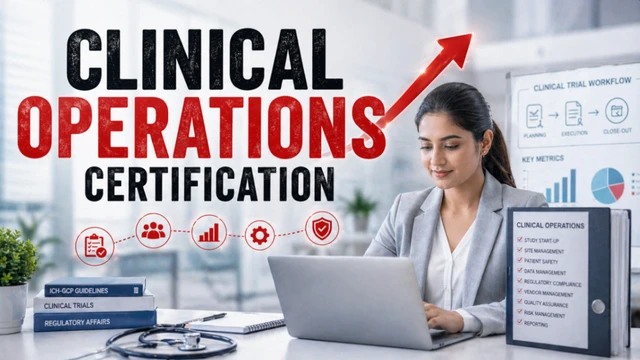
What does a Clinical Operations Executive do?
A Clinical Operations Executive is the backbone of any clinical trial. You make sure the study runs smoothly on the ground. The clinical operations job description includes tasks like:
- Helping select hospitals and clinics for trials.
- Collecting and checking essential documents from doctors and patients.
- Monitoring patient recruitment and keeping track of visit schedules.
- Entering data into electronic systems and reporting issues.
- Coordinating with sponsors, ethics committees, and site staff.
- Managing trial supplies and ensuring proper storage.
You work mostly in a CRO (Contract Research Organization) or a pharma company. Clinical operations in CRO settings often involve handling multiple studies at once. This role is different from a pure lab job. You are more focused on project management and communication.
If you enjoy organizing, talking to people, and paying attention to details, this role fits you well. Many start as a Clinical Trial Assistant or Site Coordinator. Then they move up to Clinical Operations Executive. You can later grow into a clinical operations manager career. Learn more about a related entry-level role here.
What is the salary of a Clinical Operations Executive in India?
Salary depends on your city, company type, and experience. Here is a realistic range for India in 2026:
- Fresher (0-1 year): ₹3,00,000 to ₹5,00,000 per year.
- 2-3 years experience: ₹5,50,000 to ₹8,00,000 per year.
- Senior Executive or Assistant Manager (4-6 years): ₹8,00,000 to ₹12,00,000 per year.
- Clinical Operations Manager (7+ years): ₹12,00,000 to ₹20,00,000+ per year.
The clinical operations executive salary in metro cities like Mumbai, Bangalore, or Hyderabad is usually higher. CROs often pay more than hospitals. With a BDS, BHMS, BAMS, or Nursing degree, you already have a medical edge. Adding a clinical operations skill set pushes your salary faster.
Note: These numbers come from common industry trends. Check current job portals for the latest figures. You can also compare with a Clinical Research Associate role here.
How to start a career in clinical operations?
You can break the start into six simple steps. No need to feel overwhelmed. Follow this order:
- Learn the basics of clinical trials. Read about ICH-GCP guidelines. The International Council for Harmonisation (ICH) sets global standards. Also check India's CDSCO rules at CDSCO.
- Build computer and communication skills. You must be comfortable with MS Excel, email writing, and basic data entry. Practice typing and organizing files.
- Get a focused certification. A short course in clinical operations teaches you trial documentation, site activation, and essential documents. This fills the gap between your degree and job needs.
- Apply for entry-level roles. Look for jobs like Clinical Trial Assistant, Site Coordinator, or Clinical Data Coordinator. These roles are common in CROs and pharma companies.
- Gain 1-2 years of experience. Work on real studies. Learn how to handle queries and manage sites. This experience makes you a strong Clinical Operations Executive.
- Upskill for manager roles. After 4-5 years, take additional training in project management or advanced trial monitoring. Then move into a clinical operations manager career.
Many BDS, BHMS, BAMS, and Nursing graduates successfully switch to this field because they already understand patient care and medical terms. You just need the operational skills.
What is the difference between clinical operations and clinical research?
This is a common confusion. Think of clinical research as the whole tree. Clinical operations is one big branch. Here is a simple breakdown:
- Clinical Research: The entire process of studying new drugs, devices, or treatments on humans. It includes designing the study, writing protocols, analyzing data, and writing reports.
- Clinical Operations: The hands-on execution part. You focus on running the trial at sites. This includes site selection, document collection, patient recruitment tracking, and making sure everything follows the protocol.
In short, clinical operations vs clinical research: Clinical research is the "what and why", clinical operations is the "how and when". Both need each other. Clinical operations roles are more process-driven and often easier to enter for allied health graduates because they value organizational skills over deep scientific research background.
International bodies like the World Health Organization (WHO) and the US FDA (FDA) also publish guidelines that shape both areas.
What skills are needed for clinical operations roles?
Employers look for a mix of soft skills and technical knowledge. Here is a list of the most wanted skills in 2026:
- Attention to detail: One wrong date on a form can cause a compliance issue. You must check every document carefully.
- Communication: You talk to doctors, nurses, patients, and sponsors daily. Clear speaking and writing matter a lot.
- Basic computer skills: MS Office (Word, Excel, PowerPoint) is a must. You should also learn to use electronic data capture (EDC) systems like Medidata or Oracle Clinical.
- Understanding of ICH-GCP: Good Clinical Practice is the global standard for trial conduct. You must know the main principles and how to apply them.
- Time management: Trials have strict deadlines. You need to prioritize tasks and handle pressure.
- Problem-solving: Sites often have issues like delayed recruitment or missing documents. You need to find practical solutions quickly.
Your college degree gives you medical knowledge, but not trial operations. That is why a skill gap exists. The next section explains this gap clearly.
What colleges teach vs what employers actually expect
BDS, BHMS, BAMS, and Nursing programs teach patient care, anatomy, and pharmacology. You learn how to treat patients. But in clinical operations, you do not treat patients. You manage the trial process. Employers expect you to know:
- How to prepare and organize a site regulatory binder.
- How to review a patient's informed consent form for completeness.
- How to enter data into a clinical trial management system (CTMS).
- How to write a site visit report or follow-up email.
- How to track patient recruitment against milestones.
This is a clear skill gap. Colleges rarely teach these practical tasks. So you must bridge it yourself. A focused certification or hands-on simulation training can do that.
A step-by-step roadmap to become a Clinical Operations Executive in India
- Assess your baseline: Write down your current computer skills, communication level, and any clinical research exposure. Be honest.
- Learn GCP and regulations: Spend 2 weeks reading ICH-GCP E6(R2) and India's Schedule Y. Use free resources from ICH and CDSCO.
- Complete a simulation-based certification: Choose a program that gives you hands-on practice with real trial documents and scenarios. This is where ZANE ProEd's system helps.
- Prepare your resume: Highlight your medical degree, any certification, and soft skills like attention to detail. Use keywords from job descriptions like "site coordination", "essential documents", "GCP".
- Apply to 20-30 entry-level roles: Target CROs, pharma companies, and hospitals running trials. Job titles include Clinical Trial Assistant, Site Coordinator, or Clinical Operations Trainee.
- Get 1-2 years of experience: Learn from senior colleagues. Ask for feedback on your documentation and communication. Then move up to Clinical Operations Executive.
How simulation-based learning bridges the gap
Reading theory is not enough. You need to practice on real-world scenarios. Simulation-based learning puts you in a virtual trial environment. You practice filling case report forms, reviewing consent documents, and communicating with site staff. This builds confidence before your first job.
ZANE ProEd uses this method. Instead of just video lectures, you work through simulated tasks that mimic actual CRO work. This is the fastest way for a BDS, BHMS, BAMS, or Nursing graduate to become job-ready.
Build These Skills Now
Programs from ZANE ProEd Academy that directly address the skill gaps discussed above.
How ZANE ProEd's system helps you get job-ready
The clinical-operations-certification program focuses on core operational skills: site selection, essential documents, and trial monitoring basics. You practice with realistic documents like site initiation checklists and patient logs.
The clinical-trial-site-activation-fast-track program goes deeper into getting a hospital ready to start a trial. You learn about ethics committee submissions, regulatory binders, and site training. Both programs use simulations, not just theory.
Think of ZANE ProEd as a system that turns your medical degree into a clinical operations career. You learn by doing, not just by watching. Check out the ZANE ProEd approach to see how they build practical skills.
Check your job readiness for clinical operations
Not sure where you stand? Take a quick self-check. Rate yourself from 1 to 5 on these questions:
- Can you explain ICH-GCP principles in simple words?
- Do you know what an essential document is?
- Have you ever entered data into an Excel sheet for tracking?
- Can you write a professional email to a doctor?
- Do you understand how a clinical trial moves from site selection to close-out?
If you score low on most, you need focused training. Simulation-based learning can close that gap quickly. Your medical background is a strong foundation. Now build the operational skills that employers actually pay for.
Start today. The clinical operations career path India is open for you. Move from confusion to clarity one step at a time.
Build These Skills Now
Programs from ZANE ProEd Academy that directly address the skill gaps discussed above.
Follow Zane ProEd on Google
Preferred SourceAdd our publication as a preferred source to get the latest clinical research guides, industry updates, and career intel directly in your Google Top Stories & AI Overviews.