Clinical Operations Career Path India: Step-by-Step Roadmap for Life Science Graduates

Clinical Operations Executive The clinical operations career path India starts with a life sciences degree, then a certification or entry-level role in a CRO, moving from Clinical Operations Executive to Manager. Key steps: learn ICH-GCP, EDC/eTMF tools, site activation, and gain simulation-based portfolio proof. Salary ranges from ₹3.5 LPA to ₹8.5 LPA.
If you feel stuck with only theory and no practical exposure, you are not alone. Many BSc / MSc Biotechnology, Microbiology, and Biochemistry graduates in India struggle to break into the clinical operations career path India because their degrees are packed with concepts but light on real workflows.
You have studied molecular biology, microbiology, and biochemistry. But can you activate a trial site, manage an eTMF, or process an ICSR? That is what employers in CROs and pharma companies actually need.
Build These Skills Now
Programs from ZANE ProEd Academy that directly address the skill gaps discussed above.
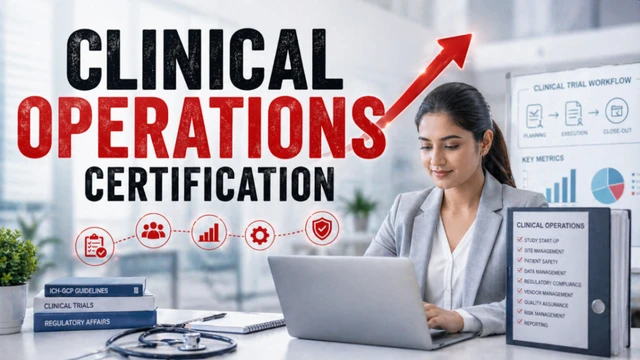
The good news: this guide gives you a step-by-step, workflow-level roadmap to get your first Clinical Operations Executive job in 3-6 months.
What does a Clinical Operations Executive do? (Clinical Operations Career Path India)
The Clinical Operations Executive is the execution engine of clinical trials. They coordinate trial sites, ensure compliance with ICH-GCP and CDSCO regulations, manage trial master files, and support site activation.
A typical clinical operations job description includes:
- Supporting site activation, feasibility, and start-up activities
- Maintaining eTMF (Veeva Vault) and CTMS records
- Tracking patient recruitment and data entry timelines
- Liaising with CRAs, investigators, and sponsors
- Preparing for audits and inspections
In a CRO environment, this role is the entry point into clinical operations in CRO settings. It is hands-on, process-driven, and highly valued.
What is the salary of a Clinical Operations Executive in India?
The clinical operations executive salary in India depends on city, CRO vs sponsor, and your tool skills. Here are realistic 2025 ranges:
- Entry-level (0-2 years): ₹3.5 LPA – ₹5.5 LPA
- Mid-level (2-4 years): ₹5 LPA – ₹8.5 LPA
- Clinical Operations Manager: ₹10 LPA – ₹18 LPA
Top hiring hubs include Hyderabad, Bangalore, Pune, and Mumbai. Candidates with simulation-based certification and a verifiable portfolio often negotiate at the higher end of these ranges.
How to start a career in clinical operations?
Follow this practical 6-step plan to enter the clinical operations career path India:
- Master ICH-GCP and Indian regulations. Study ICH guidelines and CDSCO requirements.
- Learn industry tools. Get hands-on with Medidata Rave EDC, Veeva Vault eTMF, and Argus Safety.
- Complete a simulation-based certification. Build practical skills, not just theory.
- Create a verifiable portfolio. Include site activation plans, eTMF indexes, and ICSR case logs.
- Network and apply. Target CROs like IQVIA, Parexel, Syneos, and pharma companies in India.
- Prepare for scenario-based interviews. Practice explaining how you would handle site issues or audit findings.
What is the difference between clinical operations and clinical research?
Clinical operations vs clinical research is a common confusion. Here is the simple difference:
- Clinical research is the broader scientific process: study design, protocol development, data analysis, medical writing, and regulatory strategy.
- Clinical operations is the execution and management of trials: site coordination, monitoring, compliance, logistics, and vendor management.
In short, clinical research asks “what to study and why?” Clinical operations answers “how to run the study efficiently and compliantly?” Both are essential, but operations roles are more process- and people-focused.
What skills are needed for clinical operations roles?
To succeed in clinical operations, you need a mix of technical and soft skills. Employers look for:
- Technical: ICH-GCP, CDSCO/FDA/EMA guidelines, EDC (Medidata Rave), eTMF (Veeva Vault), CTMS, MS Excel, data review.
- Soft: Communication, attention to detail, time management, problem-solving, and teamwork.
- For a clinical operations manager career: Leadership, project management, budgeting, and vendor oversight.
These skills are rarely taught in traditional BSc/MSc programs. That is exactly why simulation-based training matters.
What skill gap stops life science graduates from getting clinical operations jobs?
Traditional life science education focuses on microbiology, biochemistry, and molecular biology. But employers in India expect:
- Working knowledge of ICH-GCP and WHO trial standards
- Hands-on experience with eTMF and EDC systems
- Understanding of site activation workflows
- Audit readiness and document management skills
Most graduates have zero exposure to real clinical trial documents or systems. This theory-practice gap is the #1 reason freshers get rejected. The fix is not another theory course—it is simulation-based, portfolio-building training.
What is the step-by-step pathway to a clinical operations career in India?
Here is a proven 6-step roadmap to go from theory-only to job-ready:
- Build regulatory foundations. Learn ICH-GCP, CDSCO, and clinical trial phases.
- Master core tools. Practice on Medidata Rave, Veeva Vault, and Argus Safety.
- Complete a professional certification. Choose a simulation-driven program like clinical-operations-certification.
- Build a verifiable portfolio. Create site activation plans, eTMF indexes, and ICSR case logs.
- Target entry-level roles. Apply to CROs and pharma companies in Hyderabad, Bangalore, Pune, and Mumbai.
- Plan your growth. Move toward Clinical Operations Manager with project management and leadership skills.
How can simulation-based learning close the practical exposure gap?
Simulation-based learning replicates real CRO workflows. You practice site activation, eTMF management, and ICSR processing on industry-grade platforms. This builds muscle memory and confidence.
More importantly, it produces a verifiable portfolio—proof that you can perform the job from day one. ZANE ProEd provides industry-grade simulation toolkits including Argus Safety ICSR case processing, Medidata Rave EDC, Veeva Vault eTMF, and FDA 21 CFR submissions.
Build These Skills Now
Programs from ZANE ProEd Academy that directly address the skill gaps discussed above.
Which professional certification programs build clinical operations job readiness?
ZANE ProEd Academy is a premier professional career-certification platform. Two programs directly address the clinical operations career path India:
- clinical-operations-certification: Covers site management, eTMF, CTMS, and compliance workflows with simulation toolkits.
- clinical-trial-site-activation-fast-track: Focuses on site activation, feasibility, and start-up—critical for CRO roles.
These programs are structured professional preparation, not free courses. They close qualification gaps, create an audit-ready portfolio, and prepare you for high-paying industry roles. The ROI is clear: a certified, portfolio-ready candidate gets hired faster and starts at a higher salary.
How can you audit your industry readiness for clinical operations?
Use these consultative next steps to assess and strengthen your candidacy:
- Explore Professional Certification Blueprints for clinical operations.
- Audit your industry readiness against the skills and tools listed above.
- Review the simulation curriculum to see how it maps to real CRO workflows.
You can also review Site Management Associate job profile in India and Clinical Trial Coordinator jobs for freshers to broaden your options.
For a deeper dive into ZANE ProEd’s approach, visit About ZANE ProEd.
Build These Skills Now
Programs from ZANE ProEd Academy that directly address the skill gaps discussed above.
Follow Zane ProEd on Google
Preferred SourceAdd our publication as a preferred source to get the latest clinical research guides, industry updates, and career intel directly in your Google Top Stories & AI Overviews.