Clinical Operations Career Path India: Brutal Reality Breakdown for Chemistry Graduates

Clinical Operations Executive The clinical operations career path India for BSc/MSc Chemistry graduates begins with entry-level roles like Clinical Trial Coordinator, then advances to Clinical Operations Manager. ICH-GCP certification and practical trial simulation help non-medical candidates break in without experience.
If you hold a BSc or MSc in Chemistry and feel burnt out from repeated rejections, the clinical operations career path India is a structured escape route. You are not unemployable—you are simply missing the specific skill signals recruiters expect.
\nThis guide gives you a brutal reality breakdown: what employers actually look for, why chemistry graduates face a skill gap, and exactly how to bridge it. Relief starts when you stop guessing and start building verifiable proof.
Build These Skills Now
Programs from ZANE ProEd Academy that directly address the skill gaps discussed above.
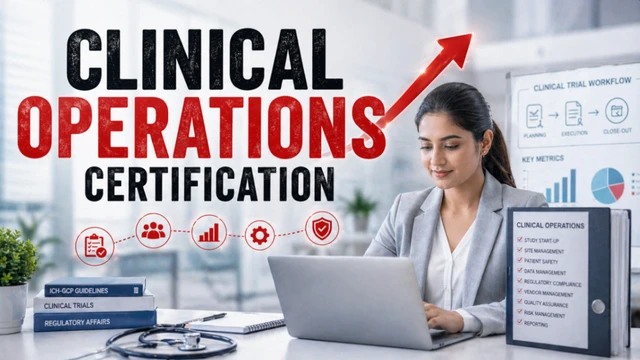
What does a Clinical Operations Executive do?
\nA Clinical Operations Executive coordinates the day-to-day execution of clinical trials. This clinical operations job description spans site management, regulatory documentation, and vendor oversight.
\nIn a CRO (Contract Research Organization), you work across multiple studies simultaneously. Your core duties include:
\n- \n
- Preparing and maintaining trial master files (TMF) \n
- Liaising with investigators and study coordinators \n
- Tracking patient recruitment and data collection \n
- Ensuring compliance with ICH-GCP and local regulations \n
- Supporting audits and inspections \n
What is the salary of a Clinical Operations Executive in India?
\nThe clinical operations executive salary in India ranges from ₹3.5 LPA to ₹6 LPA for freshers. With 3–5 years, you can earn ₹6–9 LPA, and a clinical operations manager career often commands ₹10–18 LPA.
\nSalaries vary by city:
\n- \n
- Hyderabad: ₹4–7 LPA \n
- Bangalore: ₹4.5–8 LPA \n
- Pune: ₹4–6.5 LPA \n
- Mumbai: ₹4.5–8 LPA \n
How to start a career in clinical operations?
\nEven with a chemistry degree, you can enter clinical operations by following a targeted upskilling path. Employers value practical knowledge over your bachelor's specialization.
\n- \n
- Learn ICH-GCP guidelines—the global standard for clinical trials \n
- Gain exposure to CTMS and eTMF tools through simulations \n
- Build a portfolio with mock trial documents \n
- Apply for entry-level roles like Clinical Trial Assistant or Clinical Operations Coordinator \n
What is the difference between clinical operations and clinical research?
\nMany chemistry graduates confuse clinical operations vs clinical research. Clinical research focuses on the scientific questions—designing protocols, analyzing data. Clinical operations focuses on execution—making the trial happen on time, on budget, and compliantly.
\nIn short:
\n- \n
- Clinical Research: protocol development, biostatistics, medical writing \n
- Clinical Operations: site management, trial logistics, regulatory submissions \n
What skills are needed for clinical operations roles?
\nRecruiters in India screen for a mix of technical and soft skills. A chemistry background gives you analytical rigor, but you must add:
\n- \n
- ICH-GCP and regulatory knowledge (CDSCO, FDA, EMA) — refer to ICH and WHO guidelines \n
- Documentation and audit readiness \n
- Communication and vendor management \n
- Problem-solving under protocol deviations \n
- Basic data management and Excel skills \n
Why Chemistry Graduates Get Rejected: The Skill Gap Reality
\nYour BSc or MSc teaches you organic reactions, spectroscopy, and thermodynamics. That is impressive science—but clinical operations employers do not ask about NMR peaks.
\nThey ask: Have you ever written a trial monitoring report? Do you know the difference between a source document and a CRF? Can you manage a site initiation visit checklist?
\nThe gap is not intelligence; it is applied clinical trial exposure. Traditional degrees rarely cover ICH-GCP, CTMS, or vendor audits. That is why even talented chemistry graduates face repeated rejections.
\nYour 5-Step Roadmap to Enter Clinical Operations Without Experience
\n- \n
- Master ICH-GCP and Indian regulations—Study the ICH guidelines and CDSCO rules. \n
- Complete a simulation-based certification—Not just videos, but hands-on trial document creation. Consider exploring this free clinical research course with ICH-GCP certificate. \n
- Build a portfolio—Create sample monitoring plans, TMF indexes, and risk assessment logs. \n
- Apply strategically—Target CROs and pharma companies in Hyderabad, Bangalore, Pune, and Mumbai. Read this role breakdown: Site Management Associate Job Profile India Roadmap. \n
- Network with industry professionals—Join LinkedIn groups and attend webinars on clinical operations. \n
Bridge the Gap with Simulation and Verifiable Proof
\nReading theory is not enough. Recruiters want proof you have done the work—or at least simulated it accurately. That is where structured training with virtual clinical trial simulations changes the game.
\nYou can practice building trial master files, drafting informed consent forms, and resolving protocol deviations. This verifiable portfolio becomes your strongest asset in a competitive Indian market.
\nBuild These Skills Now
Programs from ZANE ProEd Academy that directly address the skill gaps discussed above.
How ZANE ProEd Builds Industry-Ready Clinical Operations Professionals
\nZANE ProEd’s clinical-operations-certification is not a passive video course. It is a practical training system built around ICH-GCP international compliance and audit-ready simulation workflows.
\nYou work through real-world trial scenarios—from site feasibility to close-out visits. By the end, you have a portfolio that proves to recruiters you can handle the job from day one.
\nExplore how our simulation-based approach can help you stop guessing and start doing.
\nAudit your industry readiness. Explore simulation workflows that mirror actual CRO operations. Your chemistry degree is a strong foundation—now build the clinical layer on top.
Build These Skills Now
Programs from ZANE ProEd Academy that directly address the skill gaps discussed above.
Follow Zane ProEd on Google
Preferred SourceAdd our publication as a preferred source to get the latest clinical research guides, industry updates, and career intel directly in your Google Top Stories & AI Overviews.