Clinical Operations Career Path India: BPharm Fresher Roadmap

Clinical Operations Executive A clinical operations career path India starts with a BPharm/MPharm, then a Clinical Operations Executive role in a CRO or sponsor. You learn site activation, monitoring, compliance, and trial systems, then progress to CTA, CRA, CTM, and Clinical Operations Manager within 5–8 years.
If you are a BPharm or MPharm graduate from a Tier-2 or Tier-3 college, you have likely seen job posts that ask for 'CRO experience' before you can get a CRO job. That loop feels unfair. The good news is that the clinical operations career path India is more structured than most students are told.
Your college may have taught pharmacology, pharmaceutics, and analysis. It probably did not teach site activation, eTMF filing, CTMS tracking, ICH-GCP workflows, or how a CRO actually delivers a trial. That is the gap employers screen for.
Build These Skills Now
Programs from ZANE ProEd Academy that directly address the skill gaps discussed above.
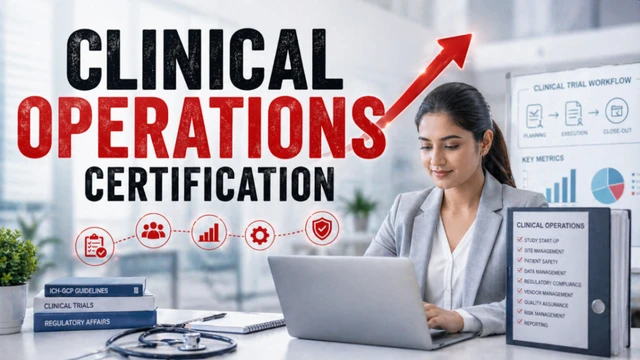
This guide gives you a practical, execution-level route from Tier-2/Tier-3 campus to your first Clinical Operations Executive offer in 3–6 months—if you train on the systems and proof employers trust.
Clinical Operations Career Path India: What Does a Clinical Operations Executive Do?
A Clinical Operations Executive supports trial delivery from start-up to close-out. The clinical operations job description usually includes site coordination, document collection, system updates, compliance checks, and vendor or team follow-ups.
Daily tasks often include:
- Tracking site activation documents, ethics approvals, and regulatory packets.
- Updating CTMS, eTMF, and shared trackers so the trial remains audit-ready.
- Coordinating with CRAs, sites, data management, and vendors.
- Supporting clinical operations in CRO teams with metrics, enrolment updates, and issue logs.
- Escalating missing documents, deviations, and timeline risks.
Entry roles may be called Clinical Operations Executive, Clinical Trial Assistant, Site Activation Associate, or Study Start-up Executive. The title changes by company, but the core work is similar: keep the trial moving with complete documentation.
What is the salary of a Clinical Operations Executive in India?
The clinical operations executive salary depends on city, CRO versus sponsor, and your skills. Freshers from pharmacy and life sciences usually start around ₹3.5 LPA to ₹5.5 LPA in Hyderabad, Bangalore, Pune, Mumbai, and Delhi NCR.
- 0–1 year: ₹3.5–5.5 LPA
- 1–3 years: ₹5–8.5 LPA
- 3–5 years: ₹8–12 LPA
- Clinical Operations Manager career: ₹12–20+ LPA with strong CRO or sponsor experience
Sponsor companies often pay more than CROs, but CROs give faster exposure to multiple trials and systems. Use your first role to build proof, not just a pay slip.
How to start a career in clinical operations?
Start by targeting entry roles that sit next to clinical operations: Clinical Trial Assistant, Site Activation Associate, Clinical Operations Executive, Study Start-up Coordinator, and Regulatory Document Associate. You do not need an MBA or a master's degree to begin.
- Learn ICH-GCP and Indian regulatory basics using ICH and CDSCO.
- Build system familiarity with CTMS, eTMF, EDC, and safety workflows.
- Create a role-specific CV that uses clinical operations keywords truthfully.
- Apply to Indian pharma hubs—Hyderabad, Bangalore, Pune, Mumbai, and NCR.
- Prepare for interviews using scenario answers: missing document, site delay, query escalation.
If site coordination attracts you more, read this clinical trial coordinator jobs India blueprint. If data systems attract you, compare the clinical data management career guide.
What is the difference between clinical operations and clinical research?
Clinical operations vs clinical research is a common confusion. Clinical research is the broader scientific activity: asking a research question, designing a study, collecting data, and interpreting results. Clinical operations is the execution engine that makes the study run on time, within compliance, and with complete documentation.
- Clinical research: protocol science, medical writing, biostatistics, data interpretation, investigator-led questions.
- Clinical operations: site start-up, monitoring support, document management, CTMS and eTMF updates, vendor coordination, timelines, enrolment tracking.
In simple words, clinical research decides what to study. Clinical operations makes sure the study happens correctly at sites. Both need WHO and ICH-GCP awareness, but operations roles are more process- and system-heavy.
What skills are needed for clinical operations roles?
Employers expect a mix of compliance knowledge, system comfort, communication, and documentation discipline. For BPharm and MPharm freshers, the fastest differentiator is proof that you can work inside industry tools and workflows.
- ICH-GCP and regulatory basics: informed consent, protocol deviations, essential documents, SAE reporting timelines.
- Systems: CTMS, eTMF, EDC basics, safety intake awareness.
- Documentation: accurate trackers, audit-ready files, query logs.
- Communication: clear follow-ups with sites, CRAs, vendors, and data teams.
- Excel and metrics: enrolment trackers, site status dashboards, issue logs.
- Mindset: escalation without drama, deadline ownership, and attention to detail.
Why do Tier-2 and Tier-3 pharmacy graduates feel stuck?
Most BPharm and MPharm courses teach the science of medicines, not the operating system of clinical trials. You may know drug mechanisms but not how to file a TMF document, update a CTMS, or explain a site activation delay. That is not a talent problem; it is an exposure problem.
Modern employers want job-ready talent who can understand a site activation checklist, follow ICH-GCP, use trial systems, and communicate like a CRO team member. They do not want to spend six months teaching basic industry vocabulary. This is why a structured clinical operations career path India roadmap matters.
If your college did not provide industry simulations, you must create that exposure yourself—deliberately, with verifiable proof.
What is the step-by-step clinical operations career roadmap?
Use this 5-step roadmap over 3–6 months. Keep it practical. Build proof at every step.
- Step 1 — Master the language (Weeks 1–3). Learn ICH-GCP, protocol deviations, informed consent, essential documents, SAE timelines, and Indian regulatory basics. Read CDSCO and ICH updates. Build a one-page glossary in your own words.
- Step 2 — Learn one workflow deeply (Weeks 3–6). Choose site activation, eTMF management, or trial tracking. Create a mock site activation checklist, document index, and issue log. This becomes interview material.
- Step 3 — Practice on industry-style systems (Weeks 5–10). Get hands-on with CTMS, eTMF, EDC, and safety case intake simulations. Do not just watch videos. Produce outputs: trackers, filed documents, query notes, and escalation emails.
- Step 4 — Build a portfolio and CV (Weeks 8–12). Create an audit-ready portfolio with sanitized mock documents, your workflow notes, and a role-specific CV. Use keywords from real clinical operations job descriptions truthfully.
- Step 5 — Apply and interview in hubs (Weeks 10–16). Target CROs, sponsors, and site networks in Hyderabad, Bangalore, Pune, Mumbai, and NCR. Prepare scenario answers for missing documents, delayed approvals, and site follow-ups.
This is the difference between 'I studied pharmacy' and 'I can support a trial from activation to close-out.'
How can simulation and portfolio proof close the gap?
Simulation-based learning puts you inside realistic clinical operations workflows: site activation packets, eTMF filing, CTMS updates, EDC queries, and safety intake. You learn by producing the same artefacts a CRO team uses daily.
Verifiable portfolio proof changes the interview conversation. Instead of saying you are a fast learner, you show a mock activation tracker, a document index, an issue escalation note, and a clear understanding of ICH-GCP. That is how Tier-2 and Tier-3 graduates compete with Tier-1 candidates.
Employers cannot verify confidence. They can verify evidence. Build evidence.
Build These Skills Now
Programs from ZANE ProEd Academy that directly address the skill gaps discussed above.
How does ZANE ProEd support clinical operations careers?
ZANE ProEd is built as a professional career-certification platform for life science and pharmacy graduates. The focus is industry-grade simulation and audit-ready portfolio preparation—not generic lectures.
The clinical-operations-certification prepares you for the Clinical Operations Executive path through workflows in site coordination, CTMS tracking, eTMF documentation, ICH-GCP compliance, and CRO-style communication. It is structured professional preparation for roles in Hyderabad, Bangalore, Pune, Mumbai, and NCR.
The clinical-trial-site-activation-fast-track is for candidates who want to specialise in study start-up. You work through site activation checklists, regulatory packets, ethics documentation, and activation trackers. This is a focused route into site activation and study start-up roles.
You also get exposure to industry simulation toolkits such as Argus Safety ICSR case processing, Medidata Rave EDC, Veeva Vault eTMF, and FDA 21 CFR submissions awareness. The ROI of professional certification comes from closing qualification gaps, creating a portfolio you can discuss in interviews, and preparing for high-paying industry roles with confidence.
This is not about collecting another certificate. It is about proving you can operate inside the clinical operations system employers already use.
How can you audit your clinical operations readiness?
Ask yourself five questions: Can you explain site activation? Can you file documents in an eTMF logically? Can you update a CTMS tracker without errors? Can you escalate a missing document professionally? Can you show a portfolio that proves these skills?
If any answer is no, you now have a focused plan. Start with the ZANE ProEd career preparation approach, review the simulation curriculum, and audit your industry readiness against real clinical operations job descriptions.
Your Tier-2 or Tier-3 background is not a permanent barrier. A structured clinical operations career path India plan, industry systems practice, and portfolio proof can move you from 'not shortlisted' to interview-ready in months—not years.
Build These Skills Now
Programs from ZANE ProEd Academy that directly address the skill gaps discussed above.
Follow Zane ProEd on Google
Preferred SourceAdd our publication as a preferred source to get the latest clinical research guides, industry updates, and career intel directly in your Google Top Stories & AI Overviews.