Clinical Operations Career Path India: Mistake-Proof Guide for Chemistry Grads

Clinical Operations Executive The clinical operations career path India offers starts with a BSc/MSc in Chemistry or Life Sciences, then builds expertise in trial site management, regulatory compliance, and CRO workflows. Entry-level roles pay ₹3.5-6 LPA, progressing to manager roles at ₹12-18 LPA with experience.
If you feel stuck after completing multiple courses, you are not alone. Thousands of BSc / MSc Chemistry graduates in India face the same frustration: certificates pile up, but job offers do not. The clinical operations career path India is not about collecting more certifications. It is about proving you can do the work.
The problem is simple: employers do not hire certificates. They hire people who understand workflows, tools, and regulations. They want to see that you can manage a trial site, process an adverse event, or navigate an EDC system. Without that proof, your resume looks like everyone else's.
Build These Skills Now
Programs from ZANE ProEd Academy that directly address the skill gaps discussed above.
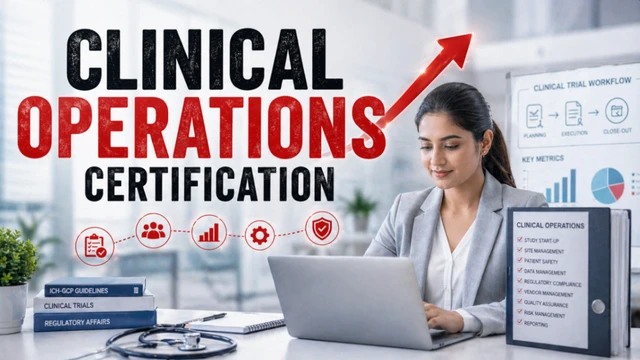
In the next hiring cycle, CROs and pharma companies in Hyderabad, Bangalore, Pune, and Mumbai will screen hundreds of resumes. The ones that stand out are not the ones with the most courses. They are the ones with a verifiable, practical portfolio. This blog will show you how to build exactly that.
What is the clinical operations career path India for BSc/MSc Chemistry graduates?
The clinical operations career path India for Chemistry graduates is a structured journey from understanding trial workflows to mastering industry tools and building a verifiable portfolio. It does not require a medical degree. It requires practical competence.
What does a Clinical Operations Executive do?
A Clinical Operations Executive is the frontline coordinator of clinical trials. Your clinical operations job description includes:
- Supporting site activation, patient recruitment, and data collection.
- Ensuring compliance with CDSCO and ICH-GCP guidelines.
- Coordinating with investigators, monitors, and vendors.
- Tracking trial milestones, budgets, and timelines.
- Managing documents in eTMF systems like Veeva Vault.
Daily tasks often involve updating trial master files, resolving queries, and preparing for audits. In a clinical operations in CRO setting, you might work on multiple sponsors' trials simultaneously.
What is the salary of a Clinical Operations Executive in India?
Salaries vary by city, experience, and company type. Here are typical clinical operations executive salary ranges in India:
- Fresher (0-1 year): ₹3.5 - ₹4.5 LPA
- 1-3 years: ₹4.5 - ₹7 LPA
- 3-5 years: ₹7 - ₹12 LPA
- Clinical Operations Manager (5+ years): ₹12 - ₹18 LPA
Top hubs like Hyderabad, Bangalore, and Mumbai pay at the higher end. Pune is catching up quickly. A clinical operations manager career can eventually lead to Director-level roles at ₹25+ LPA.
How to start a career in clinical operations?
Starting is not about another course. It is about following a structured pathway that builds proof of skill. Here is a 5-step roadmap:
- Learn the core workflows: Understand trial phases, site activation, monitoring, and close-out.
- Master the tools: Get hands-on with Medidata Rave EDC, Veeva Vault eTMF, and Argus Safety ICSR case processing.
- Build a portfolio: Create sample documents (e.g., a site activation plan, an ICSR narrative) that you can show in interviews.
- Network strategically: Connect with CRAs and Clinical Operations leads on LinkedIn. Attend webinars and industry events.
- Apply for entry-level roles: Target Clinical Trial Assistant, Site Management Associate, or Clinical Operations Executive positions.
Use the Clinical Operations Career Path India Handbook for a deeper dive. Also review the Site Management Associate Job Profile Guide.
What is the difference between clinical operations and clinical research?
Many people confuse the two. The clinical operations vs clinical research distinction is important:
- Clinical Research: Focuses on scientific investigation, protocol design, and data analysis. Usually requires a medical or PhD background.
- Clinical Operations: Focuses on execution, logistics, and compliance. It is the engine that runs the trial. Ideal for BSc/MSc Chemistry graduates.
In short, clinical research asks 'what if?' while clinical operations asks 'how do we get it done?' The latter has more entry points for non-medical graduates.
What skills are needed for clinical operations roles?
Employers look for a mix of technical and soft skills:
- Technical: ICH-GCP, CDSCO regulations, EDC systems, eTMF management, adverse event reporting.
- Soft: Communication, attention to detail, time management, problem-solving.
- Tools: Proficiency in Medidata Rave, Veeva Vault, Argus Safety, and MS Office.
According to the WHO, good clinical practice is the backbone of ethical trials. You must know it cold.
Why your certifications are not working (Skill Gap Audit)
Conventional education teaches you theory. Modern employers expect workflow-level competence. Here is the gap:
- What you learned: Definitions, principles, and exam-oriented knowledge.
- What employers want: Ability to process an ICSR case, manage a trial master file, or resolve a data query in an EDC system.
For BSc/MSc Chemistry graduates, the gap is even wider because your degree rarely touches clinical trial operations. That is why certificates alone do not impress hiring managers.
What is the step-by-step pathway to become a Clinical Operations Executive?
Follow this 6-step roadmap to go from Chemistry graduate to job-ready professional:
- Foundation: Learn clinical trial phases, ICH-GCP, and regulatory basics (CDSCO, FDA).
- Tool Proficiency: Complete hands-on simulations in Argus Safety, Medidata Rave, and Veeva Vault.
- Portfolio Building: Create 3-5 sample deliverables (e.g., a monitoring report, an ICSR narrative, a site activation tracker).
- Resume Optimization: Highlight your portfolio, not just your certificates.
- Interview Preparation: Practice scenario-based questions on site management and compliance.
- Strategic Applications: Target CROs and pharma companies in Hyderabad, Bangalore, Pune, and Mumbai.
How can simulation-based learning make you job-ready?
Certifications without practice are useless. What you need is a verifiable portfolio that proves you can do the job. Simulation-based learning bridges the gap between theory and real-world workflows.
At ZANE ProEd Academy, we provide industry-grade simulation toolkits that mimic actual CRO and pharma environments. You will work on:
- Argus Safety: Process ICSR cases from intake to submission.
- Medidata Rave EDC: Enter and manage clinical trial data.
- Veeva Vault eTMF: Organize and track trial master files.
- FDA 21 CFR submissions: Prepare regulatory documents.
These are the exact tools used by top companies. By the time you finish, you will have a portfolio that speaks louder than any certificate.
Build These Skills Now
Programs from ZANE ProEd Academy that directly address the skill gaps discussed above.
Why choose ZANE ProEd Academy for your clinical operations career?
ZANE ProEd Academy is a premier professional career-certification platform. Our programs are designed to close qualification gaps and prepare you for high-paying industry roles.
Our Clinical Operations Certification and Clinical Trial Site Activation Fast Track are built around real-world simulations. You will not just learn concepts; you will execute workflows.
The ROI is clear: a focused, portfolio-based certification can help you land a ₹4.5-6 LPA entry-level role instead of staying stuck in the ₹2-3 LPA range. It prepares you for the next hiring cycle with audit-ready proof of competence.
Explore our professional certification blueprints to see how we can accelerate your career. Audit your industry readiness by reviewing the simulation curriculum. Your future in clinical operations starts with practical proof, not more theory.
Ready to build a job-ready clinical operations portfolio?
If you are tired of collecting certificates that do not lead to interviews, it is time to switch to a practical approach. Explore Professional Certification Blueprints that include simulation toolkits and portfolio-building exercises. Audit your industry readiness against real CRO expectations. Review the simulation curriculum to see the difference for yourself.
Your clinical operations career path India does not have to be a struggle. With the right preparation, you can become the candidate that employers fight to hire.
Learn more About ZANE ProEd.
Build These Skills Now
Programs from ZANE ProEd Academy that directly address the skill gaps discussed above.
Follow Zane ProEd on Google
Preferred SourceAdd our publication as a preferred source to get the latest clinical research guides, industry updates, and career intel directly in your Google Top Stories & AI Overviews.