Clinical Operations Career Path India: A Step-by-Step Guide for Freshers

Clinical Operations Executive Start your clinical operations career path India by learning trial management, regulatory compliance, and data handling. Even with a BSc, BCA, or BTech degree and a career gap, you can enter this field with the right skills and certification.
Feeling stuck after a career gap? You’re not alone. Many BSc, BCA, and BTech graduates in India worry that non-medical backgrounds close doors. But the truth is, clinical operations welcomes freshers from diverse fields. The clinical operations career path India is open to you—even if you’ve taken time off or switched from IT/BPO.
\nThis step-by-step guide shows you exactly how to build a career as a Clinical Operations Executive. No medical degree required. Just the right skills and a clear plan.
Build These Skills Now
Programs from ZANE ProEd Academy that directly address the skill gaps discussed above.
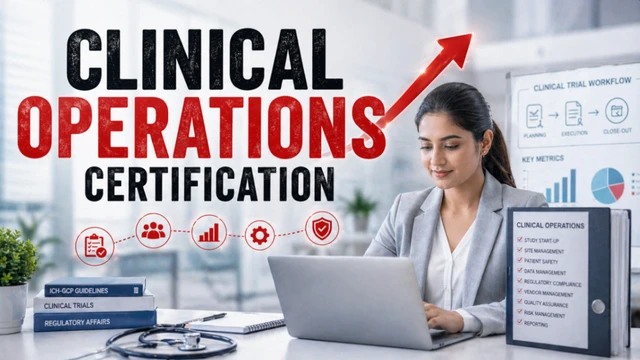
What is the Clinical Operations Career Path in India? (What Does an Executive Do?)
\nA Clinical Operations Executive supports the day-to-day activities of clinical trials. You ensure trials run smoothly, from planning to completion. Your work helps bring new medicines to market safely.
\n- \n
- Help prepare trial documents like protocols and consent forms. \n
- Coordinate with investigators, labs, and ethics committees. \n
- Monitor data collection and ensure quality. \n
- Maintain regulatory files as per ICH-GCP and CDSCO guidelines. \n
- Solve problems that arise during trials. \n
It’s a detail-focused role. You don’t treat patients. Instead, you manage the process behind the scenes. This is the core of the clinical operations job description in CROs and pharma companies.
\nWhat is the Salary of a Clinical Operations Executive in India?
\nThe clinical operations executive salary in India ranges from ₹2.5 LPA to ₹5 LPA for freshers. With 2–4 years of experience, you can earn ₹5–8 LPA. Senior roles like Clinical Operations Manager draw ₹8–15 LPA or more.
\nSalaries vary by city and company. Top CROs like IQVIA, Parexel, and Syneos often pay higher. Even during a career gap, showing certified skills can help you negotiate a better starting pay.
\nHow to Start a Career in Clinical Operations?
\nHere’s a simple roadmap even if you come from IT, BPO, or have a non-healthcare degree:
\n- \n
- Learn the basics: Understand clinical trial phases, ICH-GCP, and regulatory bodies like FDA and EMA. \n
- Get hands-on training: Enroll in a simulation-based certification program to practice real tasks. \n
- Build a project portfolio: Work on mock trials, document creation, and data management exercises. \n
- Apply for entry roles: Target CROs, pharma companies, and biotech firms. Highlight transferable skills like organization and communication. \n
- Ace the interview: Be ready to discuss clinical scenarios and how you’d handle trial challenges. \n
Remember, clinical operations career path India doesn’t require a medical background. Your discipline and willingness to learn matter most.
\nWhat is the Difference Between Clinical Operations and Clinical Research?
\nMany confuse these terms. Clinical research is the science—designing trials, analyzing data, writing protocols. Clinical operations is the execution—making sure the trial runs, sites are active, and rules are followed.
\n| Clinical Research | Clinical Operations |
|---|---|
| Focuses on scientific questions and data analysis | Focuses on trial logistics, timelines, and compliance |
| Roles: Clinical Research Coordinator, Data Manager | Roles: Clinical Operations Executive, Trial Manager |
| More academic and lab-oriented | More process and coordination-oriented |
If you enjoy organizing, planning, and problem-solving, clinical operations in CRO is your fit.
\nWhat Skills Are Needed for Clinical Operations Roles?
\nEmployers look for these skills specifically in freshers:
\n- \n
- Attention to detail: Every comma in a regulatory form counts. \n
- Communication: You’ll write emails, reports, and speak with site staff daily. \n
- Time management: Trials have strict deadlines. Juggling tasks is key. \n
- Basic computer skills: Use of MS Office, Google Suite, and trial management software. \n
- Regulatory knowledge: Even a foundational grasp of ICH-GCP and CDSCO sets you apart. \n
College often misses these practical angles. That’s where targeted training bridges the gap.
\nThe Skill Gap: What Colleges Teach vs. What Employers Expect
\nYour BSc or BTech syllabus likely covered theory—maybe a brief mention of clinical trials. But hiring managers need you to know:
\n- \n
- How to prepare a trial master file. \n
- How to track patient enrollment using Excel sheets. \n
- How to handle protocol deviations on a real study. \n
These aren’t taught in most Indian universities. That’s why many freshers face rejection. The solution? Show proof of applied skills through simulation-based projects.
\nYour Step-by-Step Roadmap to Enter Clinical Operations (Even After a Gap)
\n- \n
- Self-assessment: List your transferable skills—organization, multitasking, using computers. \n
- Bridge the knowledge gap: Take a short, focused certification that teaches real-world clinical operations workflows. \n
- Work on mini projects: Complete assignments like drafting a site initiation checklist or reviewing a mock informed consent form. \n
- Network with intent: Connect with clinical operations professionals on LinkedIn. Ask about their daily work. \n
- Apply strategically: Use keywords from the clinical operations job description in your resume. Mention your certification and projects. \n
- Prepare for the interview: Practice answers to common questions like “How would you handle a missing data point in a case report form?” \n
The System Bridge: Simulation-Based Learning
\nReading about clinical operations isn’t enough. You need to do it. Simulation-based learning lets you practice on mock trials, make mistakes in a safe space, and build confidence. At ZANE ProEd, our programs recreate real CRO environments—complete with protocols, site communications, and compliance checks. You’ll finish with a portfolio that speaks louder than a degree.
\nBuild These Skills Now
Programs from ZANE ProEd Academy that directly address the skill gaps discussed above.
Why ZANE ProEd’s Clinical Operations Certification Works
\nThe clinical operations certification from ZANE ProEd is built as a career launch system—not just a course. It covers:
\n- \n
- End-to-end trial management from startup to closeout. \n
- Real-world tasks like creating monitoring reports and managing essential documents. \n
- Mentor feedback on your work. \n
Designed by industry experts, it aligns with ICH and CDSCO standards. Many freshers with career gaps have used this program to land their first role. For a broader view of the clinical operations manager career, read our detailed guide on clinical operations career growth.
\nCheck your job readiness. See how your current skills stack up against what employers expect. A small step now can open a big door in the next hiring cycle.
Build These Skills Now
Programs from ZANE ProEd Academy that directly address the skill gaps discussed above.
Follow Zane ProEd on Google
Preferred SourceAdd our publication as a preferred source to get the latest clinical research guides, industry updates, and career intel directly in your Google Top Stories & AI Overviews.