Drug Regulatory Strategy Career India: Complete Roadmap for BSc/MSc Chemistry Graduates

Drug Regulatory Strategist A drug regulatory strategy career in India involves planning and managing drug approvals across CDSCO, FDA, and EMA. You need a BSc/MSc Chemistry background, hands-on regulatory knowledge, and a portfolio of simulated submissions. Salaries range from ₹4 LPA to ₹12 LPA, with growth into senior strategist roles.
You have tried multiple courses but still feel stuck. That is because most courses teach theory, not the practical decisions that define a drug regulatory strategy career in India. For BSc/MSc Chemistry graduates, the gap is not knowledge—it is the ability to apply regulations to real submissions.
Recruiters in Hyderabad, Bangalore, Pune, and Mumbai do not ask how many certificates you have. They ask: Can you map a CDSCO submission? Can you compare FDA and EMA pathways? Can you build a regulatory strategy from scratch?
Build These Skills Now
Programs from ZANE ProEd Academy that directly address the skill gaps discussed above.
This blog is your decision tree. Stop collecting certificates. Start building strategic proof.
What does a Drug Regulatory Strategist do? (Drug Regulatory Strategy Career India)
A Drug Regulatory Strategist is the architect of drug approvals. The regulatory strategy job description goes beyond filing documents. You plan the fastest, most compliant route to market across CDSCO, FDA, and EMA regulatory pathways.
Your daily tasks include:
- Mapping submission strategies for new drugs, generics, and biologics.
- Interpreting ICH guidelines and local regulations.
- Advising R&D teams on data gaps before they become costly delays.
- Coordinating with regulatory affairs teams to execute the strategy.
- Managing health authority meetings and deficiency responses.
In short, you decide what to submit, where, and when. Regulatory affairs then executes the submission.
What is the salary of a Regulatory Strategist in India?
The regulatory strategist salary in India depends on experience, city, and whether you can demonstrate strategic decision-making. Here are realistic INR LPA ranges for BSc/MSc Chemistry graduates:
- Entry-level (0-2 years): ₹3.5 LPA – ₹6 LPA. Roles: Regulatory Associate, Junior Strategist.
- Mid-level (3-5 years): ₹6 LPA – ₹10 LPA. Roles: Regulatory Strategist, Submission Lead.
- Senior (6+ years): ₹10 LPA – ₹18 LPA+. Roles: Senior Strategist, Regulatory Portfolio Manager.
Hyderabad and Mumbai pay 10-15% higher for CDSCO and FDA strategy roles. Bangalore and Pune are strong for EMA and global submissions. Your salary jumps when you show a portfolio of simulated submissions, not just certificates.
How to build a career in regulatory strategy?
Building a career in regulatory strategy requires three things: regulatory knowledge, practical application, and visible proof. Here is a high-level decision tree:
- Learn the fundamentals: Master the drug registration process India and global pathways (CDSCO, FDA, EMA). Understand ICH and WHO guidelines.
- Apply through simulations: Build mock submissions. Practice gap analysis. Create a portfolio of strategy documents.
- Target entry roles: Look for Regulatory Associate, Regulatory Affairs Executive, or Strategy Trainee roles in Indian pharma hubs.
- Specialize: Choose a niche like biologics, generics, or medical devices. Deepen your CDSCO FDA EMA regulatory pathway expertise.
For a detailed fresher roadmap, read our Regulatory Affairs Career Path India Freshers Guide. It covers networking, internships, and first-job strategies.
What is the drug registration process in India (CDSCO)?
The drug registration process India is governed by the Central Drugs Standard Control Organisation (CDSCO). For new drugs, the process follows these key steps:
- Pre-submission meeting: Discuss your drug and data package with CDSCO.
- Application filing: Submit Form CT-04 or relevant forms with preclinical and clinical data.
- Technical review: CDSCO reviews safety, efficacy, and quality. They may ask for clarifications.
- Inspection: Manufacturing site inspection for GMP compliance.
- Approval: CDSCO grants permission to import or manufacture. Timelines range from 6-18 months.
Strategists must also understand WHO prequalification and FDA/EMA pathways for global launches. The CDSCO FDA EMA regulatory pathway comparison is a core strategic skill.
What is the difference between regulatory affairs and regulatory strategy?
The regulatory strategy vs regulatory affairs distinction is critical for your career. Think of it as the difference between the architect and the builder.
- Regulatory Affairs: Executes submissions. Prepares dossiers. Maintains compliance. Focuses on how to submit.
- Regulatory Strategy: Designs the approval roadmap. Chooses pathways. Manages risk. Focuses on what, where, and when to submit.
Strategy roles require stronger critical thinking, health authority negotiation, and cross-functional leadership. Affairs roles are more process-driven. Many professionals start in affairs and move to strategy after 2-3 years. But you can accelerate this with simulation-based training.
What skills do BSc/MSc Chemistry graduates actually need for regulatory strategy?
Conventional BSc/MSc Chemistry education teaches you chemical principles, lab techniques, and theory. Modern employers in India expect something different. Here is the gap:
- What colleges teach: Organic chemistry, spectroscopy, basic pharmacology. Little to no regulatory coursework.
- What employers expect: Ability to interpret CDSCO, FDA, and EMA guidelines. Hands-on experience with submission formats (CTD, eCTD). Proficiency in tools like Veeva Vault, Argus Safety, and Medidata Rave.
- What is missing: A portfolio of simulated submissions, gap analyses, and strategy documents. Certificates alone do not prove you can do the job.
This is why many Chemistry graduates feel stuck. You have the scientific foundation, but you lack the regulatory application. The solution is not another theory course. It is simulation-based practice.
What is the step-by-step roadmap to become a Drug Regulatory Strategist?
Follow this 5-step decision tree to move from confusion to clarity in the next 6 months:
- Month 1 – Master the landscape: Study CDSCO, FDA, and EMA pathways. Read ICH guidelines. Understand the drug registration process India.
- Month 2 – Build a simulation portfolio: Create a mock CDSCO submission. Write a gap analysis for a fictional drug. Document your strategic decisions.
- Month 3 – Learn industry tools: Get hands-on with Veeva Vault eTMF, Argus Safety ICSR, and Medidata Rave EDC. These are standard in Indian pharma hubs.
- Month 4 – Network and apply: Connect with regulatory professionals on LinkedIn. Target entry roles in Hyderabad, Mumbai, Pune, and Bangalore. Use our Regulatory Affairs Interview Guide to prepare.
- Month 5-6 – Specialize and certify: Choose a niche (generics, biologics, devices). Complete a professional certification that includes simulation and portfolio proof.
This roadmap works because it replaces passive learning with active proof.
Why simulation-based learning beats certificate collection?
Certifications without practice are useless. Recruiters want to see that you can apply regulations to real-world scenarios. Simulation-based learning solves this by giving you a safe environment to make strategic decisions.
You practice with actual industry tools: Argus Safety ICSR case processing, Medidata Rave EDC, Veeva Vault eTMF, and FDA 21 CFR submissions. You build a verifiable portfolio that proves your capability before you get the job.
This is the system bridge: from theory to practice, from certificates to proof.
Build These Skills Now
Programs from ZANE ProEd Academy that directly address the skill gaps discussed above.
How can ZANE ProEd Academy accelerate your regulatory strategy career?
ZANE ProEd Academy is a premier professional career-certification platform. We do not offer theory-only courses. Our programs are built around industry-grade simulation toolkits and audit-ready portfolio development.
Two programs are designed for BSc/MSc Chemistry graduates targeting regulatory strategy:
- regulatory-affairs-strategy-certification: Focuses on strategic decision-making, CDSCO FDA EMA regulatory pathways, and portfolio building. You complete a mock submission and defend your strategy.
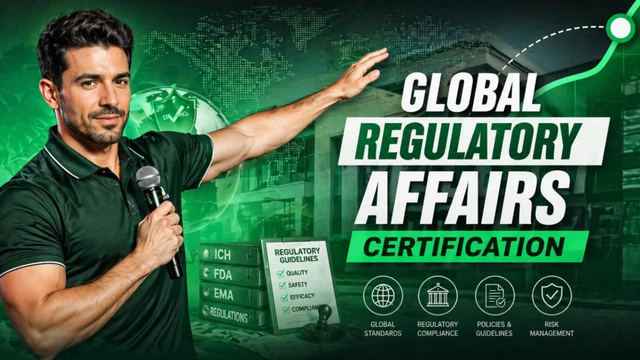
- global-regulatory-affairs-certification: Covers multi-country submissions, ICH guidelines, and global regulatory strategy. Includes hands-on work with eCTD and Veeva Vault.
These certifications close the qualification gap. You graduate with an audit-ready portfolio and the confidence to interview for high-paying roles. The ROI is clear: a portfolio that proves you can do the job, not just a certificate that says you studied.
Learn more about ZANE ProEd and our mission to build industry-ready professionals.
Ready to audit your regulatory strategy readiness?
Do not collect another certificate that no recruiter asks for. Instead, take these consultative next steps:
- Explore Professional Certification Blueprints: Review the simulation curriculum for regulatory strategy.
- Audit your industry readiness: Identify your gaps in CDSCO, FDA, and EMA pathways.
- Review the simulation curriculum: See how Argus, Veeva, and Medidata are integrated into training.
Move from confusion to clarity. Build a portfolio that proves your strategic value.
Build These Skills Now
Programs from ZANE ProEd Academy that directly address the skill gaps discussed above.
Follow Zane ProEd on Google
Preferred SourceAdd our publication as a preferred source to get the latest clinical research guides, industry updates, and career intel directly in your Google Top Stories & AI Overviews.