Drug Regulatory Strategy Career in India: Complete Roadmap for BSc & MSc Chemistry Freshers

Drug Regulatory Strategy Career India: A drug regulatory strategy career in India means planning how a medicine wins approval across CDSCO, FDA and EMA markets. BSc or MSc Chemistry freshers enter through regulatory affairs associate roles, master the drug registration process India rules, and grow into strategists earning ₹6 LPA to ₹18 LPA within three to six years.
If you are a BSc or MSc Chemistry graduate with no experience, you have probably been told your options are QC labs, teaching, or a slow PhD. That advice is outdated. A drug regulatory strategy career in India is one of the fastest-growing and least-crowded paths open to chemical sciences graduates right now.
Here is the honest reality trigger: degrees alone are not enough anymore. Companies in Hyderabad, Bangalore, Pune and Mumbai hire people who can read a guideline, map a submission pathway, and defend that strategy in a client call. Your MSc marks do not prove that skill. Your portfolio does.
Build These Skills Now
Programs from ZANE ProEd Academy that directly address the skill gaps discussed above.
In a highly competitive Indian market, the fresher who understands the CDSCO, FDA and EMA regulatory pathway - and can prove it with simulation work - gets the first interview. This guide gives you the exact roadmap.
What does a Drug Regulatory Strategist do?
A Drug Regulatory Strategist decides the fastest, safest and most cost-effective route to get a pharmaceutical product approved in one or many countries. The formal regulatory strategy job description usually covers market assessment, submission planning, health-authority interaction and lifecycle management.
Typical daily tasks
- Reading ICH guidelines and local regulations to decide which submission type applies.
- Mapping a product to the right pathway - new drug, generic, biosimilar, device or OTC.
- Building submission timelines and cost models for CDSCO, FDA, EMA or WHO prequalification.
- Advising R&D, clinical and manufacturing teams on the data regulators will demand.
- Handling deficiency letters, query responses and post-approval variations.
- Tracking regulatory intelligence, competitor approvals and changing laws.
Where do regulatory strategists work in India?
- Global capability centres of MNCs such as Novartis, Sanofi, Pfizer and AstraZeneca.
- Indian majors such as Dr Reddy's, Cipla, Sun Pharma, Biocon and Lupin.
- CROs and regulatory consultancies managing global dossiers.
- Medical device, nutraceutical and cosmetics regulatory teams.
For a deeper industry view, read the Drug Regulatory Strategy Career India Handbook.
What is the salary of a Regulatory Strategist in India?
The regulatory strategist salary in India depends on experience, city and how many markets you can independently handle. Freshers usually start in associate roles and move up fast once they own a full submission.
| Role | Experience | Indicative Salary (INR) |
|---|---|---|
| Regulatory Affairs Associate | 0-1 year | ₹2.8 LPA - ₹4.5 LPA |
| Regulatory Affairs Executive | 1-3 years | ₹4 LPA - ₹7 LPA |
| Senior Regulatory Specialist / Submission Lead | 3-6 years | ₹7 LPA - ₹12 LPA |
| Regulatory Strategist | 5-8 years | ₹12 LPA - ₹20 LPA |
| Global Regulatory Lead / Manager | 8+ years | ₹22 LPA - ₹40 LPA |
What changes the number?
- City: Hyderabad and Bangalore pay a premium for global capability centre roles. Pune, Mumbai and Ahmedabad follow closely.
- Market coverage: Professionals who handle US FDA or EU EMA submissions earn 25 to 40 percent more than India-only profiles.
- Tool fluency: Experience with submission and safety platforms speeds up your climb from executive to specialist.
- Portfolio proof: A candidate who can show a completed mock dossier outperforms one with only academic marks.
How to build a career in regulatory strategy?
Building a regulatory career is not about waiting for a lucky break. It is about stacking three assets: guideline knowledge, tool skills and documented submission work.
- Choose a market focus. India plus one global market (US or EU) is the strongest entry combination.
- Learn the regulations, not just the theory. Study the Drugs and Cosmetics Act, the NDCT Rules 2019, and ICH quality and safety modules.
- Build tool proficiency. Regulators and sponsors work inside document, submission and safety systems every single day.
- Create a submission portfolio. Draft a mock CTD Module 3 for a real molecule and label every step.
- Target associate and executive roles in global capability centres, CROs and mid-size pharma firms.
- Shift from execution to strategy after two to three years by owning pathway decisions, not just filings.
The full step-by-step hiring map is covered in the Regulatory Affairs Career Path India Playbook.
What is the drug registration process in India (CDSCO)?
The drug registration process India follows a defined legal route. The Central Drugs Standard Control Organisation (CDSCO) under the DCGI is the national authority, supported by state licensing authorities and the Central Drugs Laboratory for testing.
Key steps in the Indian registration pathway
- Classification: Decide whether the product is a new drug, generic, fixed dose combination, import or medical device.
- Application filing: Submit the relevant forms with the prescribed fee, usually through the SUGAM online portal.
- Technical review: CDSCO examines chemistry, manufacturing, preclinical and clinical data as applicable.
- Testing and inspection: Samples may be sent to the Central Drugs Laboratory and sites may be audited for GMP compliance.
- Approval: The DCGI grants permission, and state authorities issue manufacturing or sale licences.
- Post-approval: Variations, renewals, pharmacovigilance reports and periodic safety updates follow.
Dossiers are usually built in CTD or eCTD format, with Modules 1 to 5 covering administrative data, summaries, quality, non-clinical and clinical information.
Always verify current requirements on the official portals: CDSCO, ICH and WHO. Guideline text and timelines are revised regularly, and employers expect you to check the source, not a coaching note.
What is the difference between regulatory affairs and regulatory strategy?
This is the question that confuses most freshers. In short, regulatory affairs executes the submission, while regulatory strategy decides which submission to make, when and why. The comparison below uses regulatory strategy vs regulatory affairs as a working framework.
| Parameter | Regulatory Affairs | Regulatory Strategy |
|---|---|---|
| Primary focus | Preparing and filing accurate documents | Choosing the optimal approval pathway |
| Timing | After the plan is fixed | Before development and filing begin |
| Core output | Complete, compliant submissions | Approval roadmap, risk and cost model |
| Typical entry level | Associate / Executive | Specialist / Lead (usually 4+ years) |
| Key skills | Attention to detail, dossier formatting, CTD knowledge | Regulatory intelligence, cross-functional influence, risk judgement |
| Salary band | ₹2.8 LPA - ₹8 LPA | ₹12 LPA - ₹40 LPA |
| Best route | Strong fresher entry point | Natural progression from regulatory affairs |
Practically, you enter through regulatory affairs and grow into strategy. Nobody is hired as a strategist on day one, and that is good news for freshers.
Why do BSc and MSc Chemistry graduates struggle to get regulatory jobs?
The gap is not talent. It is a mismatch between what your degree teaches and what a pharma employer in India actually tests in an interview.
| What your BSc / MSc teaches | What employers actually expect |
|---|---|
| Organic, inorganic and physical chemistry theory | Applied reading of CDSCO, FDA and EMA regulations |
| Lab practicals and spectroscopy | Dossier preparation in CTD and eCTD structure |
| Academic dissertations | Submission lifecycle awareness and timeline planning |
| Marksheets and rank cards | A documented, verifiable regulatory portfolio |
| Individual exam performance | Cross-functional communication with R&D, QA and clinical teams |
Fix the mismatch and your Chemistry background becomes an advantage, because formulation, API and analytical data are the core of Module 3 quality dossiers.
What is the step-by-step roadmap for a fresher with no experience?
- Month 1 - Foundation: Learn the Indian regulatory framework, CDSCO structure and the CTD module system.
- Month 2 - Global routes: Compare the CDSCO, FDA and EMA pathways and document differences in a one-page comparison sheet.
- Month 3 - Tools: Get hands-on with regulatory information management and safety systems used in real submissions.
- Month 4 - Portfolio: Build a mock dossier for a real molecule with a labelled pathway, timeline and risk table.
- Month 5 - Positioning: Write a regulatory-focused CV that leads with skills and portfolio, not just your degree.
- Month 6 - Applications: Apply to associate and executive roles in Hyderabad, Bangalore, Pune and Mumbai, and rehearse submission-based interview answers.
Three to six months of structured preparation is realistic for a first job when you follow this sequence instead of applying blindly.
How do simulation training and a verifiable portfolio get you hired faster?
Interviewers cannot test your strategy thinking from a textbook answer. They test it on a scenario: here is a molecule, here is a market, what is your plan?
Simulation-based learning puts you inside that scenario. You process real-format documents, work in industry systems, and complete a submission from start to finish. The output is a verifiable portfolio you can walk an interviewer through.
That is where structured professional certification beats self-study. It gives you the process, the tools and the proof in one track. Learn more about the training philosophy at ZANE ProEd.
Build These Skills Now
Programs from ZANE ProEd Academy that directly address the skill gaps discussed above.
Which ZANE ProEd certification fits your regulatory strategy goal?
ZANE ProEd Academy is a professional career-certification platform built for life science and chemistry graduates entering regulated industries. Two tracks map directly to this career path.
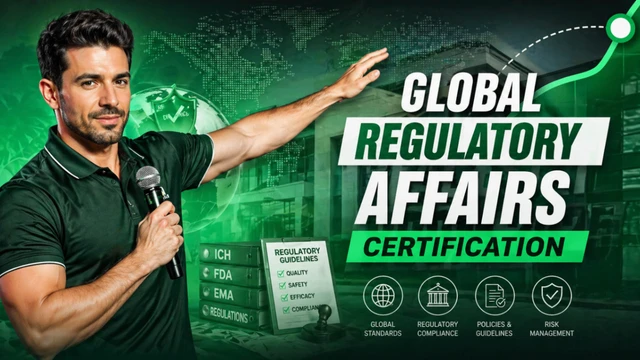
- Global Regulatory Affairs Certification - covers multi-market frameworks, CTD and eCTD dossier structure, submission lifecycle and health-authority expectations across India, US and EU routes.
- Regulatory Affairs Strategy Certification - focuses on pathway selection, regulatory intelligence, submission planning and the decision-making skills that separate a strategist from a filing executive.
Both tracks include industry-grade simulation toolkits so you practise the systems employers already use - Veeva Vault eTMF for document and trial master workflows, Medidata Rave EDC for clinical data capture, Argus Safety ICSR case processing for pharmacovigilance, and FDA 21 CFR submission formatting practice.
The ROI is straightforward. Certification closes your qualification gap, creates an audit-ready portfolio, and moves you from the general fresher pile into a shortlist of candidates who already understand regulatory workflows. That is the difference between waiting for a callback and walking into an interview with evidence.
What should you do this week to start your drug regulatory strategy career in India?
Do not wait for a perfect plan. Start with three actions.
- Audit your industry readiness honestly - can you explain the CTD modules and the CDSCO approval route out loud?
- Explore the professional certification blueprints and choose the track that matches your target market.
- Review the simulation curriculum and see exactly what you will produce as portfolio proof.
Your Chemistry degree is the raw material. Regulatory strategy is the career you build on top of it. Start now, and the 3 to 6 month goal is genuinely within reach.
Build These Skills Now
Programs from ZANE ProEd Academy that directly address the skill gaps discussed above.
Follow Zane ProEd on Google
Preferred SourceAdd our publication as a preferred source to get the latest clinical research guides, industry updates, and career intel directly in your Google Top Stories & AI Overviews.