Drug Safety Scientist Salary and Qualifications US: A Practical Career Roadmap

Drug Safety Scientist In the US, a Drug Safety Scientist typically earns $85,000-$140,000 annually, requires a PharmD, PhD, or RN with 2-5 years in pharmacovigilance, and expertise in aggregate reports like PBRER and DSUR, signal detection, and FDA regulations.
If you're an Academic Lab Technician or Bench Scientist watching colleagues pivot into pharma, you've probably seen conflicting advice about certifications like ACRP (CCRA) and SoCRA (CCRP). Here's the truth: those are for clinical research associates, not drug safety scientists. The drug safety scientist salary and qualifications us landscape is different — and more lucrative for those who build the right applied skills.
You don't need another generic certificate. You need to understand FDA expectations, author safety reports, and demonstrate signal detection ability. This guide breaks down the real requirements, pay, and a step-by-step path from the bench to a drug safety scientist role.
Build These Skills Now
Programs from ZANE ProEd Academy that directly address the skill gaps discussed above.
What qualifications do you need to be a Drug Safety Scientist?
Most US employers expect an advanced clinical or scientific degree. The most common backgrounds are:
- PharmD — pharmacy graduates often transition via industry fellowships or clinical experience.
- PhD in life sciences, epidemiology, or pharmacology — valued for analytical depth.
- RN / MSN — bedside nurses with strong clinical knowledge can move into safety case review.
- MPH — useful for population-level safety analysis.
Beyond the degree, you must demonstrate working knowledge of:
- ICH guidelines (E2A–E2F) governing safety reporting.
- MedDRA coding and WHO Drug dictionaries.
- Safety databases like Oracle Argus, ArisG, or Veeva Vault.
- Aggregate reports: PBRER (Periodic Benefit-Risk Evaluation Report) and DSUR (Development Safety Update Report).
- Signal detection using disproportionality analysis and AI-assisted tools.
Certifications like ACRP CCRA or SoCRA CCRP are not required for this role. They focus on clinical trial monitoring, not pharmacovigilance science. Recruiters care far more about whether you can author a PBRER section or run a signal detection query than about a CRA credential. If you're confused between ACRP and SoCRA, redirect your energy toward applied safety training.
What is the salary difference between a Safety Associate and a Safety Scientist?
Salary data from US biopharma hubs shows a clear step-up in compensation as you move from associate to scientist:
- Drug Safety Associate: $65,000 – $90,000 per year. Typically handles case processing, data entry, and triage.
- Drug Safety Scientist: $85,000 – $140,000 per year. Owns aggregate reports, signal detection, and risk management.
- Senior Drug Safety Scientist: $130,000 – $180,000+ per year. Leads global safety strategy and regulatory interactions.
Location matters. In Boston, San Diego, and Research Triangle Park (RTP), salaries trend 10–20% higher than the national median. The jump from associate to scientist is not just a title change — it's a shift from executing tasks to making scientific judgments and defending them to regulators.
What are aggregate safety reports like PBRER and DSUR?
Aggregate reports are the backbone of clinical safety surveillance. The FDA requires them to monitor the benefit-risk profile of drugs over time. As a Drug Safety Scientist, you'll either author or critically review these documents.
- PBRER (Periodic Benefit-Risk Evaluation Report) — submitted post-marketing to summarize worldwide safety data, including new signals and benefit-risk assessment. Follows ICH E2C(R2).
- DSUR (Development Safety Update Report) — submitted annually during clinical development to update regulators on safety findings across all trials. Follows ICH E2F.
Understanding the structure, data sources, and regulatory deadlines for these reports is non-negotiable. Employers will ask scenario questions like: 'How would you handle a newly identified safety signal for an investigational drug?' or 'Walk me through the key sections of a PBRER.'
How do PharmD graduates enter drug safety and signal detection?
PharmD graduates have a natural advantage because they already understand pharmacology, therapeutics, and adverse drug reactions. The most common entry paths include:
- Industry fellowship — Rutgers, MCPHS, and other programs place fellows in pharmacovigilance departments for 1-2 years.
- Direct hire — starting as a Drug Safety Associate and advancing after mastering case processing and aggregate reporting.
- Clinical experience — hospital pharmacists often transition into safety roles by highlighting drug information and medication safety committee work.
For signal detection pharmacovigilance jobs, you'll need to demonstrate competency in statistical methods (e.g., proportional reporting ratio, Bayesian data mining) and familiarity with tools like Empirica Signal or FAERS data. Increasingly, employers expect experience with AI-assisted signal detection — not just manual review. That's where simulation-based training gives you an edge.
What does an FDA safety audit evaluate in pharmacovigilance?
The FDA conducts routine inspections to ensure sponsors comply with 21 CFR Parts 312 and 314 and ICH E2E guidelines. During a pharmacovigilance audit, inspectors evaluate:
- Safety data integrity — accurate and complete case processing.
- Aggregate report timeliness — PBRER and DSUR submissions on schedule.
- Signal detection process — documented methodology and follow-up actions.
- Risk management — effectiveness of REMS (Risk Evaluation and Mitigation Strategies) if applicable.
- SOP compliance — every safety activity has a written procedure that is followed.
Auditors don't just look at files; they interview staff to verify understanding. If you can't explain the signal detection workflow or the difference between an expedited and periodic report, you'll fail — no matter how many certificates hang on your wall. That's why practical, audit-ready training matters more than credential collecting. See FDA for official guidance.
Skill Gap: What Academic Training Misses
As a bench scientist, you're skilled at experimental design, data analysis, and critical thinking. Those are valuable. But pharma employers expect three things you probably haven't practiced:
- Regulatory writing — crafting safety narratives and aggregate report sections that meet FDA expectations.
- Safety database navigation — using Argus or ArisG to extract and validate case data.
- Cross-functional communication — presenting safety findings to clinical teams, regulatory affairs, and medical monitors.
Traditional certifications like ACRP CCRA or SoCRA CCRP don't bridge this gap. They teach clinical operations, not pharmacovigilance science. Recruiters see these credentials and ask: 'Can this person write a PBRER? Run a signal detection analysis? Probably not.'
A Structured Pathway from Bench to Drug Safety Scientist
Here's a realistic 5-step roadmap for US-based career switchers:
- Assess transferable skills — map your data analysis, literature review, and lab documentation experience to safety case processing.
- Build foundational pharmacovigilance knowledge — study ICH E2 guidelines, MedDRA coding, and FDA postmarketing requirements. Use free FDA and NIH resources.
- Gain hands-on tool experience — practice using a safety database (even a demo environment) and author mock PBRER/DSUR sections. Simulation is key.
- Create a portfolio — include a sample signal detection report, a mock aggregate report excerpt, and a standard operating procedure you wrote. This shows applied skill.
- Target entry-level safety roles — apply for Drug Safety Associate positions first, then advance internally. Or leverage a clinical background to enter as a safety scientist in smaller biotechs.
The System Bridge: From Knowledge to Portfolio Proof
You can read every ICH guideline and still freeze when asked to draft a DSUR. That's why simulation-based learning is non-negotiable. You need to practice writing aggregate reports, running signal detection queries, and defending your decisions in a mock audit. This builds the kind of verifiable portfolio that recruiters trust far more than a certificate.
Build These Skills Now
Programs from ZANE ProEd Academy that directly address the skill gaps discussed above.
Academy Integration: Practical Training That Mirrors Industry
ZANE ProEd's approach is different from a generic video course. We focus on ICH-GCP international compliance, audit readiness, and practical trial simulation. Two programs are directly relevant to your transition:
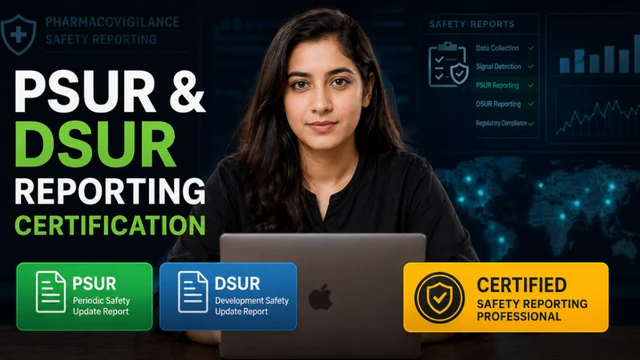
- psur-dsur-reporting-certification — a deep dive into authoring PBRER and DSUR reports, including hands-on case studies and regulatory timeline management.
- pharmacovigilance-signal-detection-with-ai — learn to use AI-assisted tools for signal detection, data mining, and safety surveillance, just like modern pharma teams do.
These aren't passive lectures. You'll work through real-world scenarios, receive feedback, and build a portfolio that demonstrates you can do the job on day one. That's what separates you from the hundreds of applicants with only a certification but no practice.
Your Next Step: Audit Your Industry Readiness
Don't wait until you've collected three more certifications. Instead, take a hard look at your current skills against the role's demand. Can you explain a PBRER structure? Do you know how to run a disproportionality analysis? If not, explore simulation workflows and get hands-on. For more insights, check out our guide on CRA career paths to see why drug safety may be a better fit for your science background.
Start with one practical skill: author a mock safety narrative or extract a signal from FAERS data. That single exercise will teach you more than a month of theory.
Build These Skills Now
Programs from ZANE ProEd Academy that directly address the skill gaps discussed above.
Follow Zane ProEd on Google
Preferred SourceAdd our publication as a preferred source to get the latest clinical research guides, industry updates, and career intel directly in your Google Top Stories & AI Overviews.