Drug Safety Scientist Salary and Qualifications in the US: An Insider Guide for Career Switchers

Drug Safety Scientist (US) — A drug safety scientist in the US earns $85,000 to $125,000 per year, with senior aggregate reporting roles reaching $140,000+. Qualifications: a life sciences or nursing degree, 2-4 years of pharmacovigilance experience, MedDRA coding, and hands-on PBRER, DSUR, and signal detection skills.
Behind the hiring scenes at most US pharmacovigilance teams, the conversation about drug safety scientist salary and qualifications in the US is far blunter than any job posting. Hiring managers do not ask where you went to college. They ask one question: can you author a PBRER section and defend it in an audit?
If you are a bedside RN or a BSN graduate trying to move into clinical research, that single question explains why your resume keeps stalling. You have real clinical judgment. You have patient assessment skills. But you have no documented industry monitoring experience, and no portfolio proving you can work inside Argus Safety or a DSUR calendar.
Build These Skills Now
Programs from ZANE ProEd Academy that directly address the skill gaps discussed above.
This guide is the insider version. It covers pay bands, the exact qualifications employers screen for, how aggregate reports work, and a practical six-step path from the floor to a drug safety desk in the next hiring cycle.
What qualifications do you need to be a Drug Safety Scientist?
US employers screen drug safety scientist candidates on four layers, not one. The degree gets you past the applicant tracking system. The rest decides the interview.
- Education: BS in biology, biochemistry, pharmacy, or nursing. A BSN absolutely qualifies. PharmD and MS holders tend to reach scientist titles faster.
- Experience: 2-4 years in pharmacovigilance case processing, aggregate reporting, or clinical safety surveillance. Internal moves from ICSR teams are the most common route.
- Technical skills: MedDRA coding, Argus Safety or ArisGlobal, Veeva Vault, line listing review, and working knowledge of ICH E2E and FDA 21 CFR 312.32 / 314.80.
- Evidence: a portfolio showing you authored or contributed to a PBRER, a DSUR, or a written signal evaluation memo.
Here is the insider detail. As an RN or BSN graduate, your clinical safety surveillance instincts are an asset, not a liability. You already read adverse event narratives the way a safety physician does. What you lack is documentation inside an industry workflow.
What is the salary difference between a Safety Associate and a Safety Scientist?
In the US market the jump is roughly $20,000 to $40,000, and it happens exactly at the aggregate reporting line.
- Drug Safety Associate / ICSR processor: $65,000 - $85,000
- Drug Safety Scientist / Aggregate Reporting: $85,000 - $125,000
- Senior or Principal Safety Scientist: $130,000 - $155,000+
- PV Manager / Signal Lead: $150,000 - $180,000+
Location shifts these bands. Boston-Cambridge and San Diego typically run 8-15% above the national midpoint to offset cost of living. Research Triangle Park and the Philadelphia-New Jersey corridor pay near the median with far lower living costs. Remote-first CRO roles usually land mid-band.
The structural reason for the gap is simple. Associates process cases. Scientists interpret them, own the periodic report calendar, and defend the benefit-risk conclusion. That is a different job title, a different budget line, and a different hiring bar.
What are aggregate safety reports like PBRER and DSUR?
Aggregate reports are how a company proves it has been watching its product over time. Every PBRER DSUR safety scientist role is built around producing them on deadline.
- PBRER / PSUR: Periodic Benefit-Risk Evaluation Report. Covers marketed products, submitted under ICH E2C(R2), usually every 6 or 12 months depending on the product and jurisdiction.
- DSUR: Development Safety Update Report. Covers investigational drugs annually, anchored to the reference safety information date in the Investigator's Brochure.
- Line listings and appendices: the raw case tables regulators cross-check against your narrative.
A typical cycle looks like this: data lock point, case reconciliation, MedDRA SMQ review, cumulative exposure tables, benefit-risk drafting, QC, medical review, then submission. The pharmacovigilance aggregate reports FDA reviewers receive are expected to be internally consistent. A single mismatched case count invites questions.
This is the most hireable skill in the field, because the calendar never negotiates. If a DSUR is due, it is due.
How do PharmD graduates enter drug safety and signal detection?
The PharmD to drug safety scientist career path usually starts in medical information or case processing, then pivots into signal work within 18-24 months. Nurses can copy that playbook almost exactly.
- Start adjacent: ICSR case processing, medical information, or clinical safety surveillance on trial teams.
- Learn the detection math: disproportionality analysis using PRR, ROR, and EBGM, plus MedDRA SMQ construction.
- Own one signal: contribute meaningfully to a signal evaluation memo, a safety review board deck, or a labeling change assessment.
- Get your name on the tracker: internal signal logs become interview material and internal transfer leverage.
Signal detection pharmacovigilance jobs are expanding because regulators now expect proactive surveillance rather than reactive reporting. AI-assisted triage is standard in larger safety teams, which raises the bar for people who understand both the statistics and the clinical context. For trial-level context, review active studies at ClinicalTrials.gov.
What does an FDA safety audit evaluate in pharmacovigilance?
An FDA inspection does not ask whether you are busy. It asks whether your safety data is traceable.
- Case intake and timeliness: serious unexpected SUSARs reported within 15 calendar days, and 7 days for fatal or life-threatening cases.
- Reconciliation: do the clinical trial database and the postmarketing safety database match?
- Aggregate report accuracy: is the PBRER or DSUR consistent with source line listings?
- Signal management: documented evaluation, decisions, escalations, and actions taken.
- Training records and SOPs: unbroken, version-controlled, and dated.
Audit-ready means you can reconstruct any decision six months later from the file alone. Employers test this mindset in interviews with scenario questions. The governing standards are published at FDA.gov.
What do nursing and biology programs teach vs what US employers actually screen for?
Conventional education teaches pathophysiology, pharmacology, and patient care. It does not teach the working vocabulary of a safety department.
What your degree gave you: clinical assessment, adverse event recognition, documentation discipline, patient communication, and fluency in hospital workflows.
What US pharmacovigilance employers actually screen for:
- Hands-on work inside Argus Safety or a comparable safety database
- MedDRA coding accuracy and SMQ logic
- PBRER and DSUR authoring structure
- Signal detection outputs, and the ability to defend them
- Regulatory timelines under 21 CFR and the ICH E2 series
That is the real gap: not knowledge, but proof of execution. It is why so many RNs are told they are 'not quite there yet' with no explanation attached.
What is the step-by-step pathway from RN to Drug Safety Scientist in the US?
- Define the entry point. Target Drug Safety Associate or Clinical Safety Surveillance roles first. Read the roadmap for entry-level drug safety associate jobs in the USA.
- Build the tool layer. Get structured exposure to a safety database workflow, MedDRA coding, and case triage logic.
- Author a real deliverable. Complete a full PBRER section and a DSUR draft using industry templates, including line listings and QC.
- Run a signal evaluation. Produce a disproportionality analysis and a written signal memo you can walk an interviewer through end to end.
- Assemble the portfolio. Bundle deliverables into an audit-ready evidence file mapped line by line to live job descriptions.
- Apply in cycle. Target CROs and mid-size biopharma in Boston, RTP, San Diego, and Philadelphia-New Jersey. CROs hire in cohorts, so timing matters.
If your goal is broader clinical operations, the parallel path is covered in how to become a Clinical Research Associate in the US. Professional bodies such as ACRP also publish role competencies worth reviewing.
How does simulation-based portfolio training close the experience gap?
Employers cannot verify what you have not done. Simulation-based training solves that by producing a documented deliverable set built inside industry-grade tooling, not a certificate of attendance.
The distinction matters. A completion badge says you watched. A portfolio containing a PBRER section, a DSUR draft, a MedDRA-coded case log, and a signal evaluation memo says you can be handed the work on day one.
That is the mechanism behind the ZANE ProEd model: reproducible, verifiable, audit-ready artifacts you can present in a technical interview. You can review the ZANE ProEd approach for the design logic behind it.
Build These Skills Now
Programs from ZANE ProEd Academy that directly address the skill gaps discussed above.
Which ZANE ProEd programs prepare you for aggregate reporting and signal detection?
Two professional certification programs map directly onto this career target.
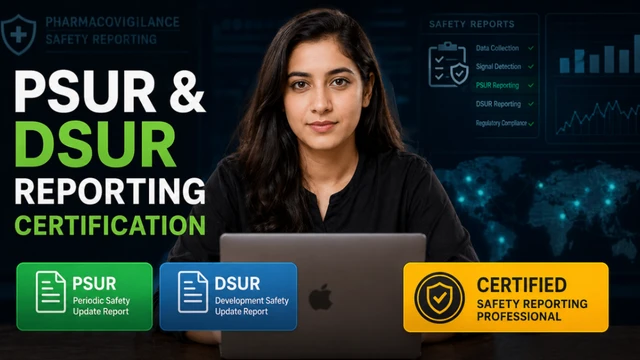
PSUR and DSUR Reporting Certification walks you through the full periodic report lifecycle: data lock point, line listings, cumulative tables, benefit-risk narrative, QC, and submission readiness. You finish with an authored report package, not just notes.
Pharmacovigilance Signal Detection with AI covers disproportionality methods, SMQ construction, signal triage inside AI-assisted workflows, and how to write an evaluation that survives medical review.
Both are built around industry-grade simulation toolkits: Argus Safety ICSR case processing, Medidata Rave EDC, Veeva Vault eTMF, and FDA 21 CFR submission workflows. The return is straightforward. You close a qualification gap that a degree cannot close, and you arrive at interviews with verifiable proof instead of a promise.
What should you do next to be hired in the next hiring cycle?
Audit your readiness honestly. List the five skills in your target job description that you cannot yet demonstrate. Then build evidence for each one, in order of pay impact.
Start with aggregate reporting, because it is the highest-paid and least crowded skill. Then layer signal detection on top of it.
Explore the Professional Certification Blueprints, review the simulation curriculum, and map your first portfolio artifact to a live job posting this week.
Build These Skills Now
Programs from ZANE ProEd Academy that directly address the skill gaps discussed above.
Follow Zane ProEd on Google
Preferred SourceAdd our publication as a preferred source to get the latest clinical research guides, industry updates, and career intel directly in your Google Top Stories & AI Overviews.