Hospital Quality Assurance Jobs India: Complete Guide for Freshers 2026

Hospital QA/QC Executive Hospital quality assurance jobs India involve ensuring patient safety, meeting NABH standards, and improving healthcare quality. Freshers from BDS, BHMS, BAMS, Nursing can enter by learning documentation, incident reporting, and audit skills. No prior experience is needed if you build these core competencies in 2026.
You studied BDS, BHMS, BAMS, or Nursing. You worked hard. But when you search for hospital quality assurance jobs India, you feel stuck. Your degree proves you know medicine. It does not prove you know quality systems. Hospitals in 2026 are hiring for quality, not just clinical knowledge.
\nThis guide is for you. It breaks down what hospital quality assurance really means, how to start, what salary to expect, and exactly which skills you need to get hired as a fresher.
Build These Skills Now
Programs from ZANE ProEd Academy that directly address the skill gaps discussed above.
What is NABH accreditation and why does it matter?
\nNABH stands for National Accreditation Board for Hospitals & Healthcare Providers. It is a board under the Quality Council of India that certifies hospitals for meeting high-quality and patient-safety standards. Think of it like an ISO certificate, but specifically for healthcare.
\nWhy does it matter for your career? Because hospitals that are NABH accredited or preparing for accreditation need Quality Officers to maintain documentation, conduct audits, and train staff. This creates a steady demand for NABH accreditation career roles, even for freshers.
\nAccording to the World Health Organization, patient safety is a global priority. NABH standards align with international patient safety goals. So if you learn these standards, you become valuable to any hospital.
\n\nHow to become a Quality Officer in a hospital?
\nYou do not need a separate medical degree. Your BDS, BHMS, BAMS, or Nursing background is enough. But you do need specific quality management knowledge. Here is a simple 5-step path:
\n- \n
- Understand healthcare quality management basics like PDCA cycle, root cause analysis, and quality indicators. \n
- Learn NABH standards chapters especially those on patient rights, infection control, and medication safety. \n
- Gain practical skills in documentation, audit checklists, and incident reporting. You can learn these through simulation-based courses (more on that later). \n
- Build a portfolio of mock quality audits or case studies you can show in interviews. \n
- Apply for entry-level roles like Quality Executive, Quality Coordinator, or Assistant Quality Officer in hospitals or healthcare chains. \n
Read our detailed guide on hospital quality assurance jobs in India for more step-by-step advice.
\n\nWhat is the salary of a hospital QA executive in India?
\nSalary depends on city, hospital size, and your skills. Here is a realistic breakdown for 2026:
\n- \n
- Fresher (0–1 year): ₹2.5 to ₹4 lakh per year. In metro cities, it may go up to ₹5 lakh. \n
- 2–4 years experience: ₹4 to ₹7 lakh per year. \n
- Senior Quality Manager: ₹8 to ₹15 lakh per year. \n
Hospitals that are actively pursuing NABH accreditation often pay more because they need skilled people quickly. So getting certified in hospital quality management can boost your starting hospital QA executive salary.
\n\nWhat are the key NABH standards a fresher should know?
\nNABH has 10 chapters and over 600 objective elements. As a fresher, focus on these high-impact areas:
\n- \n
- Access, Assessment, and Continuity of Care (AAC): How patients are admitted, assessed, and handed over. \n
- Care of Patients (COP): Treatment protocols, medication safety, and nursing care. \n
- Infection Control (IC): Hand hygiene, sterilization, and hospital-acquired infection prevention. \n
- Continuous Quality Improvement (CQI): How the hospital measures and improves quality indicators. \n
- Management of Medication (MOM): Safe storage, prescription, and administration of drugs. \n
Learning these NABH standards for freshers gives you a clear advantage. You can start by downloading the NABH 5th edition standards from the official Quality Council of India website or use trusted resources like CDSCO for drug-related regulations.
\n\nWhat skills are needed for hospital quality assurance?
\nEmployers look for a mix of technical and soft skills. Here is what you must develop:
\n- \n
- Documentation skills: Writing SOPs, policies, and audit reports. \n
- Audit skills: Using checklists, observing processes, and noting non-conformances. \n
- Incident reporting: Knowing how to file and analyze incident reports without blame. \n
- Root cause analysis: Tools like fishbone diagram, 5 Whys, and Pareto chart. \n
- Communication: Training hospital staff, presenting quality data, and talking to patients. \n
- IT skills: Excel for data tracking, and basic knowledge of hospital information systems. \n
If you are from a pharmacy background, see how these skills overlap with QA/QC pharma jobs for freshers.
\n\nWhat Colleges Teach vs What Employers Expect
\nYour college taught you anatomy, pharmacology, and clinical procedures. But did it teach you how to write a non-conformance report? Or how to do a gap analysis against NABH standards? Probably not.
\nHere is the skill gap in simple terms:
\n- \n
- College teaches: Disease treatment, drug interactions, patient care basics. \n
- Employers expect: Quality documentation, audit skills, NABH chapter knowledge, incident reporting, quality improvement tools. \n
That gap is why many freshers struggle to get hospital quality assurance jobs India. But you can bridge it in weeks with the right training.
\n\nYour 5-Step Path to Hospital QA Job in 2026
\nFollow this structured roadmap:
\n- \n
- Step 1: Learn the language of quality. Understand terms like QIP, QMS, NABH, quality indicators, and patient safety goals. \n
- Step 2: Get hands-on with mock documents. Practice writing SOPs and audit reports using sample scenarios. \n
- Step 3: Master incident reporting and root cause analysis. Use realistic case studies to build confidence. \n
- Step 4: Build a mini-portfolio. Create a folder with sample quality checklists, a mock audit report, and a one-page summary of your NABH knowledge. \n
- Step 5: Start applying and networking. Target hospitals that are NABH accredited or in the process. Use LinkedIn to connect with quality managers. \n
Simulation-Based Learning: The Fastest Way to Bridge the Gap
\nReading about quality assurance is not enough. Hospitals want people who can do the job on day one. That is where simulation-based learning comes in.
\nInstead of just watching videos, you work through real hospital scenarios. You review a mock patient file, identify quality gaps, fill an incident report, and suggest corrective actions. You learn by doing, exactly like you would in a hospital quality department.
\nBuild These Skills Now
Programs from ZANE ProEd Academy that directly address the skill gaps discussed above.
ZANE ProEd: Your Quality Career System
\nZANE ProEd offers two focused programs that work together as a system:
\n- \n
- Hospital Quality Management Certification: Covers NABH standards, documentation, and continuous quality improvement. Perfect for building your foundation. \n
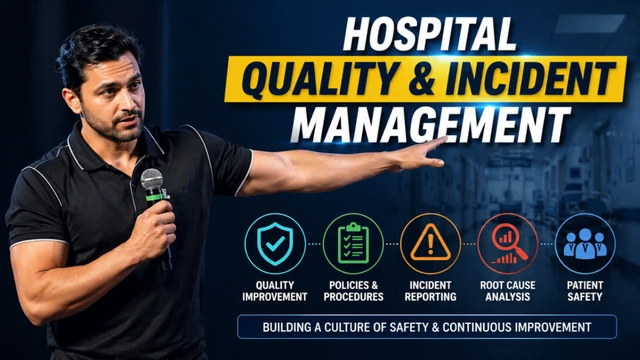
- Hospital Quality Incident Management: Teaches you how to handle adverse events, conduct root cause analysis, and implement corrective and preventive actions (CAPA). \n
These are not just courses. They are designed as a step-by-step system to take you from confused fresher to job-ready quality officer. You learn through simulations, real case studies, and practical assignments that mimic hospital work.
\n\nCheck Your Job Readiness
\nBefore you start applying, ask yourself: Can I explain the key NABH chapters? Can I write an incident report? Can I do a basic quality audit? If not, start with a skill assessment.
\nTake a moment to review our resources and see how your current skills compare. Your first quality assurance job in a hospital is closer than you think.
\n\nCheck your job readiness now. See how your skills compare. Your career in healthcare quality starts today.
Build These Skills Now
Programs from ZANE ProEd Academy that directly address the skill gaps discussed above.
Follow Zane ProEd on Google
Preferred SourceAdd our publication as a preferred source to get the latest clinical research guides, industry updates, and career intel directly in your Google Top Stories & AI Overviews.