Hospital Quality Assurance Jobs India: Recruiter's Roadmap for Chemistry Graduates

Hospital Quality Assurance Jobs India demand chemistry graduates who understand NABH standards, audit protocols, and healthcare quality management. Freshers with only academic knowledge often fail because they lack practical exposure to incident reporting, root cause analysis, and regulatory documentation. Recruiters seek candidates with verifiable simulation experience, not just degrees.
If you hold a BSc or MSc in Chemistry and feel overqualified but under-skilled for hospital quality assurance jobs India, you are not alone. Recruiters across Indian hospitals see dozens of applications from chemical sciences graduates who know laboratory techniques but cannot map a single NABH chapter to daily quality workflows.
That gap between your academic chemistry training and the real demands of healthcare quality management is exactly why you keep getting rejected. This mistake audit reveals what hiring managers actually screen for when they shortlist QA executives in Hyderabad, Bangalore, Pune, and Mumbai.
Build These Skills Now
Programs from ZANE ProEd Academy that directly address the skill gaps discussed above.
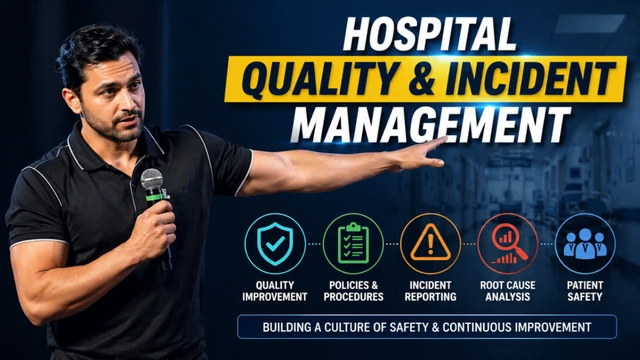
What is NABH accreditation and why does it matter for hospital quality assurance jobs India?
NABH (National Accreditation Board for Hospitals & Healthcare Providers) is India's premier quality certification for hospitals. It is based on international patient safety standards and is mandatory for many government empanelments and insurance tie-ups.
For a fresher targeting a NABH accreditation career, understanding this framework is non-negotiable. Hospitals do not hire QA executives who cannot speak the language of quality indicators, patient safety goals, and continuous quality improvement.
- NABH accreditation signals that a hospital meets 600+ objective elements across 10 chapters.
- It covers patient rights, infection control, medication management, and facility safety.
- Without NABH, a hospital cannot get empaneled with CGHS, ECHS, and many private insurers.
The World Health Organization endorses accreditation as a key driver of patient safety.
How to become a Quality Officer in a hospital?
The quality officer hospital job description goes far beyond checking documents. You will coordinate NABH pre-assessment, conduct internal audits, manage incident reports, and drive corrective actions. To become one, you need a structured plan:
- Learn NABH standards inside out – Start with the 5th edition NABH standards for hospitals.
- Master quality tools – Root cause analysis, FMEA, PDCA cycle, and statistical process control.
- Get practical exposure – Real audits, mock drills, and incident classification exercises.
- Build a portfolio – Show evidence of quality improvement projects or simulated audit reports.
- Network in healthcare hubs – Connect with QA heads in Hyderabad, Bangalore, Pune, and Mumbai.
Do not rely on a generic 'hospital management' certificate. Recruiters want proof you can handle a Mortality and Morbidity review or a Medication Error RCA on day one.
For a broader pharma QA roadmap, check QA/QC Pharma Jobs for Freshers: Roadmap.
What is the salary of a hospital QA executive in India?
The hospital QA executive salary in India ranges from ₹2.8 LPA to ₹6.5 LPA for freshers and junior roles. With 3-5 years of NABH coordination experience, it can reach ₹8.5 LPA or higher in metro cities.
Salary benchmarks by city:
- Hyderabad: ₹3.0 – ₹5.5 LPA
- Bangalore: ₹3.2 – ₹6.0 LPA
- Pune: ₹2.8 – ₹5.2 LPA
- Mumbai: ₹3.5 – ₹6.5 LPA
These numbers increase quickly if you can demonstrate audit readiness and have led a department through a mock NABH assessment. Recruiters pay a premium for candidates who can reduce their training time.
What are the key NABH standards a fresher should know?
NABH standards for freshers can feel overwhelming, but focus on these high-weightage chapters first:
- Access, Assessment and Continuity of Care (AAC): Patient entry, triage, and discharge planning.
- Care of Patients (COP): Uniform care processes, high-risk patient management.
- Medication Management (MOM): Prescription, dispensing, and error reporting.
- Infection Control (IC): Hospital infection control program, HAI surveillance.
- Continuous Quality Improvement (CQI): Quality indicators, audits, and corrective actions.
Hospitals also expect awareness of International Patient Safety Goals (IPSG) like correct patient identification, safe surgery, and reducing medication errors. Link these to daily QA tasks.
What skills are needed for hospital quality assurance?
Hospital quality assurance demands a hybrid skill set: analytical thinking, documentation discipline, and communication courage. Key skills recruiters test:
- Root Cause Analysis (RCA) – Can you lead a fishbone diagram session?
- Audit Methodology – Know how to plan, conduct, and report an internal audit.
- Data Interpretation – Convert quality indicators into actionable dashboards.
- Regulatory Awareness – Understand CDSCO, NABH, and state clinical establishment acts.
- Stakeholder Management – Convince doctors and nurses to follow protocols without authority.
If your chemistry background taught you precise documentation but not soft skills, you must bridge that gap deliberately.
Skill Gap Exposure: What College Teaches vs What Recruiters Demand
Your BSc/MSc Chemistry curriculum focused on reaction mechanisms, spectroscopy, and lab synthesis. None of that appears in a hospital QA executive job description. Here is the reality check:
- Conventional education: Titration, chromatography, molecular structure. Employer expectation: NABH pre-assessment checklists, incident severity grading, CAPA tracking.
- Conventional education: Semester exams and lab reports. Employer expectation: Simulated internal audit reports and mock quality committee presentations.
- Conventional education: Solo bench work. Employer expectation: Cross-functional collaboration with nursing, pharmacy, and administration.
This is why you feel overqualified yet under-skilled. The market does not need another chemist; it needs a quality systems thinker who can navigate healthcare workflows.
A Practical Step-by-Step Pathway to Hospital QA Jobs in India
Follow this recruiter-verified sequence to become job-ready within 90 days:
- Complete a simulation-based healthcare quality certification – Not a theory course, but one where you actually build audit checklists and classify incidents.
- Master NABH 5th edition chapters – Create your own summary notes and map each standard to a hospital department.
- Practice incident management – Use real anonymized case studies to perform root cause analysis and write CAPA plans.
- Build a digital portfolio – Include sample audit reports, quality indicator dashboards, and a mock NABH gap analysis.
- Apply strategically – Target hospitals undergoing NABH renewal or those advertising 'quality coordinator' roles in Hyderabad and Bangalore.
- Prepare for interview audits – Recruiters often give a mini case: 'A patient fell in the corridor, what do you do?' Be ready with a structured response.
The Missing Link: Simulation and Verifiable Portfolio Proof
Recruiters do not trust certificates that only prove you watched videos. They trust evidence that you have done the work in a simulated environment. That means drafting an internal audit report, classifying a medication error, or presenting a quality improvement plan.
ZANE ProEd's training system is built around ICH-GCP aligned, audit-ready simulation workflows that mirror real hospital quality departments. You will generate portfolio artifacts that directly answer the recruiter's question: 'Can this candidate handle a NABH mock audit?'
Build These Skills Now
Programs from ZANE ProEd Academy that directly address the skill gaps discussed above.
Why a Generic Certificate Fails and a Simulation System Works
The hospital-quality-management-certification program is designed for chemical science graduates making the pivot. It covers NABH standards, quality indicator monitoring, and internal audit methodology through case-based simulations.
The hospital-quality-incident-management program goes deeper into root cause analysis, CAPA design, and incident reporting systems. Both programs emphasize international compliance frameworks and practical trial simulation, so you emerge with a verifiable skill record.
For additional free resources, explore Best Free Online Certifications for Healthcare & Life Sciences.
Remember that hospital QA also intersects with CDSCO for medical devices and drugs, and global quality norms from ICH.
Your next move: Audit your industry readiness. Download the NABH 5th edition standards index, then map your current skills against the quality officer hospital job description. Identify three gaps, and start building portfolio evidence this week.
Explore simulation workflows that turn theoretical knowledge into recruiter-visible competence.
Build These Skills Now
Programs from ZANE ProEd Academy that directly address the skill gaps discussed above.
Follow Zane ProEd on Google
Preferred SourceAdd our publication as a preferred source to get the latest clinical research guides, industry updates, and career intel directly in your Google Top Stories & AI Overviews.