Pharmacovigilance Case Processing Jobs for Freshers: Salary, ICSR Workflow & 6-Month Roadmap
Pharmacovigilance Case Processor jobs involve reviewing, coding, and submitting adverse event reports (ICSRs) into safety databases such as Argus Safety. For freshers in India, pharmacovigilance case processing jobs freshers pay around ₹2.8–₹4.5 LPA at entry, require MedDRA coding knowledge, and are hired mainly by CROs in Hyderabad, Bangalore, Pune, and Mumbai.
If you are a BDS, BHMS, BAMS, or Nursing graduate wondering where your clinical knowledge fits outside a clinic, there is a quiet, high-growth answer. Pharmacovigilance case processing jobs freshers roles are open right now — and CROs struggle to fill them every quarter.
You already understand adverse events, drug reactions, and patient terminology. The industry needs exactly that, plus database and coding skills.
Build These Skills Now
Programs from ZANE ProEd Academy that directly address the skill gaps discussed above.

Every marketed medicine in India and abroad must be tracked for safety after approval. That tracking produces thousands of ICSRs every month. Someone has to read them, code them, and submit them on deadline. That someone is a Pharmacovigilance Case Processor.
This guide breaks down the real CRO workflow, the salary bands, and a 6-month plan to your first offer.
Pharmacovigilance Case Processing Jobs for Freshers: What Does a PV Case Processor Actually Do?
The pharmacovigilance case processor job description is narrower than people expect — and that is good news for freshers. You own the case from intake to database entry, not the medical judgement.
Your daily work usually includes:
- Case intake and triage — reading emails, call logs, and literature alerts to spot valid adverse events.
- Data entry into a safety database (Argus Safety, ArisGlobal LifeSphere, or Veeva Vault Safety).
- MedDRA coding of adverse events and WHO Drug coding of suspect medicines.
- Narrative writing — a clear, factual summary of what happened.
- Quality checks and follow-ups — chasing missing details from the reporter.
- Handover to medical review within strict timelines, often 24 hours for serious cases.
You do not need to prescribe or diagnose. You need accuracy, speed, and a habit of following SOPs.
What is the salary of a PV Case Processor in India?
PV case processor salary India ranges depend on city, CRO size, and how quickly you clear probation. Realistic bands for 2025:
- Fresher (0–1 year): ₹2.8 LPA – ₹4.5 LPA
- 1–3 years: ₹4.5 LPA – ₹7.0 LPA
- 3–5 years or QC/Senior Processor: ₹7.0 LPA – ₹12.0 LPA
- Medical Reviewer or Team Lead: ₹12 LPA+ (usually needs MBBS, BDS, or BAMS plus experience)
Hyderabad and Bangalore host the largest CRO hubs. Pune and Mumbai lean toward sponsor-side and generics safety teams. Shift allowances can add 10–20% to your CTC.
Notice something important: your BDS, BHMS, BAMS, or Nursing background is a genuine advantage. CROs value clinical understanding when reviewing medical history and causality.
How to get a PV case processing job as a fresher?
Most freshers fail at the same point — they apply with only theory and no proof of workflow ability. Fix that first, then apply.
- Learn the domain vocabulary: ICSR, adverse event, serious adverse event, causality, expectedness, E2B R3, GVP.
- Get hands-on with a safety database: even simulated Argus Safety case entry changes how interviewers see you.
- Practise MedDRA coding: code 30–50 sample events across the hierarchy.
- Write 10 full case narratives from simulated source documents.
- Build a portfolio PDF of coded cases, narratives, and QC checklists.
- Target the right companies: IQVIA, ICON, Syneos, Parexel, Accenture, Cognizant, TCS, Lambda, and mid-size CROs in Hyderabad and Bangalore.
- Apply on LinkedIn, Naukri, and career pages with a short resume summary that names your tools.
For a wider view of the market, read the pharmacovigilance jobs for freshers in India career roadmap.
What is ICSR processing in pharmacovigilance?
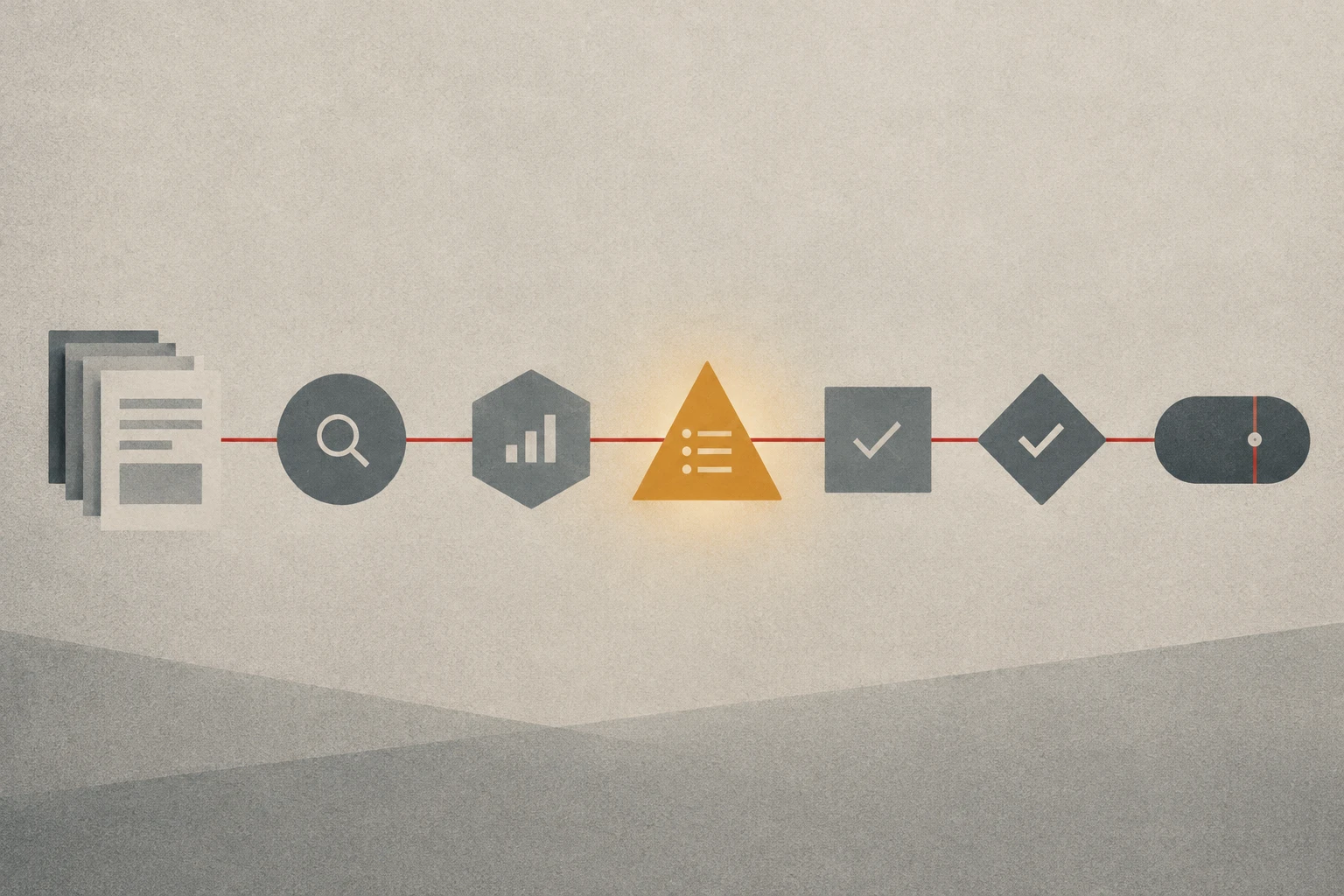
ICSR stands for Individual Case Safety Report — one patient, one adverse event, and one or more suspect drugs. ICSR processing is the end-to-end cycle that turns a reported event into a compliant submission.
The standard workflow:
- Intake and triage: confirm a valid case (identifiable patient, reporter, drug, and event).
- Book-in: create the case in the safety database and start the regulatory clock.
- Data entry: demographics, drug history, event details, lab values, seriousness criteria.
- Coding: MedDRA for events, WHO Drug for medicines.
- Narrative writing: chronological and factual, with no opinions.
- QC: a second reviewer checks accuracy and completeness.
- Medical review and submission: sent to CDSCO and global regulators within E2B-compliant timelines.
Timelines matter. Serious unexpected cases often need submission within 15 days, and fatal cases within 7 days in some jurisdictions. An ICSR processing career teaches you to work fast without slipping on accuracy.
Read the official guidance at cdsco.gov.in and the technical standard at ich.org.
What is MedDRA coding and how is it used in PV?
MedDRA (Medical Dictionary for Regulatory Activities) is a standardised medical vocabulary used worldwide to describe adverse events. Coding means translating a reporter's sentence — such as 'patient had a bad reaction and could not breathe' — into the exact term: Dyspnoea.
Why it matters:
- Consistency: every company reports the same concept the same way.
- Signal detection: regulators can spot spikes in specific events across thousands of cases.
- Compliance: submissions must follow ICH and WHO-UMC standards (see who.int).
For MedDRA coding for freshers, the practical path is to learn the five-level hierarchy, understand Lowest Level Terms (LLTs) versus Preferred Terms (PTs), and code real sample cases repeatedly. Interviews often include a short coding exercise.
What do employers expect that your degree does not teach?
Conventional education gives you strong clinical fundamentals — anatomy, pathology, patient communication. Employers in India expect something different.
What your course covered:
- Disease processes and treatment protocols
- Clinical judgement and patient interaction
- Theoretical drug safety concepts
What a CRO expects on day one:
- Navigating Argus Safety or a similar database
- MedDRA and WHO Drug coding accuracy above 95%
- Writing a compliant narrative without extra coaching
- Understanding E2B R3 fields and submission timelines
- Working to GVP, FDA 21 CFR Part 11, and audit-ready documentation standards
This gap is the real reason allied health graduates get rejected — not their degree. Candidates who show tool familiarity and a portfolio get shortlisted within weeks.
What is the step-by-step roadmap to your first PV job in 6 months?
- Month 1 — Fundamentals: learn PV terminology, GVP modules, ICH E2B, and the full case lifecycle.
- Month 2 — Database skills: practise case entry in a simulated Argus Safety environment and learn every mandatory field.
- Month 3 — Coding: complete 50+ MedDRA coding exercises and 20 WHO Drug examples.
- Month 4 — Output practice: write full narratives, run self-QC, and assemble your portfolio.
- Month 5 — Interview prep: rehearse the top 25 PV interview questions, including seriousness criteria and causality.
- Month 6 — Apply strategically: 15 targeted applications per week with a tool-specific resume.
Switching from a non-clinical background? Use this playbook: pharmacovigilance jobs for freshers — non-healthcare switcher playbook.
Why does simulation-based training beat theory for adverse event reporting jobs?
Because recruiters cannot verify theory. A certificate that says you 'studied pharmacovigilance' is weak. A portfolio that shows you processed a case end-to-end is proof.
Simulation-based learning puts you inside the workflow: source documents, triage decisions, database fields, coding, QC flags, and submission logic. You make mistakes safely, before a real patient's case is on your screen.
Verifiable proof changes the interview. Instead of 'I am a quick learner', you say, 'Here is my completed ICSR with MedDRA coding, narrative, and QC checklist.'
Build These Skills Now
Programs from ZANE ProEd Academy that directly address the skill gaps discussed above.
Which ZANE ProEd programs prepare you for PV case processing roles?
ZANE ProEd Academy is built as a professional career-certification platform, not a lecture library. The programs follow the exact workflows CROs use daily.
- Industry Essentials of Pharmacovigilance — builds your regulatory base: GVP, CDSCO, ICH E2B, seriousness criteria, causality, and signal detection basics.
- ICSR Case Processing and Triage — a hands-on track covering intake, triage, Argus Safety case entry, MedDRA coding, narrative writing, and QC.
You also work with industry-grade simulation toolkits — Argus Safety ICSR case processing, Medidata Rave EDC, Veeva Vault eTMF, and FDA 21 CFR submission logic — so your resume reflects tools, not just topics.
The ROI is simple. Structured certification closes the qualification gap, creates an audit-ready portfolio, and positions you for ₹3.5–₹5 LPA entry roles instead of waiting months for a callback.
How do you audit your PV industry readiness?
Answer these honestly:
- Can you name the four elements of a valid ICSR?
- Can you code 10 adverse events in MedDRA without help?
- Have you ever entered a case into a safety database?
- Do you know the reporting timelines for serious versus non-serious cases?
Three or more 'no' answers means you need structured preparation before applying.
Next step: review the simulation curriculum, explore the professional certification blueprints, and map your 6-month plan with a mentor. Build proof — not just knowledge.
Build These Skills Now
Programs from ZANE ProEd Academy that directly address the skill gaps discussed above.
Follow Zane ProEd on Google
Preferred SourceAdd our publication as a preferred source to get the latest clinical research guides, industry updates, and career intel directly in your Google Top Stories & AI Overviews.