Pharmacovigilance Case Processing Jobs for Freshers: Step-by-Step Roadmap

Pharmacovigilance Case Processor Pharmacovigilance case processing jobs for freshers involve reviewing and entering reports of adverse drug reactions into safety databases. You need basic knowledge of ICSR processing, MedDRA coding, and regulatory guidelines. Freshers from non-healthcare backgrounds can enter this field with targeted training and practical skills.
You are stuck in IT or BPO, working odd shifts and feeling there is no growth. You want a stable healthcare career, but you do not have a pharmacy degree. Good news: pharmacovigilance case processing jobs freshers from all backgrounds are possible. Yes, even if you have BSc, BCA, or BTech.
There is a way out. Pharmacovigilance (PV) is growing fast in India. Companies need case processors to handle adverse event reports. The work is desk-based, pays well, and has clear career paths.
Build These Skills Now
Programs from ZANE ProEd Academy that directly address the skill gaps discussed above.
This guide gives you a step-by-step roadmap to switch into PV case processing in the next 6 months. Let's start.
What does a Pharmacovigilance Case Processor do?
A PV Case Processor reviews and enters reports of side effects (adverse events) from drugs. They make sure each report is complete, accurate, and submitted to regulators on time.
Pharmacovigilance case processor job description includes:
- Receiving Individual Case Safety Reports (ICSRs) from various sources.
- Triaging cases based on seriousness and priority.
- Entering data into safety databases like Argus or ArisG.
- Coding medical terms using MedDRA.
- Performing quality checks and follow-ups.
This role is central to adverse event reporting jobs in the pharma industry. You work behind a desk, not in a lab.
What is the salary of a PV Case Processor in India?
The PV case processor salary India varies by experience, location, and company. Here are typical ranges:
- Freshers (0-2 years): ₹2.5 to ₹4.5 LPA
- Mid-level (3-5 years): ₹5 to ₹8 LPA
- Senior (5+ years): ₹9 to ₹14 LPA or more
Metro cities like Hyderabad, Bengaluru, and Pune offer higher pay. CROs and global pharma companies often pay more than local firms. Skills in MedDRA coding and safety databases can boost your starting salary.
How to get a PV case processing job as a fresher?
You do not need a pharmacy degree for many entry-level PV roles. But you must prove you understand the workflow.
Follow this high-level path:
- Learn pharmacovigilance basics (ICH guidelines, types of adverse events).
- Get trained on ICSR processing and MedDRA coding.
- Practice with real-world case simulations.
- Earn a certification or demonstrate practical skills.
- Apply to CROs, pharma companies, and IT vendors that offer PV services.
For more details, read our guide on pharmacovigilance jobs for freshers in India.
What is ICSR processing in pharmacovigilance?
ICSR stands for Individual Case Safety Report. ICSR processing career involves handling each report of an adverse event from start to finish.
Typical steps in ICSR processing:
- Case receipt from healthcare professionals, patients, or literature.
- Triage to determine seriousness and expectedness.
- Data entry into the safety database.
- Medical coding using MedDRA.
- Quality review and medical assessment.
- Submission to regulatory authorities within deadlines.
ICSR processing is the backbone of pharmacovigilance. Employers look for candidates who understand these steps and can follow ICH guidelines.
What is MedDRA coding and how is it used in PV?
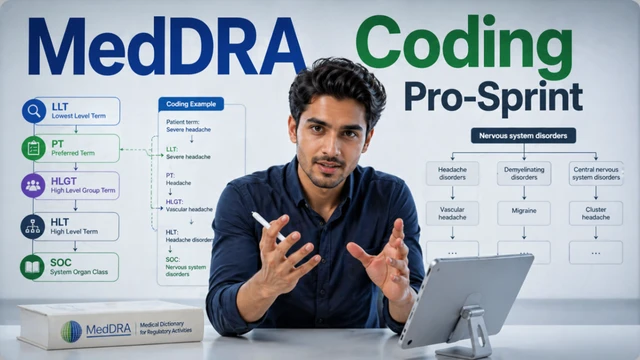
MedDRA (Medical Dictionary for Regulatory Activities) is a standardized set of medical terms. MedDRA coding for freshers is a key skill in PV case processing.
You use MedDRA to code adverse events, medical history, and indications into a common language. This helps regulators and companies analyze safety data globally.
Example: A patient reports 'heart attack'. You would code this as 'Myocardial infarction' using MedDRA. You must learn how to search and select the correct term. Accuracy is critical. For a deeper look at medical coding careers, see medical coding jobs for freshers.
Colleges and universities rarely teach pharmacovigilance to non-pharmacy students. If you have BSc, BCA, or BTech, you probably did not study drug safety at all.
Employers expect you to know:
- ICH E2E pharmacovigilance guidelines
- Basics of adverse event reporting
- ICSR workflow and data entry
- MedDRA coding accuracy
- Safety database navigation
Without practical training, you will struggle in interviews. Reading theory is not enough. You need hands-on practice with real cases.
Here is your 6-month step-by-step roadmap to land a PV case processing job.
- Month 1: Learn PV fundamentals. Understand what pharmacovigilance is, why it matters, and the regulatory framework. Study ICH E2E and WHO guidelines.
- Month 2: Master ICSR processing. Learn the end-to-end flow: receipt, triage, data entry, and submission. Practice with sample cases.
- Month 3: Get skilled in MedDRA coding. Take a structured MedDRA course. Practice coding exercises daily. Accuracy is key.
- Month 4: Use simulation-based training. Work on a platform that mimics real safety databases. Process mock ICSRs from start to finish.
- Month 5: Build your resume and apply. Highlight your practical skills. Use keywords like 'ICSR processing', 'MedDRA coding', 'adverse event reporting'. Apply to CROs and pharma companies.
- Month 6: Interview prep and networking. Prepare for case study questions. Connect with PV professionals on LinkedIn. Attend webinars.
Reading articles and watching videos will not make you job-ready. Employers want proof you can do the work from day one. That is why simulation-based learning is the fastest path.
Instead of just theory, you practice on real-world PV scenarios. You receive a mock ICSR, triage it, code it in MedDRA, and enter it into a simulated safety database. This builds confidence and practical skills.
Build These Skills Now
Programs from ZANE ProEd Academy that directly address the skill gaps discussed above.
ZANE ProEd offers a simulation-based learning system designed for career switchers. You do not just watch lectures; you work on real case processing tasks.
The icsr-case-processing-triage module teaches you how to receive, evaluate, and prioritize ICSRs. You learn the exact workflow used by pharma companies. The meddra-medical-coding-certification module trains you to code adverse events accurately using MedDRA. You get practice cases and feedback.
These modules are built to bridge the gap between your current background and employer expectations. They focus on practical skills, not just knowledge.
Not sure if you are ready? Check your job readiness for PV case processing. Compare your current skills against what employers look for. See where you stand before you start applying.
Build These Skills Now
Programs from ZANE ProEd Academy that directly address the skill gaps discussed above.
Follow Zane ProEd on Google
Preferred SourceAdd our publication as a preferred source to get the latest clinical research guides, industry updates, and career intel directly in your Google Top Stories & AI Overviews.