Pharmacovigilance Case Processing Jobs for Freshers: Complete Career Guide

Pharmacovigilance Case Processor They review and manage reports of side effects from drugs. Freshers can enter this field by learning MedDRA coding and ICSR processing. Entry-level jobs exist in CROs and IT/BPO companies. Starting salary: ₹2.5-4 LPA.
You have a degree, but not the skills. Many BSc, BCA, BTech graduates and IT/BPO switchers apply for pharmacovigilance case processing jobs freshers roles every day. But 90% fail to get hired. Why? Because employers want practical knowledge, not just theory.
This guide is for you. We will show you exactly what a PV case processor does, the salary you can expect, and the step-by-step path to land your first job in 3–6 months. No fluff. Just honest advice.
Build These Skills Now
Programs from ZANE ProEd Academy that directly address the skill gaps discussed above.
What does a Pharmacovigilance Case Processor do?
A pharmacovigilance case processor reviews adverse event reports from patients, doctors, or drug companies. They check each report for completeness and accuracy. Then, they enter the data into a safety database and assign medical codes using MedDRA. The processor ensures that reports are submitted to regulators like the FDA or CDSCO within strict timelines. This role is the backbone of drug safety.
The pharmacovigilance case processor job description includes:
- Receiving and triaging individual case safety reports (ICSRs)
- Entering data into software like Oracle Argus or ArisGlobal
- Coding adverse events using MedDRA
- Writing case narratives
- Performing quality checks
- Following standard operating procedures (SOPs)
What is the salary of a PV Case Processor in India?
The PV case processor salary India varies by company and location. Freshers can earn between ₹2.5 lakhs and ₹4 lakhs per year. In IT/BPO companies, starting pay is often ₹2.8-3.5 LPA. After 2–3 years, with experience in ICSR processing, salaries rise to ₹4.5-6 LPA. Senior case processors or team leads can make over ₹8 LPA. ICH guidelines knowledge adds value.
How to get a PV case processing job as a fresher?
Getting your first adverse event reporting jobs requires a clear plan. Recruiters look for hands-on skills, not just a degree. Follow these steps:
- Learn drug safety basics: Understand the drug development lifecycle and why pharmacovigilance matters. Read guidelines from WHO and EMA.
- Get trained in ICSR processing: Take a practical course that teaches you to handle real cases. Check our guide on pharmacovigilance jobs for freshers.
- Practice MedDRA coding: MedDRA is the standard medical dictionary. Learn to code symptoms and diagnoses accurately. Mistakes can delay reports.
- Use simulation tools: Work on dummy cases as if in a real job. This builds confidence and a portfolio.
- Target the right employers: Apply to CROs (IQVIA, Parexel), IT companies (TCS, Accenture), and BPOs that handle PV processes.
What is ICSR processing in pharmacovigilance?
An ICSR processing career focuses on Individual Case Safety Reports. Every time a patient has a side effect, it becomes an ICSR. Processing involves several steps:
- Triage: Classifying the report as serious or non-serious.
- Data entry: Recording patient details, drug names, and reactions.
- Coding: Mapping medical terms to MedDRA codes.
- Medical review: A safety scientist or doctor reviews the case.
- Submission: Sending the report to regulatory authorities.
ICSR processing is a team effort and a great entry point into the PV world. Employers value speed and accuracy. Simulation practice helps you master it. For more on medical coding roles, see our medical coding jobs for freshers guide.
What is MedDRA coding and how is it used in PV?
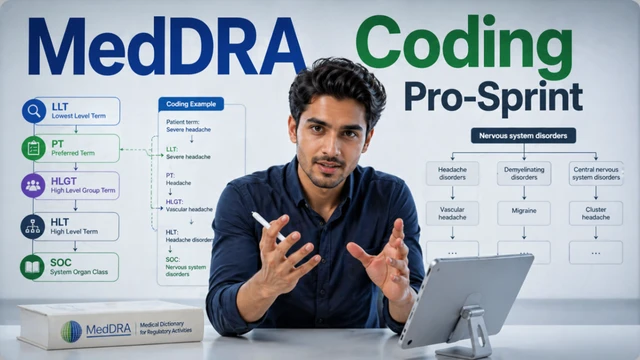
MedDRA coding for freshers can seem tough, but it's a learnable skill. MedDRA (Medical Dictionary for Regulatory Activities) is a huge list of medical terms organized in a hierarchy. When a case processor sees a side effect like 'severe headache,' they find the exact MedDRA code. This makes all safety reports uniform and searchable. You don't need to memorize all terms; you need to know how to search and select the right code. Practice with real scenarios is key. Employers test coding accuracy during interviews.
The Skill Gap: What Colleges Miss
Your degree gave you theory. But a PV job needs practical skills. Colleges rarely teach:
- How to use safety databases (Argus, ArisG)
- ICSR triage decision-making
- MedDRA hierarchy navigation
- Regulatory submission rules
- Narrative writing for cases
Employers expect you to handle a case from start to finish on day one. That's the gap. And that's why 90% of freshers get rejected. You need a bridge.
Your 6-Step Roadmap to a PV Case Processor Job
- Build a foundation: Study ICH E2B guidelines. Know the CIOMS form. Understand what makes a valid case.
- Enroll in a simulation-based program: Look for courses that give you hands-on practice, not just videos.
- Practice ICSR triage: Work through 50+ dummy cases. Learn to identify reportable events and timelines.
- Master MedDRA coding: Complete a certification that tests your ability to code adverse events and medical history.
- Create a portfolio: Document the cases you've processed. Show accuracy and speed metrics.
- Apply with confidence: Tailor your resume with keywords like 'ICSR processing,' 'MedDRA coding,' and 'narrative writing.' Apply to companies that hire freshers (our recruiter guide lists them).
The System Bridge: Simulation Over Theory
Books and lectures can't replicate a fast-paced PV environment. You need to make mistakes safely and learn from them. Simulation-based learning fills the college-industry gap. It's like a flight simulator for case processors. You get assigned cases, write narratives, code terms, and get feedback. That's the only way to become job-ready.
Build These Skills Now
Programs from ZANE ProEd Academy that directly address the skill gaps discussed above.
How ZANE ProEd Bridges the Gap
Our system combines two critical courses: ICSR Case Processing & Triage and MedDRA Medical Coding Certification. These are not just courses; they are job simulators. In the ICSR Triage module, you work on real-like cases from intake to submission. You learn to use tools just like in a CRO. The MedDRA Certification tests you on coding accuracy with hundreds of terms. By the end, you have a portfolio that proves you can do the job. That's what recruiters want to see.
Are You Job-Ready? Find Out Now.
Stop guessing. Take our free self-assessment to see if your skills match industry expectations. Know exactly where you stand before you apply. Click below to start.
Build These Skills Now
Programs from ZANE ProEd Academy that directly address the skill gaps discussed above.
Follow Zane ProEd on Google
Preferred SourceAdd our publication as a preferred source to get the latest clinical research guides, industry updates, and career intel directly in your Google Top Stories & AI Overviews.