Pharmacovigilance Case Processing Jobs for Freshers: Complete Career Guide

Pharmacovigilance Case Processor jobs for freshers involve receiving, assessing, and entering adverse event reports into safety databases. Freshers with BPharm/MPharm can get these roles by learning ICSR processing, MedDRA coding, and ICH guidelines. Starting salary in India is ₹2.5–4 LPA.
If you are a BPharm or MPharm graduate and have failed multiple placements, you are not alone. Many freshers miss out on pharmacovigilance case processing jobs freshers because they do not know the exact skills recruiters test. This blog breaks down the exact mistakes and gives you a clear path to get shortlisted consistently.
You studied hard. You cleared your exams. But campus interviews reject you again and again. The reason is simple: colleges teach theory, but pharmacovigilance jobs test practical skills. The gap is huge, but it is fixable.
Build These Skills Now
Programs from ZANE ProEd Academy that directly address the skill gaps discussed above.
What does a Pharmacovigilance Case Processor do?
A Pharmacovigilance Case Processor is the first person to handle a reported side effect. Your job is to turn raw information into a clean, coded safety report. This is the core of the pharmacovigilance case processor job description.
Daily tasks include:
- Receive adverse event reports from emails, calls, or literature.
- Check if the report is complete and valid (triage).
- Enter data into safety databases like Argus or ArisG.
- Code medical terms using MedDRA.
- Assess seriousness and causality.
- Submit reports to regulatory authorities within deadlines.
You do not need to be a doctor. You need to be accurate, detail-oriented, and trained in adverse event reporting jobs workflows.
What is the salary of a PV Case Processor in India?
The PV case processor salary India varies by city, company, and your skill level. For freshers, the range is clear:
- Fresher (0–1 year): ₹2.5–4 LPA
- After 1–2 years: ₹4–6 LPA
- Senior Case Processor (3–5 years): ₹6–9 LPA
Companies like Accenture, Cognizant, TCS, IQVIA, and Wipro hire freshers in bulk. Cities like Hyderabad, Pune, Bangalore, and Chennai offer the most openings. If you have a certification in ICSR processing, you can often ask for the higher end of the range.
How to get a PV case processing job as a fresher?
Recruiters reject freshers because of skill gaps, not because of bad luck. Here is a proven path to get shortlisted:
- Learn ICSR processing end-to-end. Know how to triage, enter data, and assess reports.
- Get hands-on with safety databases. Practice on Argus, ArisG, or Veeva Vault.
- Master MedDRA coding. Understand hierarchy and coding rules.
- Know ICH and GVP guidelines. Read ICH E2A, E2B, and GVP modules.
- Build a portfolio of sample ICSRs. Show recruiters you can do the job from day one.
For a detailed roadmap, check our guide on pharmacovigilance jobs for BPharm freshers.
What is ICSR processing in pharmacovigilance?
ICSR processing career starts with understanding the Individual Case Safety Report (ICSR). An ICSR is a formatted report of a single adverse event. Processing means turning that report into a clean, coded entry.
The ICSR workflow has five steps:
- Triage: Check if the report is valid and complete.
- Data entry: Enter patient details, drug details, and event details.
- Coding: Use MedDRA to code medical terms.
- Assessment: Check seriousness, causality, and expectedness.
- Submission: Send the report to regulators within the deadline.
Most freshers fail at step 1 because they do not know what makes a valid report. Employers test this directly in interviews.
What is MedDRA coding and how is it used in PV?
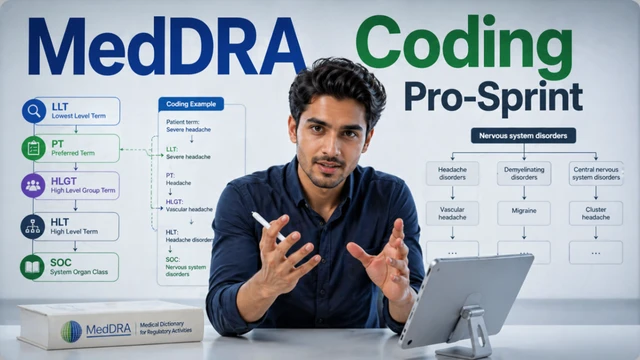
MedDRA (Medical Dictionary for Regulatory Activities) is the global standard for coding adverse events. MedDRA coding for freshers is not about memorizing the dictionary. It is about knowing the hierarchy and coding rules.
MedDRA has five levels:
- System Organ Class (SOC)
- High Level Group Term (HLGT)
- High Level Term (HLT)
- Preferred Term (PT)
- Lowest Level Term (LLT)
You take a reported term like 'severe headache' and find the correct PT (e.g., 'Headache'). Then you code it in the safety database. Coders must follow WHO and CDSCO guidelines. A single mistake can delay a report or lead to an audit finding.
Why do colleges fail you for PV jobs?
BPharm and MPharm curricula cover pharmacology, but not the exact tools and workflows of a PV case processor. Employers expect you to know:
- Argus or ArisG navigation
- ICSR triage and data entry
- MedDRA coding with real examples
- Regulatory submission timelines
Colleges teach the 'why' but not the 'how'. That is why you fail interviews even when you understand the theory.
Your step-by-step roadmap to get shortlisted
- Audit your current skills. List every tool and process from a PV job description. Be honest about what you can and cannot do.
- Close the gaps with focused learning. Spend 4–6 weeks on ICSR processing and MedDRA coding only.
- Practice on simulated cases. Use free or low-cost platforms that replicate Argus or ArisG.
- Create a skill portfolio. Show a completed sample ICSR and a coding exercise.
- Apply with a targeted resume. Highlight keywords like 'ICSR', 'MedDRA', 'Argus', 'triage'.
- Prepare for interview questions. Expect questions on seriousness criteria, causality terms, and MedDRA hierarchy.
For a deep dive into medical coding careers, read this complete guide to medical coding jobs for freshers.
The simulation advantage: learn by doing
The biggest reason freshers get rejected is lack of hands-on practice. Reading about Argus is not the same as using it. Simulation-based learning puts you inside a real PV workflow. You triage a case, enter data, code with MedDRA, and submit. You make mistakes in a safe space, not in an interview.
Build These Skills Now
Programs from ZANE ProEd Academy that directly address the skill gaps discussed above.
At ZANE ProEd, we do not just sell courses. We built a system that mirrors the daily job of a PV case processor. The ICSR Case Processing and Triage course walks you through every step of a real case. The MedDRA Medical Coding Certification course forces you to code hundreds of terms until it feels natural. These are not lectures; they are simulations.
Check your job readiness today
Do not wait for another placement rejection. Take one hour and answer these questions honestly:
- Can I list the five steps of ICSR processing?
- Do I know the four seriousness criteria from ICH?
- Can I code 'heart attack' in MedDRA without help?
- Have I ever used Argus or ArisG, even in a simulation?
If you answered no to two or more, your skill gap is the problem. Fix it with a structured system, not random YouTube videos. See how your skills compare to real job requirements. Start with the ZANE ProEd approach.
Build These Skills Now
Programs from ZANE ProEd Academy that directly address the skill gaps discussed above.
Follow Zane ProEd on Google
Preferred SourceAdd our publication as a preferred source to get the latest clinical research guides, industry updates, and career intel directly in your Google Top Stories & AI Overviews.