Pharmacovigilance Case Processing Jobs for Freshers: A Complete Guide

Pharmacovigilance Case Processor jobs for freshers involve collecting, processing, and documenting adverse event data from drugs. Graduates with a medical or life science degree (BDS, BAMS, BHMS, Nursing) can enter this field by gaining practical skills in ICSR processing, MedDRA coding, and regulatory guidelines to secure a position.
Are you a BDS, BHMS, BAMS, or Nursing graduate working in a job that doesn't use your medical knowledge? You might feel stuck, knowing your degree holds more potential. There's a hidden career path where your expertise is highly valued: finding one of the many available pharmacovigilance case processing jobs for freshers.
This field, also known as drug safety, is a critical part of the healthcare industry. It focuses on monitoring the effects of medical drugs after they have been licensed for use. It's a stable, growing, and rewarding career where you directly contribute to patient safety.
Build These Skills Now
Programs from ZANE ProEd Academy that directly address the skill gaps discussed above.
Forget the frustration of your current role. This guide is a step-by-step roadmap to help you switch careers and build a successful future in pharmacovigilance, a domain that desperately needs your medical background.
What does a Pharmacovigilance Case Processor do?
A Pharmacovigilance Case Processor is like a detective for drug safety. Their main job is to handle reports of side effects or adverse events that patients experience while taking a medication. This is a key part of the pharmacovigilance case processor job description.
Here are their daily tasks:
- Data Collection: They receive reports about adverse events from doctors, patients, and other sources. These reports are called Individual Case Safety Reports (ICSRs).
- Triage: They assess the seriousness of the case to determine how urgently it needs to be processed and reported to regulatory authorities like the FDA or EMA.
- Data Entry: They accurately enter all the case information into a specialized safety database (like Argus or ArisG).
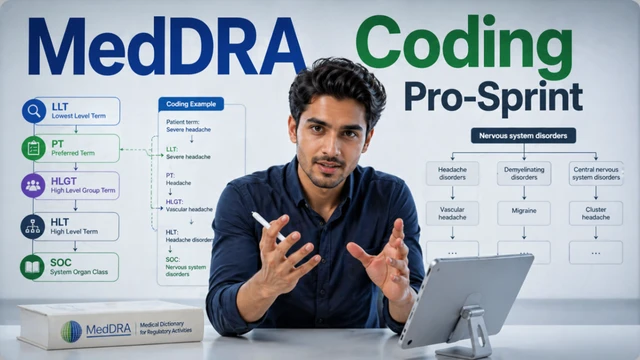
- Medical Coding: They use standardized medical dictionaries, primarily MedDRA, to code the patient's medical history, symptoms, and diagnosis. This is a critical skill for MedDRA coding for freshers.
- Narrative Writing: They write a clear, concise summary of the adverse event, which is a crucial part of the report.
- Quality Check: They review the case to ensure all information is accurate and complete before it's submitted.
Essentially, they ensure that every adverse event report is documented perfectly, creating clean data that helps companies and governments make important decisions about drug safety.
What is the salary of a PV Case Processor in India?
For freshers entering the field, the PV case processor salary India is quite competitive, especially for those with a medical or allied health degree. Your unique knowledge base gives you an edge.
A typical starting salary for a Pharmacovigilance Case Processor in India ranges from ₹2.5 Lakhs to ₹4.5 Lakhs per annum. This can vary based on a few factors:
- Company Type: Multinational Corporations (MNCs) like IQVIA, Cognizant, and Accenture often pay more than smaller Indian companies.
- Location: Major pharmaceutical hubs like Bengaluru, Mumbai, Pune, and Hyderabad may offer higher salaries.
- Skills: Candidates with practical training in safety databases, MedDRA coding, and knowledge of regulatory guidelines from bodies like ICH are preferred and can command better salaries.
As you gain 2-3 years of experience, your salary can quickly grow to ₹5 Lakhs - ₹8 Lakhs per annum. An ICSR processing career offers strong financial growth as you move into senior roles like Senior Case Processor, Quality Reviewer, or Team Lead.
How to get a PV case processing job as a fresher?
Getting your first job in pharmacovigilance requires a focused approach. Your degree is the entry ticket, but employers are looking for specific, job-ready skills. Simply getting a generic certificate is a common mistake many make. You can learn more about this in our guide on common certificate mistakes.
Here is how to get started:
- Understand the Basics: Learn the fundamentals of pharmacovigilance, including key terms, the drug development lifecycle, and the importance of patient safety.
- Build Job-Specific Skills: This is the most important step. Focus on learning the actual tasks you will perform on the job. This includes ICSR case processing, MedDRA coding, and narrative writing.
- Tailor Your Resume: Update your resume to highlight your medical knowledge (anatomy, physiology, pharmacology) and any new PV skills you've acquired. Use keywords like 'ICSR', 'MedDRA', 'Case Processing', and 'Drug Safety'.
- Prepare for Interviews: Be ready to answer questions about regulatory guidelines, the ICSR workflow, and how you would handle a sample case.
What is ICSR processing in pharmacovigilance?
ICSR stands for Individual Case Safety Report. It is the foundation of all adverse event reporting jobs. Think of an ICSR as a detailed form that documents a single patient's adverse experience with a specific drug.
ICSR processing is the step-by-step workflow for handling these reports. It includes:
- Case Receipt: Receiving the initial report via email, fax, or a call center.
- Triage: Quickly assessing if the case is serious and unexpected, which determines the reporting timeline (e.g., 7 days or 15 days).
- Data Entry & Coding: Inputting all patient details, drug information, and event descriptions into a safety database and coding the terms using MedDRA.
- Quality Review: A senior team member checks the case for accuracy and completeness.
- Regulatory Submission: Submitting the final report to health authorities like the FDA, EMA, or India's CDSCO.
Mastering the ICSR processing cycle is the number one skill every fresher needs to start their career in pharmacovigilance.
What is MedDRA coding and how is it used in PV?
MedDRA stands for the Medical Dictionary for Regulatory Activities. It is a globally standardized medical dictionary used to classify adverse event information.
Imagine one doctor reports 'feeling dizzy' and another reports 'vertigo'. While they mean similar things, a computer system would see them as different. MedDRA solves this problem by providing a standard set of terms.
In PV, Case Processors use MedDRA to assign a specific code to every symptom, diagnosis, and medical procedure mentioned in an ICSR. This ensures that data is consistent and can be analyzed accurately across thousands of reports. For freshers, learning the basics of MedDRA is a huge advantage, as it shows employers you understand how to manage and standardize safety data.
The Skill Gap: What Your Degree Didn't Teach You
As a BDS, BAMS, BHMS, or Nursing graduate, you have a strong foundation in human anatomy, physiology, and disease. This is your advantage. However, academic programs don't teach the practical, software-based skills that pharmacovigilance companies need.
Employers expect you to know:
- The end-to-end ICSR processing workflow.
- How to code adverse events using MedDRA.
- The basics of global drug safety regulations (ICH-GCP).
- How to write a medical narrative.
- Familiarity with safety databases.
Your degree proves you can learn complex medical topics. Now, you need to add these specific industry skills to bridge the gap and become a candidate companies want to hire. This is especially true for PharmD graduates, who face a similar challenge we discuss in the PharmD Paradox article.
Your 5-Step Roadmap to a PV Career
Here is a clear pathway you can follow to transition from your current job into pharmacovigilance:
- Build Your Foundational Knowledge: Dedicate time to learning the core concepts of pharmacovigilance. Understand the 'why' behind drug safety monitoring.
- Master ICSR Case Processing: This is non-negotiable. Learn the complete lifecycle of a case, from receipt to submission. This is the primary skill for entry-level roles.
- Develop MedDRA Coding Skills: Learn the structure of MedDRA and practice coding real-world case scenarios. This skill makes your profile stand out.
- Get Hands-On Practice (The Missing Link): Theory is not enough. You must practice these skills in a simulated environment that feels like a real job.
- Create a Professional Brand: Update your LinkedIn profile and resume to reflect your new skills and career focus. Start networking with professionals in the PV industry.
The Problem with Theory-Only Learning
Most online courses just give you videos and PDFs. You learn the theory, but you never get to apply it. This is like reading a book about how to drive a car without ever getting behind the wheel.
Pharmacovigilance companies know this. They need people who can start working on real cases from day one. That's why they often reject candidates who only have theoretical knowledge.
The solution is simulation-based learning. This approach lets you work on realistic case studies in a software environment that mimics the tools used by top pharma companies. It's the bridge between what you learned in college and what you need to succeed on the job.
Build These Skills Now
Programs from ZANE ProEd Academy that directly address the skill gaps discussed above.
How the ZANE ProEd System Builds Job-Ready Skills
At ZANE ProEd, we don't just sell courses; we provide a system designed to make you job-ready. Our programs are built on a 'Perform-to-Learn' model where you spend most of your time doing the actual work.
Our ICSR Case Processing & Triage program gives you hands-on experience managing and processing safety cases. You'll learn the complete workflow by actually doing it.
Our MedDRA Medical Coding Certification program teaches you how to accurately code adverse events, a skill that is in high demand. You will work on hundreds of real-world verbatims to build confidence and accuracy.
Together, these programs form a complete system that gives you the exact skills and confidence needed to clear interviews and excel as a Pharmacovigilance Case Processor.
Are You Ready for a Career in Pharmacovigilance?
Switching careers can feel daunting, but you already have the most important asset: your medical knowledge. By adding a few specific, practical skills, you can unlock a stable and rewarding career in a high-growth industry.
Don't let your valuable degree go to waste in an unrelated field. It's time to take the next step towards a future that values your expertise.
See how your skills compare with what top pharma companies are looking for. Check your job readiness and discover the exact steps you need to take to start your PV journey.
Build These Skills Now
Programs from ZANE ProEd Academy that directly address the skill gaps discussed above.
Follow Zane ProEd on Google
Preferred SourceAdd our publication as a preferred source to get the latest clinical research guides, industry updates, and career intel directly in your Google Top Stories & AI Overviews.