Pharmacovigilance Case Processing Jobs Freshers: Complete Career Guide

Pharmacovigilance Case Processor pharmacovigilance case processing jobs freshers are entry-level roles where you collect, enter, and code adverse event reports for drug safety. You need ICSR processing, MedDRA coding, and basic regulatory knowledge. Companies hire BSc, BCA, and BTech graduates, offering ₹2.5–4.5 LPA starting salary in India.
You failed placements. Multiple times. You applied for pharmacovigilance case processing jobs freshers and got rejected. Or maybe you gave up because you thought PV is only for pharmacy graduates. Wrong. Here is the brutal truth: employers don't care about your degree. They care about whether you can process an ICSR report without making mistakes. If you are from BSc, BCA, or BTech, you can break in—if you stop making the same mistakes everyone else makes.
The biggest mistake? Thinking a certificate is enough. It is not. Recruiters reject freshers every day because they cannot do MedDRA coding or triage a case. This guide breaks down exactly what you need to become job-ready, not just certified. Read this if you are tired of watching others get hired while you stay stuck. For a broader view of PV roles, check this guide on pharmacovigilance jobs for freshers in India.
Build These Skills Now
Programs from ZANE ProEd Academy that directly address the skill gaps discussed above.
What does a Pharmacovigilance Case Processor do?
If you are looking for pharmacovigilance case processing jobs freshers, you need to know exactly what a Pharmacovigilance Case Processor does. A Pharmacovigilance Case Processor is the first line of drug safety. You take raw adverse event reports from doctors, patients, or clinical trials and turn them into clean, coded data for regulatory submission. This is the exact pharmacovigilance case processor job description:
- Receive and triage adverse event reports (AEs) from various sources.
- Enter case data into safety databases like Argus, ArisG, or Veeva Vault.
- Perform MedDRA coding for medical terms and drug names.
- Check for duplicate cases and request follow-up information.
- Meet strict timelines (e.g., 24-hour expedited reports).
Your work directly impacts patient safety. One wrong code can delay a signal or hide a dangerous side effect. That is why companies test your practical skills before hiring. They don't ask you to recite definitions; they give you a sample case and ask you to process it. If you freeze, you lose.
What is the salary of a PV Case Processor in India?
The PV case processor salary India ranges from ₹2.5 LPA to ₹4.5 LPA for freshers. With 2-4 years of experience, you can earn ₹4–6 LPA. Senior case processors or leads make ₹6–10 LPA. These numbers vary by city:
- Pune, Hyderabad, Bangalore: ₹3–5 LPA for freshers.
- Delhi NCR, Mumbai: ₹2.8–4.2 LPA.
- Chennai, Ahmedabad: ₹2.5–3.8 LPA.
Shift allowances can add ₹20,000–50,000 per year. But salary grows slowly if you stay in basic data entry. The real jump comes when you move to case processing lead, safety scientist, or aggregate reporting. That is why you must master ICSR and MedDRA early.
How to get a PV case processing job as a fresher?
Stop chasing certificates. Start building skills. Follow this realistic path:
- Learn ICSR basics: Understand what an Individual Case Safety Report is, its fields, and regulatory timelines (ICH E2B).
- Practice MedDRA coding: Use free resources or simulated cases to code adverse events correctly.
- Build a mini-portfolio: Process 20-30 mock cases and document your approach. Show it in interviews.
- Apply to entry-level roles: Look for PV Trainee, Drug Safety Associate, or Case Processor openings. Use job portals and LinkedIn.
- Prepare for scenario interviews: Expect questions like "How do you handle a duplicate report?" or "What is seriousness criteria?"
Many freshers fail because they only read theory. Employers need you to do the work from day one. If you can't, you are a liability. So get hands-on practice before you apply.
What is ICSR processing in pharmacovigilance?
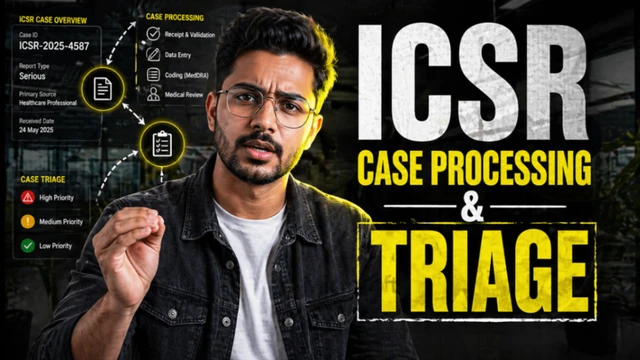
ICSR stands for Individual Case Safety Report. ICSR processing career is the backbone of pharmacovigilance. It is the process of taking a report of an adverse event and turning it into a structured, coded document that regulators can review. The steps include:
- Receipt: Report comes from a doctor, patient, literature, or clinical trial.
- Triage: Determine if the report is valid (minimum criteria: identifiable patient, reporter, suspect drug, adverse event).
- Data entry: Enter all details into a safety database.
- Coding: Use MedDRA to code medical terms; use WHO Drug Dictionary for drug names.
- Medical review: A physician or trained reviewer checks causality and seriousness.
- Submission: Send to regulatory authorities within required timelines (e.g., 7 days for serious unexpected).
ICH guidelines ICH define the global standard for ICSR. In India, CDSCO CDSCO oversees pharmacovigilance. Companies expect you to know these basics.
What is MedDRA coding and how is it used in PV?
MedDRA (Medical Dictionary for Regulatory Activities) is a standardized medical terminology developed under ICH. MedDRA coding for freshers is a crucial skill. You code adverse events, medical history, and indications using MedDRA terms. For example, "heart attack" is coded as "Myocardial infarction". The dictionary has five levels: System Organ Class (SOC), High Level Group Term, High Level Term, Preferred Term (PT), and Lowest Level Term (LLT).
In PV, you code the reported adverse event to the closest PT. If a patient says "feeling tired", you might code "Fatigue". Wrong coding can change the safety signal. That's why employers test MedDRA coding heavily in interviews. For more on medical coding careers, see this guide on medical coding jobs for freshers in India.
What skills do employers expect but colleges don't teach?
Colleges teach you theory: definitions of adverse events, pharmacovigilance history, maybe some regulations. But employers expect you to:
- Navigate a safety database (Argus, ArisG) without hand-holding.
- Code a case using MedDRA in under 10 minutes.
- Understand seriousness criteria (death, hospitalization, disability).
- Write clear case narratives.
- Spot duplicate cases and inconsistencies.
If you are from BSc, BCA, or BTech, you likely never touched these tools. That is the skill gap. You don't need a pharmacy degree, but you do need practical exposure. Reading a textbook won't help you pass a case processing simulation test.
What is the step-by-step path to become a PV Case Processor?
Here is a 6-step roadmap that actually works:
- Learn the language: Study ICH E2B, MedDRA basics, and Indian PV regulations.
- Get trained on a tool: Practice on a simulated safety database or at least understand data fields.
- Code mock cases: Use free MedDRA browsers or sample cases to code AEs correctly.
- Build a case processing portfolio: Document 20+ processed cases with your coding rationale.
- Apply for internships or trainee roles: Even unpaid experience counts.
- Interview with confidence: Walk in with a portfolio, not just a certificate.
This path takes 2-3 months if you focus. The problem is most freshers skip steps 2-4 and wonder why they fail.
How can simulation-based training bridge the gap?
Simulation-based learning puts you in real case processing scenarios without the risk. You receive mock ICSRs, triage them, code with MedDRA, and write narratives. You get feedback on errors. This is exactly what employers test in interviews. Reading theory is passive; simulation is active. It builds muscle memory. If you practice on 50 simulated cases, you walk into an interview calm and prepared. That is the difference between "certified" and "job-ready".
Build These Skills Now
Programs from ZANE ProEd Academy that directly address the skill gaps discussed above.
How does ZANE ProEd build job-ready PV case processors?
ZANE ProEd is not just a course provider. It is a system that replicates the exact workflow of a PV case processor. Two programs matter here:
- ICSR Case Processing Triage: You learn to triage and enter cases, handle duplicates, and meet timelines. You practice on a simulated database.
- MedDRA Medical Coding Certification: You code hundreds of real-world adverse events and get accuracy feedback.
These are not lectures. You do the work. You make mistakes in a safe environment, so you don't make them in an interview. The system tracks your accuracy and speed, just like an employer would. For more about ZANE's approach, visit about ZANE ProEd.
Are you ready to test your PV skills?
Don't apply for another job without knowing where you stand. Check your job readiness. See how your skills compare to what employers expect. If you cannot process a case end-to-end, you are not ready. That is okay—now you know what to fix. Start with simulation practice, build your portfolio, and then apply. The next rejection could be your last.
Build These Skills Now
Programs from ZANE ProEd Academy that directly address the skill gaps discussed above.
Follow Zane ProEd on Google
Preferred SourceAdd our publication as a preferred source to get the latest clinical research guides, industry updates, and career intel directly in your Google Top Stories & AI Overviews.