Pharmacovigilance Case Processing Jobs for Freshers: Step-by-Step Roadmap to Enter Industry

Pharmacovigilance Case Processor for freshers involves processing Individual Case Safety Reports (ICSRs), coding adverse events with MedDRA, and ensuring regulatory compliance. Non-medical graduates can enter by mastering ICSR workflows, MedDRA coding, and ICH-GCP guidelines through simulation-based training that builds a verifiable portfolio for employers.
If you have a BSc, BCA, BTech, or come from IT/BPO and keep hitting walls in placements, you are not alone. The truth is that pharmacovigilance case processing jobs for freshers exist—but only for those who can prove they already know the work, not just the theory. Failed placements are not a reflection of your potential; they are a signal that the market demands hands-on ICSR skills that most colleges never teach.
This roadmap is built for you. It cuts through the noise and shows exactly how to build job-ready expertise in pharmacovigilance within six months—even without a medical background.
Build These Skills Now
Programs from ZANE ProEd Academy that directly address the skill gaps discussed above.
What does a Pharmacovigilance Case Processor do?
A Pharmacovigilance Case Processor is the first line of defense in drug safety. You receive, triage, and enter reports of adverse events from patients, doctors, and clinical trials into a safety database. The role is critical because every entry can influence a drug's safety profile and regulatory decisions.
Typical daily tasks include:
- Reviewing source documents for adverse event reports
- Entering data into safety databases like Argus or ArisG
- Performing MedDRA coding for adverse events and medical history
- Assessing seriousness, causality, and expectedness of events
- Ensuring compliance with ICH-GCP and local regulations
Employers look for people who can handle high volumes of cases with accuracy, speed, and an audit-ready mindset. This is not a desk job where you learn slowly—it is a production environment where every case counts.
What is the salary of a PV Case Processor in India?
PV case processor salary India varies by city, company, and experience. For freshers, the range typically falls between ₹2.8 LPA to ₹4.5 LPA. In pharmacovigilance hubs like Hyderabad, Bangalore, Pune, and Mumbai, the upper end can reach ₹5 LPA for candidates with strong simulation-based portfolios.
With 2–3 years of experience, salaries jump to ₹5.5 LPA – ₹8.5 LPA. Companies also offer shift allowances, performance bonuses, and clear promotion paths to senior case processor, quality reviewer, or safety scientist roles.
The key differentiator is not your degree but your ability to demonstrate mastery of ICSR processing and MedDRA coding during the interview. A random certification without practice will not fetch you the higher band.
How to get a PV case processing job as a fresher?
Breaking into pharmacovigilance case processing jobs for freshers requires a strategic approach. Here is a step-by-step plan that works for non-medical graduates:
- Learn the regulatory framework: Study WHO guidelines and CDSCO requirements for adverse event reporting. Understand the difference between an ICSR, SAE, and SUSAR.
- Master ICSR workflow: Practice data entry, case triage, and follow-up requests using simulated case scenarios. You can find free resources or structured programs that include mock cases.
- Get hands-on with MedDRA: Learn how to code adverse events using the MedDRA browser. Many freshers struggle here, but employers test this directly.
- Build a portfolio of processed cases: Create a folder with 5–10 sample ICSRs you have coded, triaged, and documented. This is your proof of skill.
- Target entry-level openings: Search for titles like 'Pharmacovigilance Trainee', 'Drug Safety Associate', or 'Case Processor' on job portals and LinkedIn. Use your portfolio as a conversation starter.
Remember: companies are not hiring your potential; they are hiring your demonstrated ability. This detailed roadmap for PV freshers in India breaks down each step further.
What is ICSR processing in pharmacovigilance?
ICSR processing career revolves around Individual Case Safety Reports. An ICSR is a document that contains information about a single patient who experienced an adverse event after taking a drug. Processing an ICSR involves several critical steps:
- Receipt and validation: Check if the report has the minimum four elements: identifiable patient, reporter, suspect drug, and adverse event.
- Triage: Prioritize cases based on seriousness and urgency. Serious cases must be reported to regulators within 15 days.
- Data entry: Enter all details into the safety database accurately. This includes patient demographics, medical history, drug details, and event description.
- Coding: Use MedDRA to code the adverse event, medical history, and indications.
- Medical review: A physician or safety scientist reviews the case for causality and expectedness.
- Submission: Submit the report to regulatory authorities if required.
Mastering this workflow is the core of any adverse event reporting job. Employers expect you to understand these steps without being reminded. Simulation-based practice helps you internalize them.
What is MedDRA coding and how is it used in PV?
MedDRA coding for freshers is often the hardest skill to acquire because it requires both medical knowledge and practical experience. MedDRA (Medical Dictionary for Regulatory Activities) is a standardized international terminology used to classify adverse events, medical history, and drug indications.
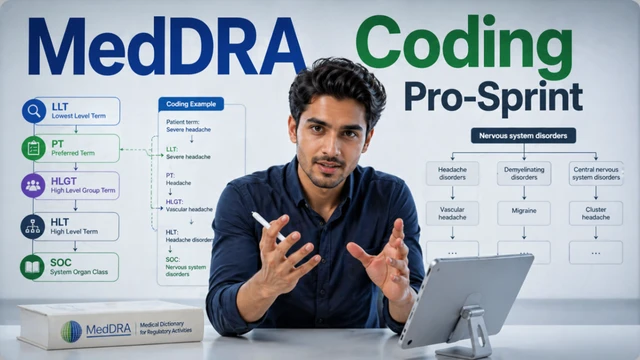
In pharmacovigilance, every adverse event reported in an ICSR must be mapped to a MedDRA term. For example, a patient reporting 'heart attack' would be coded as 'Myocardial infarction' (PT level). The coder must select the most appropriate term from the hierarchy: System Organ Class (SOC) → High Level Group Term (HLGT) → High Level Term (HLT) → Preferred Term (PT) → Lowest Level Term (LLT).
Employers test MedDRA coding skills in interviews because errors can lead to misclassification of safety signals. You can practice with free MedDRA browsers or structured programs that provide mock coding exercises. This guide on free PV courses with certificates lists resources to get started.
Skill Gap: What College Teaches vs What Employers Expect
Most Indian BSc, BCA, and BTech programs do not include pharmacovigilance in their curriculum. Even if you studied biology, you likely never touched a safety database or coded a single MedDRA term. This creates a massive skill gap.
Conventional education teaches: theory of drug development, basic pharmacology, and maybe a mention of adverse drug reactions. Modern employers expect: you to log into a safety database on day one, process 10–15 cases per day with 99% accuracy, and code events without hand-holding.
Certifications that are purely video-based do not close this gap. You need real-world simulation where you handle mock cases, receive feedback, and build a portfolio that proves you have done the work.
Structured Pathway to Enter PV as a Fresher (6-Month Plan)
- Month 1–2: Build Foundation – Study ICH-GCP guidelines, CDSCO regulations, and pharmacovigilance basics. Complete a free or low-cost introductory course. Focus on vocabulary: ICSR, SAE, SUSAR, causality, expectedness.
- Month 3–4: Master ICSR Processing – Enroll in a simulation-based ICSR processing program. Practice case triage, data entry, and follow-up on at least 20 mock cases. Learn to navigate a safety database interface (even a demo version).
- Month 4–5: Get Proficient in MedDRA Coding – Dedicate focused time to MedDRA coding. Use the official MedDRA browser to code 25–30 sample adverse events. Get feedback on your coding choices.
- Month 5–6: Build Portfolio and Apply – Compile your best 10 processed ICSRs with documentation of your coding rationale. Update your resume with specific skills: 'ICSR processing', 'MedDRA coding', 'Argus database (simulated)'. Apply to 20+ entry-level PV roles weekly.
This pathway works because it replaces vague claims with concrete evidence. Employers can see your portfolio and trust that you will be productive from the first week.
System Bridge: Simulation-Based Learning and Verifiable Portfolio
The missing link for most freshers is not information but simulation and proof. Reading about ICSR processing does not make you job-ready; actually processing simulated cases does. ZANE ProEd's training system is built on this principle: you learn by doing in a safe environment, then you show employers exactly what you can do.
You will work through realistic adverse event reports, navigate triage decisions, code with MedDRA, and produce audit-ready documentation. This portfolio becomes your strongest interview asset—far more convincing than a certificate alone.
Build These Skills Now
Programs from ZANE ProEd Academy that directly address the skill gaps discussed above.
Academy Integration: Practical Programs That Mirror the Job
ZANE ProEd offers two focused programs that directly address the skills above: ICSR Case Processing & Triage and MedDRA Medical Coding Certification. These are not passive video courses; they are simulation-driven training systems designed with industry experts.
Both programs are aligned with ICH-GCP international compliance and emphasize audit readiness. You will practice on realistic case scenarios, receive personalized feedback, and build a portfolio that demonstrates your ability to work in a regulated environment. Whether you aim for a CRO, pharma company, or IT vendor handling PV outsourcing, this practical exposure sets you apart from the thousands of applicants with only theoretical knowledge.
Ready to move from rejection to offer? Start by auditing your current industry readiness. Explore simulation workflows and see where you stand. Learn more about ZANE ProEd's approach to career acceleration.
Build These Skills Now
Programs from ZANE ProEd Academy that directly address the skill gaps discussed above.
Follow Zane ProEd on Google
Preferred SourceAdd our publication as a preferred source to get the latest clinical research guides, industry updates, and career intel directly in your Google Top Stories & AI Overviews.