Pharmacovigilance Case Processing Jobs for Freshers: Complete Roadmap

Pharmacovigilance Case Processing Jobs for Freshers involve triaging, coding, and evaluating individual case safety reports (ICSRs) from adverse events. In India, BPharm/MPharm graduates can secure these roles by mastering MedDRA coding, ICSR workflows, and safety database tools—even without industry connections.
For BPharm and MPharm graduates in India with no industry connections, landing pharmacovigilance case processing jobs freshers often feels like an impossible gatekeeping exercise. Recruiters screen hundreds of resumes, and without the right keywords, your application never reaches a human eye.
But here's what recruiters reveal: they don't reject freshers because of lack of connections. They reject because of skill gaps. The gap between what your degree taught you and what daily case processing actually demands is wider than you think. This guide closes that gap—step by step.
Build These Skills Now
Programs from ZANE ProEd Academy that directly address the skill gaps discussed above.
What does a Pharmacovigilance Case Processor do?
A Pharmacovigilance Case Processor is the first line of defense in drug safety. You receive, triage, and enter data from adverse event reports into safety databases. Your daily workflow includes:
- Receipt and triage of ICSRs from various sources (spontaneous reports, clinical trials, literature).
- Data entry of patient demographics, suspect drugs, and adverse events into systems like Argus, ArisG, or Veeva Vault.
- MedDRA coding of adverse events and medications using the Medical Dictionary for Regulatory Activities.
- Narrative writing to summarize the case clearly and objectively.
- Assessment of seriousness, expectedness, and causality in line with ICH guidelines.
- Follow-up queries to obtain missing information from reporters.
- Regulatory submission support by preparing cases in E2B format for authorities like CDSCO.
This is not just data entry. It's high-stakes documentation where one missed detail can compromise patient safety. Employers test your ability to handle this workflow—not just your theoretical pharmacology knowledge.
What is the salary of a PV Case Processor in India?
The PV case processor salary India varies by city, company type, and your demonstrable skills. For freshers, the entry-level compensation ranges from ₹2.8 LPA to ₹4.2 LPA. After 1-2 years of experience, salaries jump to ₹4.5 LPA to ₹7 LPA. Senior case processors and leads can earn ₹8 LPA to ₹12 LPA.
Pharma hubs like Hyderabad, Bangalore, Pune, and Mumbai offer the highest density of adverse event reporting jobs. CROs and global pharma companies often pay 20-30% higher than domestic firms. But higher pay comes with higher skill expectations—especially in MedDRA coding accuracy and ICSR processing speed.
How to get a PV case processing job as a fresher?
Without industry connections, you must build a resume that screams competence. Recruiters look for proof of hands-on ability, not just certificates. Follow these steps:
- Learn the regulatory foundation – Study ICH E2B guidelines, GVP modules, and Indian pharmacovigilance regulations from CDSCO and ICH.
- Master MedDRA coding – Practice coding adverse events from real case scenarios. Understand hierarchy from SOC to LLT.
- Simulate ICSR processing – Use free tools or structured courses to process mock cases end-to-end: triage, data entry, coding, narrative, assessment.
- Build a case processing portfolio – Compile your processed cases with narratives, coded terms, and assessments. Share this as a PDF or link in your resume.
- Optimize your resume and LinkedIn – Use keywords like 'ICSR processing', 'MedDRA coding', 'adverse event reporting'. Highlight your portfolio.
- Apply strategically – Target entry-level roles in CROs, pharma companies, and pharmacovigilance service providers. For deeper guidance, read our handbook on pharmacovigilance jobs for freshers in India and explore a free pharmacovigilance course with certificate to kickstart your learning.
What is ICSR processing in pharmacovigilance?
ICSR stands for Individual Case Safety Report. ICSR processing is the end-to-end handling of a single adverse event report. It's the core of any ICSR processing career. The workflow includes:
- Receipt and validation – Confirm the report meets minimum criteria (identifiable patient, reporter, suspect drug, adverse event).
- Duplicate check – Ensure the same case isn't already in the database.
- Data entry – Enter all relevant information into the safety database.
- MedDRA coding – Assign appropriate codes to adverse events and medications.
- Narrative writing – Create a concise clinical summary.
- Medical assessment – Determine seriousness, expectedness, and causality.
- Submission – Prepare E2B XML files for regulatory authorities as per WHO and ICH standards.
Employers expect freshers to understand this workflow, even if you haven't done it in a real job. Simulation is your best friend.
What is MedDRA coding and how is it used in PV?
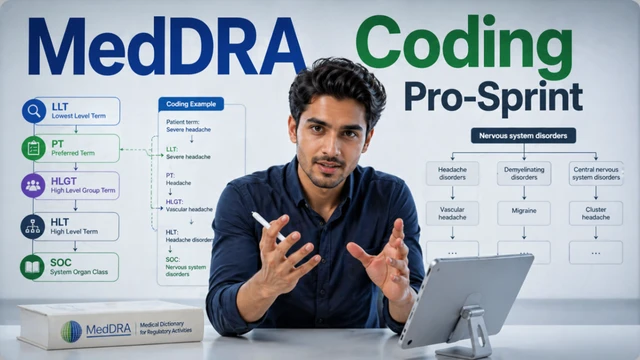
MedDRA (Medical Dictionary for Regulatory Activities) is the global standard for coding adverse events and medical history in pharmacovigilance. It has a five-level hierarchy: System Organ Class (SOC), High Level Group Term (HLGT), High Level Term (HLT), Preferred Term (PT), and Lowest Level Term (LLT).
In case processing, you assign the most appropriate Preferred Term to each adverse event and the Lowest Level Term for medications. Accuracy in MedDRA coding for freshers is non-negotiable. One wrong code can change the safety signal interpretation. Recruiters often test coding skills with real-world examples during interviews.
Skill Gap Exposure: What Education Teaches vs What Employers Expect
Your BPharm or MPharm degree taught you pharmacology, toxicology, and drug regulation. But it rarely covered the hands-on tools and workflows used daily in pharmacovigilance.
- Education gives you theoretical knowledge of adverse drug reactions.
- Employers expect you to navigate a safety database, code in MedDRA, write compliant narratives, and follow ICH E2B guidelines.
- Education doesn't teach you how to handle duplicate checks, manage follow-up queries, or assess expectedness against the reference safety information.
- Employers won't train you from scratch—they want job-ready candidates who can contribute from day one.
This gap is why freshers with no connections get filtered out. The solution is not more theory. It's simulation-based practice that mirrors real case processing.
Structured Pathway to Your First PV Case Processing Job
- Build Regulatory Vocabulary – Study ICH E2B, GVP modules, and CDSCO guidelines. Know the difference between serious and non-serious, expected and unexpected.
- Get Hands-On with MedDRA – Practice coding 50+ adverse events from case scenarios. Use the official MedDRA browser or structured exercises.
- Simulate ICSR Workflows – Process at least 10 mock cases from receipt to submission. Document each step meticulously.
- Create a Portfolio – Compile your mock cases into a professional PDF. Include narratives, coding decisions, and assessments. This is your proof of skill.
- Optimize Application Materials – Tailor your resume with keywords: 'ICSR processing', 'MedDRA coding', 'adverse event reporting jobs'. Link your portfolio.
- Apply and Interview – Target 20-30 companies. During interviews, walk through a case you processed. Confidence comes from practice.
System Bridge: Simulation-Based Learning and Portfolio Proof
You can't get a job without experience, and you can't get experience without a job. Simulation breaks that deadlock. By working through realistic case scenarios in a controlled environment, you build the exact muscle memory recruiters look for. Even better, you produce verifiable artifacts—processed cases, narratives, and coding decisions—that you can show to employers.
This is where structured training systems beat random YouTube videos. A well-designed simulation program recreates the pressure and complexity of real pharmacovigilance workflows, including audit-ready documentation and ICH-GCP compliance. Your portfolio becomes your silent advocate in a competitive Indian market.
Build These Skills Now
Programs from ZANE ProEd Academy that directly address the skill gaps discussed above.
Academy Integration: Practical Training That Mirrors Industry
ZANE ProEd's approach to pharmacovigilance training is not a passive video library. It's an industry simulation system built around two critical skill tracks:
- ICSR Case Processing & Triage – You process mock cases from receipt to narrative writing, learning triage logic, duplicate checks, and E2B submission readiness. This mirrors the daily workflow of a case processor in a CRO.
- MedDRA Medical Coding Certification – You practice coding adverse events across therapeutic areas, mastering the MedDRA hierarchy and avoiding common errors that fail audits.
Both programs emphasize ICH-GCP international compliance and audit readiness. You leave with a portfolio of processed cases that demonstrates your ability to contribute on day one—not just theoretical knowledge.
Audit Your Industry Readiness
Take an honest look at your current skills. Can you code an adverse event in MedDRA without hesitation? Can you write a compliant narrative under time pressure? If not, explore simulation workflows that force you to practice these exact tasks. Your first pharmacovigilance case processing job is closer than you think—when you build the skills recruiters actually test.
Build These Skills Now
Programs from ZANE ProEd Academy that directly address the skill gaps discussed above.
Follow Zane ProEd on Google
Preferred SourceAdd our publication as a preferred source to get the latest clinical research guides, industry updates, and career intel directly in your Google Top Stories & AI Overviews.