QA QC Pharma Jobs for Freshers: Complete Step-by-Step Career Guide

QA/QC Executive (Pharma) QA QC pharma jobs for freshers are entry-level roles where you check raw materials, monitor manufacturing, and ensure medicines meet safety rules. With GMP knowledge and hands-on tools, graduates from BDS, BHMS, BAMS, or Nursing can qualify. Start with a clear skill roadmap.
If you have a BDS, BHMS, BAMS, or Nursing degree, you may feel overqualified on paper but under-skilled for industry roles. Many allied health graduates face the same gap. QA QC pharma jobs for freshers are one of the fastest ways to enter the pharma sector. But the industry does not care about your degree alone.
\nIt cares about one thing: Can you handle the daily quality workflow? This guide breaks down exactly what you need to become job-ready, not just certified. No fluff. Only practical steps.
Build These Skills Now
Programs from ZANE ProEd Academy that directly address the skill gaps discussed above.
What is the difference between QA and QC in pharma (and why it matters for QA QC pharma jobs for freshers)?
\nMany freshers confuse QA and QC. In simple terms:
\n- \n
- QA (Quality Assurance) is about preventing mistakes before they happen. It focuses on systems, processes, and documentation. QA answers: 'Are we doing things right?' \n
- QC (Quality Control) is about testing and checking products after manufacturing. It focuses on lab tests, sampling, and finding defects. QC answers: 'Is the product right?' \n
Both follow global guidelines from ICH and WHO. In a pharma company, QA reviews batch records, handles audits, and approves release. QC runs analytical tests on raw materials and finished products. For QA QC pharma jobs for freshers, you often start in QC lab roles and then move to QA.
\nWhat is the salary of a QA/QC Executive in India?
\nQuality assurance pharma salary for freshers typically ranges from ₹2.5 lakh to ₹4.5 lakh per year. In metro cities like Mumbai, Hyderabad, or Ahmedabad, you may get slightly higher. With 2-4 years of experience, the salary jumps to ₹5-8 LPA. Senior executives or QA managers can earn ₹10 LPA or more.
\nThese numbers depend on the company size, location, and your specific skills. A candidate who knows GMP documentation software and can handle batch release tasks will always command a higher offer.
\nHow to get a QA/QC job in pharma as a fresher?
\nFollow this simple five-step route:
\n- \n
- Learn GMP basics: Understand Good Manufacturing Practices. Free resources exist on FDA and CDSCO websites. \n
- Pick one QA/QC tool: Learn to read a batch manufacturing record (BMR) or use a basic quality management system (QMS) software. Even a demo version helps. \n
- Get a short internship or project: Many small pharma companies offer unpaid or low-paid internships. Use that to build real workflow knowledge. \n
- Prepare for QA QC interview questions: Expect questions like 'What is CAPA?', 'Difference between validation and qualification?', and 'How do you handle an OOS result?'. Practice answers with simple examples. \n
- Apply to 20+ targeted jobs weekly: Use LinkedIn, Naukri, and company career pages. Focus on roles that say 'fresher' or '0-2 years'. \n
Don't wait for a perfect job. Even a QC lab technician role can be your entry point.
\nWhat qualifications are needed for QA/QC in pharma?
\nTraditional routes include BPharm, MPharm, BSc Chemistry, or MSc. But if you come from a medical background like BDS, BHMS, BAMS, or Nursing, you are also eligible in many companies. What matters is proof of:
\n- \n
- Basic understanding of pharmaceutical manufacturing \n
- Knowledge of GMP and documentation \n
- Familiarity with quality terms like SOP, CAPA, deviation, and change control \n
- Hands-on exposure to lab instruments or batch records (even simulated) \n
Some employers accept allied health graduates if you complete a targeted certification in pharma quality control career skills. It bridges the gap between your medical theory and pharma reality.
\nWhat does a QA/QC Executive do daily?
\nHere is a realistic QA QC executive job description for a typical day:
\n- \n
- Morning: Review batch manufacturing records from previous day. Check for missing signatures, timestamps, or errors. \n
- Midday: Collect samples from production line. Send them to QC lab for testing. Conduct in-process checks like tablet hardness, weight variation, or pH. \n
- Afternoon: Enter data into quality management system. Prepare or update SOPs. Attend a brief meeting on open deviations or CAPA actions. \n
- Evening: Approve or reject finished product batches. Document everything as per GMP. Sign off on release for dispatch. \n
This job is detail-heavy. You must be comfortable with paperwork and basic software tools. But once you learn the workflow, it becomes second nature.
\nSkill Gap Exposure: What Colleges Teach vs What Employers Expect
\nYour BDS or BHMS degree gives you strong anatomy, pharmacology, and patient care knowledge. But pharma quality departments run on a different system. Here is the gap:
\n- \n
- Colleges teach: Disease mechanisms, drug actions, clinical diagnosis. \n
- Employers expect: GMP documentation, audit trail review, batch release logic, and deviation handling. \n
That is why many medical graduates feel lost in interviews. The good news? This gap is bridgeable with focused, simulation-based practice. You do not need another 4-year degree.
\nFor related roles, check out our guide on pharma validation specialist career and hospital quality assurance jobs to see how quality skills apply across settings.
\nStep-by-Step Roadmap to Become Job-Ready in 90 Days
\n- \n
- Week 1-2: Study GMP guidelines from ICH Q7 and WHO. Make one-page notes for each key section. \n
- Week 3-4: Learn to create a simple batch record. Use free templates online. Understand each field and why it matters. \n
- Week 5-6: Practice CAPA and deviation scenarios. Write mock reports for a 'temperature excursion' or 'label mix-up'. \n
- Week 7-8: Do a virtual simulation of a batch release process. Follow the entire chain from raw material receipt to finished product dispatch. \n
- Week 9-10: Apply to 50+ fresher QA/QC roles. Tailor your resume to highlight GMP knowledge and any simulation experience. \n
- Week 11-12: Attend 5-10 interviews. Use feedback to improve your answers. Keep refining your QA QC interview question responses. \n
System Bridge: Simulation Beats Rote Learning
\nReading about GMP is not enough. You need to actually work through workflows. Simulation-based learning lets you practice batch release, deviation handling, and audit preparation in a safe environment. You make mistakes now, so you don't make them on the job. This is the fastest way to convert your medical background into industry-ready quality skills.
\nBuild These Skills Now
Programs from ZANE ProEd Academy that directly address the skill gaps discussed above.
Academy Integration: The ZANE ProEd System
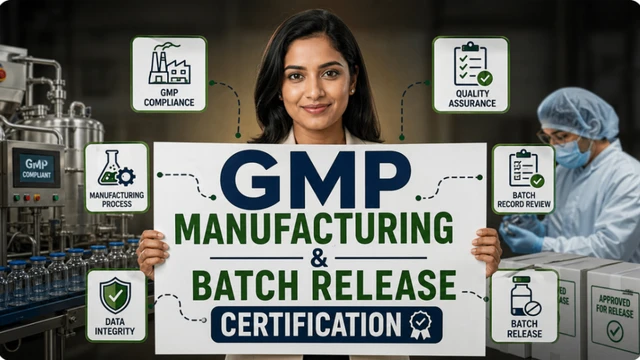
\nZANE ProEd does not sell courses. It builds a system that mirrors real pharma quality departments. The GMP Manufacturing Batch Release Certification walks you through every step of releasing a product batch. The Quality Management System Certification covers CAPA, change control, and audit readiness. Together, they give you a practical, no-nonsense foundation that fills the exact gaps employers complain about.
\nYou don't need to memorize definitions. You need to experience the workflow. That is the ZANE difference.
\nCheck Your Job Readiness
\nNot sure if you are ready for a QA/QC interview? Take a quick self-assessment. See how your current skills compare to what top pharma companies expect. Then close the gaps with targeted practice.
Build These Skills Now
Programs from ZANE ProEd Academy that directly address the skill gaps discussed above.
Follow Zane ProEd on Google
Preferred SourceAdd our publication as a preferred source to get the latest clinical research guides, industry updates, and career intel directly in your Google Top Stories & AI Overviews.