QA QC Pharma Jobs for Freshers: Complete Step-by-Step Career Guide

QA QC pharma jobs for freshers are entry-level roles in pharmaceutical quality assurance and quality control. With a BSc or MSc in Chemistry, you can start as a QA/QC Executive. Key steps: learn GMP, understand QA vs QC, and build practical skills through simulations or certifications.
You earned your BSc or MSc in Chemistry. You expected job calls. Instead, maybe a career gap made things harder. But here is the truth: QA QC pharma jobs for freshers are still wide open if you show the right skills.
\n\nMany chemical science graduates feel lost. Colleges do not teach what pharma companies actually need. But with a clear roadmap, you can get hired in 3-6 months. This guide shows you exactly how.
Build These Skills Now
Programs from ZANE ProEd Academy that directly address the skill gaps discussed above.
What are QA QC pharma jobs for freshers?
\nQA stands for Quality Assurance. QC stands for Quality Control. Both roles protect patient safety. In India, pharma companies hire freshers for these roles every quarter. You do not need 5 years of experience. You need the right knowledge and proof of skill.
\n\nAs a fresher, you will start as a QA/QC Executive. Your job is to follow standard operating procedures (SOPs). You check raw materials, monitor production, and test finished products. This is a stable, growing career path with clear promotion routes.
\n\nWhat is the difference between QA and QC in pharma?
\nThe difference between QA and QC in pharma is simple. QA is process-focused. QC is product-focused. QA prevents mistakes before they happen. QC finds mistakes after production.
\n\n- \n
- Quality Assurance (QA): You review documents, conduct audits, and ensure everyone follows GMP. You ask: 'Are we doing the right things?' \n
- Quality Control (QC): You test samples in the lab. You check purity, potency, and stability. You ask: 'Does this batch meet specifications?' \n
Both roles are equally important. A pharma quality control career suits you if you love lab work. QA suits you if you prefer systems and documentation. Many professionals move between both.
\n\nWhat is the salary of a QA/QC Executive in India?
\nThe quality assurance pharma salary for freshers ranges from ₹2.5 lakh to ₹4 lakh per year. QC salaries are similar. In metros like Hyderabad, Mumbai, and Ahmedabad, you may get higher offers.
\n\n- \n
- Fresher (0-1 year): ₹2.5 - ₹4 LPA \n
- 1-3 years: ₹3.5 - ₹6 LPA \n
- 3-5 years: ₹5 - ₹9 LPA \n
With certifications in GMP or quality management, you can negotiate 20-30% more. Big companies like Sun Pharma, Cipla, and Dr. Reddy's pay at the higher end.
\n\nHow to get a QA/QC job in pharma as a fresher?
\nGetting your first job is a step-by-step process. Here is a proven plan:
\n\n- \n
- Learn GMP basics: Read ICH guidelines and WHO GMP. Companies test this knowledge in interviews. \n
- Build practical skills: Use simulation-based training or virtual labs. Employers want people who can review batch records and handle deviations. \n
- Create a pharma-focused resume: Highlight any lab experience, internships, or certifications. Use keywords like 'GMP', 'SOP', and 'quality control'. \n
- Apply through the right channels: Use job portals like Naukri, LinkedIn, and company career pages. Also check CDSCO notifications for regulatory roles. \n
- Prepare for interviews: Expect QA QC interview questions on definitions, examples, and scenarios. Practice answering in simple, clear terms. \n
For deeper insight into a related field, read this guide on pharma validation specialist career.
\n\nWhat qualifications are needed for QA/QC in pharma?
\nYou need a BSc or MSc in Chemistry, Analytical Chemistry, or a related life science. Some companies accept BPharm or MPharm too. No prior experience is required for fresher roles.
\n\n- \n
- BSc / MSc Chemistry: Most common. Focus on analytical techniques. \n
- Knowledge of GMP: You must understand good manufacturing practices. FDA and EMA provide free resources. \n
- Computer skills: Basic Excel, Word, and LIMS (Laboratory Information Management System) are expected. \n
- Soft skills: Attention to detail, honesty, and ability to follow SOPs exactly. \n
What does a QA/QC Executive do daily?
\nThe QA QC executive job description varies by company. But daily tasks often include:
\n\n- \n
- For QC Executives: Collect samples, run tests using HPLC, UV, or dissolution apparatus. Record results in logbooks. Report any out-of-specification (OOS) results. \n
- For QA Executives: Review batch manufacturing records. Conduct line clearance before production. Check equipment calibration. Handle change controls and deviations. \n
- Both roles: Attend daily meetings. Follow safety rules. Maintain documentation as per regulatory standards. \n
You will work in shifts sometimes. But the role is stable, and the learning curve is steep.
\n\nWhy degrees alone are not enough in pharma QA/QC
\nColleges teach theory. Employers need practical skills. You may know organic chemistry, but can you review a batch record for errors? Can you identify a deviation in a manufacturing log?
\n\n- \n
- College: Focus on reactions, mechanisms, and lab experiments. \n
- Industry: Focus on GMP documentation, audit trails, and CAPA (corrective and preventive actions). \n
This skill gap is why many graduates struggle. A career gap makes it worse because you forget basic concepts. You need a bridge.
\n\nYour 5-step roadmap to a QA/QC Executive role
\n- \n
- Refresh core chemistry basics: Spend 2 weeks revising analytical techniques like titration, spectroscopy, and chromatography. \n
- Understand pharma regulations: Study ICH Q7 (GMP for APIs) and Schedule M from CDSCO. Focus on documentation rules. \n
- Practice with real-world scenarios: Use online simulations that mimic batch release, deviation handling, and audit preparation. \n
- Get certified: A short certification in GMP or Quality Management adds weight to your resume. It shows you are serious. \n
- Apply and interview: Target 20-30 companies. Prepare answers for common QA QC interview questions like 'What is the difference between QA and QC?' or 'How would you handle an OOS result?' \n
Bridging the gap with simulation-based learning
\nReading about GMP is not enough. You need to practice. Simulation-based learning puts you in a virtual pharma plant. You review fake batch records. You handle a mock FDA audit.
\n\nThis method is used by top companies for internal training. Now you can access it before your first job. It builds confidence and gives you real examples for interviews.
\n\nBuild These Skills Now
Programs from ZANE ProEd Academy that directly address the skill gaps discussed above.
How ZANE ProEd systems prepare you for QA/QC roles
\nZANE ProEd is not a course provider. It is a career system. Two specific programs help chemical science graduates:
\n\n- \n
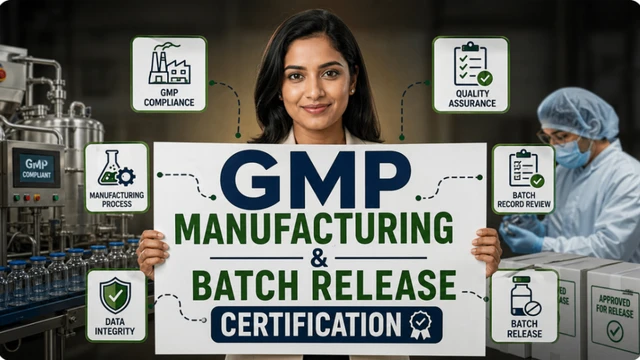
- gmp-manufacturing-batch-release-certification: Teaches you how to review batch records, perform line clearance, and release products as per GMP. You work through simulated manufacturing scenarios. \n
- quality-management-system-certification: Covers CAPA, change control, deviations, and audit readiness. You learn to think like a QA professional. \n
These systems are built by industry experts. They mirror the exact tasks you will do in your first job. Instead of memorizing definitions, you solve problems. That is what employers want.
\n\nYou can learn more about the ZANE ProEd approach here.
\n\nCheck your job readiness. See how your current skills compare to what pharma companies expect from a QA/QC fresher. Take a quick self-assessment and find your gaps.
Build These Skills Now
Programs from ZANE ProEd Academy that directly address the skill gaps discussed above.
Follow Zane ProEd on Google
Preferred SourceAdd our publication as a preferred source to get the latest clinical research guides, industry updates, and career intel directly in your Google Top Stories & AI Overviews.