QA QC Pharma Jobs for Freshers: Your Step-by-Step Guide to Getting Hired

QA/QC Executive (Pharma) QA/QC pharma jobs for freshers are entry-level roles in quality departments. They involve ensuring medicines are safe and effective. Freshers with a BPharm or MPharm can apply. Starting salaries are ₹2.5–4.5 LPA. Focus on GMP, documentation, and lab testing to get hired quickly.
If you feel stuck after doing internships but still don’t have a job, you’re not alone. Many BPharm and MPharm graduates face this exact problem. You’ve completed projects, maybe even worked in a lab, but the interview calls just don’t come. The truth is, pharma companies want more than college knowledge. They need you to walk in already understanding real-world QA/QC. This guide breaks down exactly what you need to know about QA QC pharma jobs for freshers — the roles, the salaries, the skills, and a clear path to getting hired.
\nYou’ll learn the critical differences between QA and QC, what employers actually expect, and how to become interview-ready fast — even if your internships didn’t give you real exposure.
Build These Skills Now
Programs from ZANE ProEd Academy that directly address the skill gaps discussed above.
What is the difference between QA and QC in pharma?
\nThis is the first question interviewers love to ask. Don’t mix them up! Quality Assurance (QA) and Quality Control (QC) are two sides of the same coin, but they have very different jobs.
\n- \n
- QA is process-focused. It’s about building quality into the system. QA makes sure the manufacturing process is designed and followed correctly so mistakes don’t happen in the first place. Think of it as preventing defects. \n
- QC is product-focused. It’s about testing the final product. QC checks samples in the lab to see if the medicine meets standards. If something fails, QC catches it. Think of it as detecting defects. \n
In simple terms: QA guarantees the process; QC checks the output. In a pharma company, both are essential. As a fresher, you might get hired as a QA Executive (dealing with documents, audits, and compliance) or a QC Executive (working in the lab with HPLC, dissolution testers, and other instruments).
\nWhat is the salary of a QA/QC Executive in India?
\nMoney matters! Let’s look at real numbers. The quality assurance pharma salary for entry-level executives varies by location, company size, and your degree. Here’s the typical range for freshers in India:
\n- \n
- BPharm / BSc freshers: ₹2.5 – ₹3.5 Lakhs per annum (LPA) \n
- MPharm freshers: ₹3.5 – ₹5 LPA \n
- Top companies like Sun Pharma, Dr. Reddy’s, Cipla: Can offer up to ₹6 LPA for exceptional candidates \n
In smaller cities, salaries may be on the lower end, while metro cities (Hyderabad, Mumbai, Ahmedabad) pay better. With 2-3 years of experience, you can easily reach ₹6-8 LPA. QA profiles often move into regulatory affairs or auditing, where pay scales jump significantly.
\nHow to get a QA/QC job in pharma as a fresher?
\nThe market is competitive, but you can stand out. Here’s a practical step-by-step approach:
\n- \n
- Build a skill-focused resume. Don’t just list your degree. Add keywords like GMP, SOPs, HPLC, Wet Chemistry, Documentation, and CAPA. If you’ve done any projects, link them to real-world scenarios. \n
- Learn the real-world jargon. Companies expect you to know terms like ‘change control,’ ‘OOS (Out of Specification),’ ‘deviation handling,’ and ‘batch records.’ Start reading regulatory guidelines from ICH and CDSCO. \n
- Get simulation-based practice. You can’t enter a real pharma plant easily, but online simulation programs let you practice filling deviation forms, reviewing batch records, and handling audit trails — exactly what interviewers test. \n
- Network smartly. Connect with alumni on LinkedIn who work in QA/QC. Ask for a 10-minute call. Many jobs are filled through referrals. \n
- Prepare for interviews like a pro. We’ll cover interview questions below. \n
What qualifications are needed for QA/QC in pharma?
\nFor QA QC executive job description requirements, here’s what recruiters screen for:
\n- \n
- Education: BPharm, MPharm, BSc Chemistry/Microbiology, or MSc. A pharmacy degree is preferred for QA roles; science degrees are fine for QC. \n
- Age/No barrier: Freshers up to 26-28 years are commonly hired. Some companies have age limits, but skills matter more. \n
- Key skills: Knowledge of Good Manufacturing Practices (GMP), Good Laboratory Practices (GLP), documentation, computer system validation basics, and lab techniques (pH, dissolution, assay). \n
- Certifications matter. While not mandatory, certifications in GMP or Quality Management Systems (like the ones from ZANE ProEd) can beat a plain degree any day. \n
What does a QA/QC Executive do daily?
\nLet’s go inside a typical day. The QA QC executive job description on paper is one thing, but the reality is fast-paced.
\nQA Executive’s day:
\n- \n
- Reviewing batch manufacturing records for errors \n
- Writing or updating Standard Operating Procedures (SOPs) \n
- Conducting internal audits and preparing for FDA or WHO inspections \n
- Handling deviations and change controls \n
- Working closely with the production team on line clearance \n
QC Executive’s day:
\n- \n
- Testing raw materials, in-process samples, and finished products using HPLC, UV spectrophotometer, and Karl Fischer titrator \n
- Documenting test results and raising OOS reports if needed \n
- Calibrating instruments and maintaining lab cleanliness \n
- Sending samples to external labs for microbial testing \n
Both roles require strict adherence to documentation because, as the saying goes, ‘If it’s not documented, it didn’t happen.’
\nSkill Gap: What College Taught vs. What Employers Expect
\nYour BPharm or MPharm syllabus is 70% theory. Even lab sessions often feel like a recipe without understanding the ‘why.’ Here’s the reality check:
\n| College Taught | Employers Expect |
|---|---|
| Reading SOPs in theory | Drafting an SOP from scratch for a real process |
| Running HPLC for a sample test | Troubleshooting HPLC system suitability failures |
| Knowing what GMP is | Applying GMP to prevent cross-contamination in a production line |
| One-time internships | Active problem-solving in a 24/7 manufacturing environment |
This gap is why internships sometimes don’t lead to jobs — you’re given limited tasks, not real responsibility. Employers want you to handle situations like ‘What if a batch temperature goes out of limit?’ on day one.
\nYour 4-Step Roadmap to a QA/QC Job
\nFollow this sequence to become interview-ready in weeks:
\n- \n
- Master the Language of Quality (Week 1-2). Download the ICH Q7 guideline and read about GMP for active pharmaceutical ingredients. Make flashcards for terms: CAPA, OOS, OOT, Batch Record Review, Validation Master Plan. This free knowledge shows initiative. \n
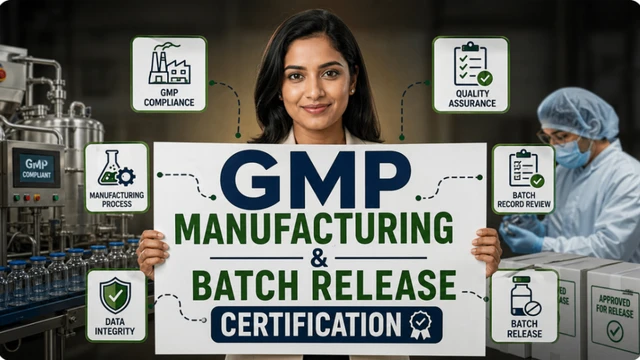
- Get Hands-On with Documentation (Week 3-4). Practice writing a deviation report on a mock scenario (e.g., ‘Mixer stopped during granulation’). Use a system where you can simulate this — real companies won’t risk giving a fresher their live documents. Simulation-based courses (like the GMP Manufacturing & Batch Release Certification from ZANE ProEd) let you do exactly this without stepping into a plant. \n
- Learn an Instrument (Week 5-6). For QC aspirants, understanding at least one advanced instrument is a superpower. Focus on HPLC. Learn about column chemistry, mobile phase buffer preparation, and peak integration. Free resources from WHO and FDA include lab testing guidelines. \n
- Mock Interviews + Certification (Week 7). Practice the most common QA QC interview questions (see below). Record yourself answering. Then, add a professional certification to your resume from a recognized system like ZANE ProEd’s Quality Management System program. This bridges the credibility gap fast. \n
Common QA QC Interview Questions (and How to Answer)
\nBe ready for these during your pharma quality control career interviews:
\n- \n
- “What is GMP?” Don’t just recite the definition. Say: “GMP is a system that ensures products are consistently produced and controlled according to quality standards. It covers everything from raw material receipt to final product release. For example, cleaning validation prevents cross-contamination.” \n
- “You find an OOS result. What do you do?” Outline the phase 1 investigation: check for obvious lab errors, look at your sample preparation, instrument calibration. Then, if no error, initiate a full OOS investigation per the company’s SOP. \n
- “What’s the difference between a deviation and a change control?” A deviation is unplanned departure from a set parameter; change control is a planned modification (like changing a supplier) that needs approval before implementation. \n
Note: practicing these scenarios through simulation builds fluency that impresses interviewers.
\nSimulation: The Missing Link to Land a QA/QC Job
\nYou can’t learn driving just by reading a manual. Similarly, QA/QC skills need practice. Simulation-based learning puts you in realistic scenarios — you manage a mock batch release, investigate a sterility failure, or review an audit report — all from your laptop. This builds confidence and bridges the “internship gap” because you’re actually doing the job, not just watching. This is exactly where ZANE ProEd fits in. Their programs aren’t just theory; you work on industry-level case studies. When a recruiter asks, “Have you handled deviations?” you can honestly say, “Yes, I’ve practiced managing deviation workflows in a GMP-simulated environment.”
\nBuild These Skills Now
Programs from ZANE ProEd Academy that directly address the skill gaps discussed above.
Why ZANE ProEd is Different
\nImagine having a virtual pharma plant where you can make mistakes without consequences. The gmp-manufacturing-batch-release-certification course puts you in the shoes of a QA Executive, teaching you to review batch records, handle exceptions, and release products. The quality-management-system-certification program goes deeper into how an entire quality system works — including audits, CAPA management, and regulatory compliance. Instead of feeling lost in your first job, you’ll walk in with hands-on experience that your peers don’t have. These aren’t just courses; they’re training systems to make you productive from day one. Many freshers have used them to turn “We’re looking for experienced candidates” into “When can you start?”
\nReady to see your actual job readiness? Check how your skills compare to what the industry demands. You might be closer than you think.
Build These Skills Now
Programs from ZANE ProEd Academy that directly address the skill gaps discussed above.
Follow Zane ProEd on Google
Preferred SourceAdd our publication as a preferred source to get the latest clinical research guides, industry updates, and career intel directly in your Google Top Stories & AI Overviews.