Signal Detection Pharmacovigilance Career in India: Complete Roadmap for Life Science Freshers

Signal Detection Specialist — A signal detection pharmacovigilance career involves reviewing safety data to identify new or changing drug safety signals. Freshers with BSc/MSc Life Sciences can enter through case processing, learn tools like Argus Safety and Empirica Signal, and earn ₹3.5–8.5 LPA in Indian pharma hubs.
If you are a BSc or MSc Biotechnology, Microbiology, or Biochemistry graduate in India, you have probably stared at a long list of options — clinical research, medical coding, regulatory affairs, quality control, pharmacovigilance — and felt genuinely stuck. The confusion is real, but there is a structured way out. A signal detection pharmacovigilance career is one of the few life science paths where your degree, your eye for detail, and your data curiosity convert directly into a stable, high-growth job.
Signal detection sits at the intelligence layer of pharmacovigilance. You are not just entering individual case reports — you are reading thousands of them together and asking a sharper question: is this drug doing something new, worse, or unexpected?
Build These Skills Now
Programs from ZANE ProEd Academy that directly address the skill gaps discussed above.
This guide is a decision framework. By the end, you will know what the job actually is, what it pays in India, which tools employers expect, and how to become a Signal Detection Specialist without wasting two years guessing.
What is signal detection in pharmacovigilance? A Signal Detection Pharmacovigilance Career Explained
Signal detection is the ongoing scientific process of reviewing cumulative safety data to find a signal — a new or incompletely documented relationship between a drug and an adverse event that deserves further investigation.
In plain terms: case processing records what happened to one patient. Signal detection asks whether the same problem keeps reappearing across many patients, countries, and time periods.
Daily activities in a typical signal detection job description
- Reviewing individual case safety reports (ICSRs) and aggregate safety data
- Running disproportionality calculations such as PRR, ROR, BCPNN, and EBGM
- Triaging and prioritising alerts inside a signal management system
- Validating signals using medical literature, product labels, and databases like FAERS and EudraVigilance
- Writing signal evaluation reports and supporting PSUR / PBRER generation
- Presenting findings to a Safety Review Committee
Pharmacovigilance signal management is a regulated activity. Every step — from alert triage to signal closure — must be documented, traceable, and audit-ready. Read the global framework at ICH and the Indian regulatory requirements at CDSCO. Global safety monitoring guidance is available at the WHO.
What is the salary of a Signal Detection Specialist in India?
The signal detection specialist salary in India is consistently higher than entry-level case processing, because the role requires analytical judgment rather than pure data entry.
- Fresher / 0–1 year (post-training): ₹3.5 – ₹5 LPA
- 1–3 years: ₹5 – ₹8.5 LPA
- 3–6 years: ₹8.5 – ₹14 LPA
- 6+ years / Lead or Principal Specialist: ₹15 – ₹25+ LPA
Location shifts the number. Hyderabad, Bangalore, Pune, and Mumbai host the largest pharmacovigilance delivery centres in India, including global capability centres of major pharma companies and large CROs.
Hyderabad and Bangalore often pay 10–15% more than other cities for the same experience level, mainly because of higher demand and a denser talent market.
One more pattern is worth noting. A candidate with a verifiable portfolio and tool exposure can negotiate ₹1–2 LPA above a peer with the same years of experience but no demonstrable skill proof.
How to become a Signal Detection Specialist?
There is no single door into this role. Use this decision tree to find your fastest route based on where you are today.
Decision tree: pick your entry point
- No industry experience at all? Enter through pharmacovigilance case processing, then move into signal detection in 12–18 months.
- Strong statistics or data skills? Apply directly for junior signal detection or aggregate reporting roles.
- Already in PV but stuck in data entry? Build signal-specific portfolio work and apply internally before switching companies.
- MSc with literature review or research experience? Lead with your scientific literature screening and causality assessment skills.
What hiring managers actually check
- Can you explain the difference between a signal and an adverse event?
- Do you understand disproportionality analysis and its limitations?
- Have you worked inside a real signal management workflow?
- Can you document a signal evaluation clearly enough to survive an audit?
- Do you understand MedDRA coding and its impact on signal quality?
Most freshers fail at point three. They can define a signal but have never run a single triage cycle end to end.
What tools are used for signal detection?
Signal detection tools and methods fall into four practical layers. Employers expect familiarity with at least the first three.
- Safety databases: Oracle Argus Safety, ArisGlobal ArisG, Veeva Vault Safety
- Signal management platforms: Oracle Empirica Signal, ArisGlobal LifeSphere Signal, VigiLyze
- Reference dictionaries: MedDRA, WHO Drug Dictionary
- Analytics and reporting: Microsoft Excel (pivot tables, PRR calculations), R or Python for data exploration, Power BI for dashboards
Method-wise, you should be able to explain disproportionality analysis, Bayesian data mining, and qualitative signal assessment using case narratives and literature.
The important truth: tools change between companies, but the workflow logic stays the same. Learn the workflow once, and any platform becomes easy to pick up.
What qualifications are needed for signal detection roles?
Indian employers typically expect the following baseline for Signal Detection Specialist roles.
- Education: BPharm, MPharm, BSc/MSc Life Sciences (Biotechnology, Microbiology, Biochemistry, Zoology), Nursing, or MBBS/BDS
- Domain knowledge: Good Pharmacovigilance Practices (GVP) modules, ICH E2E, and Indian pharmacovigilance regulations
- Technical knowledge: MedDRA coding, causality assessment, disproportionality analysis, safety database navigation
- Soft skills: Scientific writing, medical literature interpretation, and clear communication with global teams
Formal qualifications open the interview door. Practical workflow proof is what converts the interview into an offer.
Why is a BSc or MSc degree alone not enough for a signal detection job in India?
This is the gap that confuses most life science graduates, and it is worth stating plainly.
- What your degree taught you: cell biology, microbiology, biochemistry, laboratory techniques, organic chemistry, and how to write a dissertation.
- What employers actually expect: how to triage an alert, how to run PRR and ROR, how to write a signal evaluation report, how to navigate Argus Safety and Empirica Signal, and how to defend your assessment in front of a Safety Review Committee.
Your degree gave you the scientific thinking. The industry needs the operational workflow on top of it. In a highly competitive Indian market, especially in Hyderabad and Bangalore, hundreds of equally qualified graduates apply for the same fresher role.
The candidate who can demonstrate the workflow wins. Every time.
Which step-by-step pathway gets you from fresher to Signal Detection Specialist?
Follow this five-step roadmap. It is designed for a BSc/MSc life science graduate with zero industry experience.
- Build the foundation (Weeks 1–3): learn pharmacovigilance basics, ICSR lifecycle, GVP modules, and MedDRA coding fundamentals.
- Learn the signal workflow (Weeks 4–7): study signal intake, triage, validation, prioritisation, evaluation, and closure.
- Master the calculations (Weeks 8–10): practise PRR, ROR, BCPNN, and EBGM on realistic safety datasets.
- Get hands-on with tools (Weeks 11–14): work through simulated Argus Safety case processing and signal management dashboards.
- Build portfolio proof (Weeks 15–18): complete 3–5 documented signal evaluation reports that you can show in an interview.
This mirrors the internal onboarding that companies run for new hires — which is exactly why it works in interviews.
How do you prove signal detection skills without prior industry experience?
You cannot fake experience in pharmacovigilance — auditors and interviewers will find the gaps. But you can build proof.
Simulation-based learning is the bridge. Instead of only watching lectures, you work inside realistic environments — case intake, coding, triage, disproportionality analysis, signal write-up — and produce an output that looks exactly like industry documentation.
Verifiable portfolio proof is the second half. A set of completed signal evaluation reports, an audit-ready activity log, and a documented tool walkthrough give an interviewer something concrete to evaluate.
If you also want a parallel career option in data-driven safety evidence, review the Real-World Evidence career roadmap for Indian freshers.
Build These Skills Now
Programs from ZANE ProEd Academy that directly address the skill gaps discussed above.
Which professional certification prepares you for signal detection roles?
ZANE ProEd Academy is a premier professional career-certification platform for life science graduates. Programs are built around industry-grade simulation toolkits that mirror what teams actually use — Argus Safety ICSR case processing, Medidata Rave EDC, Veeva Vault eTMF, and FDA 21 CFR aligned submission workflows.
For this specific career target, two structured programs matter most:
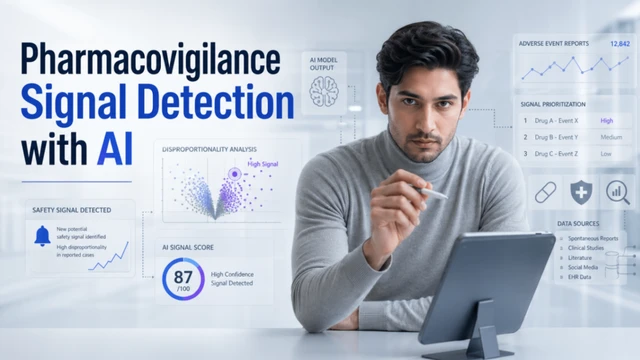
- Pharmacovigilance Signal Detection with AI — end-to-end signal management: intake, triage, disproportionality analysis, evaluation reporting, and AI-assisted signal prioritisation.
- AI-Powered Pharmacovigilance Specialist — broader PV capability covering case processing, aggregate reporting, and applied AI in safety workflows.
The return on investment is straightforward. Professional certification closes your qualification gap, creates an audit-ready portfolio, and prepares you for high-paying industry roles instead of a long job hunt with nothing to show.
Employers in Hyderabad, Bangalore, Pune, and Mumbai do not hire promises. They hire demonstrated workflow capability.
Audit your industry readiness before you apply
Before you send another application, ask three questions. Can you explain the full signal management lifecycle out loud? Can you calculate and interpret a disproportionality metric? Can you produce a document that an auditor would accept?
If any answer is no, that is your next step — not another resume rewrite.
Explore the professional certification blueprints at ZANE ProEd Academy, review the simulation curriculum for signal detection, and start building proof instead of waiting for an opportunity that rewards it. Learn more about the team behind the training at About ZANE ProEd.
Build These Skills Now
Programs from ZANE ProEd Academy that directly address the skill gaps discussed above.
Follow Zane ProEd on Google
Preferred SourceAdd our publication as a preferred source to get the latest clinical research guides, industry updates, and career intel directly in your Google Top Stories & AI Overviews.