The Unspoken Roadmap to a Pharmacovigilance Case Processor Role for Indian BPharm/Life Science Freshers

The BPharm/BSc Paradox: Why Your Degree Isn't Enough
If you're a recent BPharm or Life Sciences graduate in India, you're likely feeling a specific kind of confusion. You did everything right. You earned the degree, studied pharmacology, and maybe even memorized a few regulatory guidelines. Yet, when you look at job descriptions for a Pharmacovigilance Case Processor, it feels like they're written in a different language. There's a chasm between your academic knowledge and the job's demands, and no one gave you a map to cross it.
This feeling isn't your fault; it's a systemic failure. The academic system prepares you to know 'what' pharmacovigilance is. The industry, however, needs you to 'do' pharmacovigilance from your first day. They aren't looking for another student; they are hiring a professional who can protect patient safety and mitigate company risk. This urgency for job-ready talent is intensifying, leaving countless bright graduates stuck in a cycle of rejected applications and frustrating interviews.
Reality Check: Deconstructing the Path to a Pharmacovigilance Case Processor Role
Let's dismantle the myths that are holding you back. Your degree is a prerequisite, not a passport. That online certificate promising a 'guaranteed job' is often a PDF that teaches you less than a good textbook. Even internships can be misleading, tasking you with superficial work that doesn't build the core, high-stakes skills a real Case Processor uses daily.
Build These Skills Now
Programs from ZANE ProEd Academy that directly address the skill gaps discussed above.
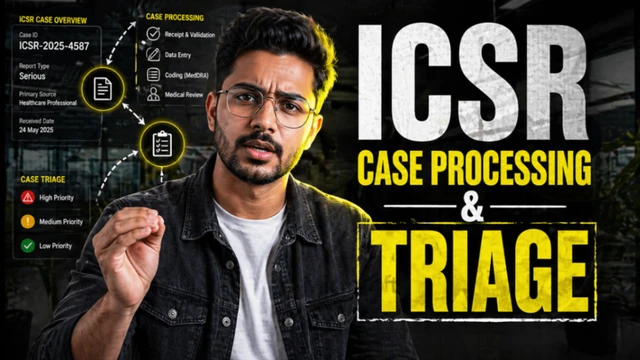
The industry doesn't operate on theory. It operates on execution, precision, and speed under immense regulatory pressure. A hiring manager doesn't care if you can define an 'Adverse Event'. They care if you can correctly triage a complex case, code it accurately using MedDRA, write a medically coherent narrative, and do it all within the strict reporting timelines mandated by agencies like the CDSCO in India or the FDA in the US.
The Insider's View: What Hiring Managers Actually Want
As industry insiders, we see the disconnect clearly. We don't hire resumes; we hire capabilities. We are looking for evidence that you can handle the core workflow of Individual Case Safety Report (ICSR) processing. This means demonstrating proficiency in:
- Triage Intelligence: Can you look at an unstructured report and immediately determine if it meets the criteria for seriousness as defined by regulators like the International Council for Harmonisation (ICH)?
- Data Precision: Can you extract and enter data into a safety database (like Oracle Argus or ARISg) with near-perfect accuracy? A single mistake can have massive compliance implications.
- Medical Coding Acuity: It's not just about finding a term in MedDRA. It's about selecting the *most appropriate* term that accurately reflects the clinical reality of the event.
- Narrative Craftsmanship: Can you write a clear, concise, and medically sound case narrative that tells the complete story for a regulator to understand?
The Critical Skill Gap: College Theory vs. Industry Execution
The gap is not about knowledge; it's about application. It's the difference between knowing the recipe and being able to cook in a high-pressure restaurant kitchen during peak hours.
What College Teaches You:
- Definition of an Adverse Drug Reaction (ADR).
- List of global regulatory authorities.
- The theoretical steps of case processing.
What the Industry Expects on Day 1:
- Assess an incomplete, real-world report from a doctor's handwritten note to determine seriousness, expectedness, and causality based on the Company Core Data Sheet (CCDS).
- Navigate the specific submission timelines for a serious, unexpected ADR for India versus the European Medicines Agency (EMA).
- Execute all four core ICSR tasks (triage, data entry, coding, narrative) for a single case within a stringent quality and time deadline.
The 'Clinical Acuity Gap' Framework
We call this chasm the 'Clinical Acuity Gap'. It is the void between passive academic knowledge and the active, decision-making intelligence required to handle real patient safety data. Your degree gives you the scientific foundation, but it doesn't build the clinical acuity to interpret, analyze, and act on ambiguous information. Closing this gap is the single most important step in your transition from fresher to professional.
The Playbook: A 5-Step Roadmap to Bridge the Gap
Stop collecting certificates and start building a system for competence. Here is the execution-level playbook to become a top-tier Pharmacovigilance Case Processor.
- Master ICSR Fundamentals, Not Just Definitions: Go beyond the 'what' and into the 'how' and 'why'. Understand the complete lifecycle of a case, from receipt to submission. Focus on the interplay between medical assessment and regulatory compliance.
- Develop High-Fidelity Triage Skills: Triage is the gatekeeper of pharmacovigilance. Learn to rapidly assess source documents and make defensible decisions on case validity and seriousness according to global standards like those from the World Health Organization (WHO).
- Learn to 'Speak' MedDRA: Medical coding is a language. You must develop fluency in MedDRA (Medical Dictionary for Regulatory Activities) to translate clinical verbatims into standardized, analyzable data. This is a non-negotiable skill.
- Practice Narrative Writing Relentlessly: This is where many fail. A good narrative is a medical story. It must be logical, chronological, and contain all key elements without ambiguity. Practice summarizing case information into a professional narrative. This is why many candidates fail, a problem we detail in our analysis of common certificate mistakes.
- Gain Experience Through Simulation: You cannot learn to process cases by reading about it. You need to get your hands on realistic, complex cases and process them in a simulated environment that mirrors a real company's workflow.
Micro-Scenario: Your First Real Test
Imagine this: A case file lands on your desk. It's an email from a clinic in rural Kerala. The text is brief: 'Patient Mr. Sharma, 58y/o, on our Drug Z for hypertension, now has severe jaundice and elevated liver enzymes. Pls advise.' Your performance clock starts now. What are your immediate next steps? Is this serious? How do you code 'jaundice' and 'elevated liver enzymes' in MedDRA? What follow-up questions do you need to ask? This is the job. Your ability to answer these questions decides your career trajectory, and it is a core part of the decision framework every graduate must consider.
The Bridge from Theory to Practice: Simulation-Based Learning
How do you get this experience without having a job? You can't. Not with traditional methods. Reading books and watching videos creates passive knowledge. To gain active skill, you must replicate the professional environment. You need a system that allows you to process dozens of diverse, realistic cases—from simple to complex—and receive expert feedback on your performance. This is the only way to build the muscle memory and clinical acuity the industry demands.
A simulation-based training system isn't about passing a test; it's about building operational readiness. It's designed to expose you to the pressures, ambiguities, and challenges of a real case queue, allowing you to make mistakes and learn in a controlled environment before you ever touch a live patient report.
Build These Skills Now
Programs from ZANE ProEd Academy that directly address the skill gaps discussed above.
Building Your Operating System with the ZANE ProEd Method
At ZANE ProEd, we don't sell courses; we build professional operating systems. Our methodology is designed to systematically eliminate the 'Clinical Acuity Gap' by immersing you in high-fidelity simulations that replicate the demands of a top pharmaceutical company.
Our training modules are integrated components of this system. The ICSR Case Processing & Triage simulation is your virtual work environment, where you will process a full range of cases, from routine to complex, mastering the core workflow. This isn't a quiz; it's a performance environment.
This component fits within our broader End-to-End Pharmacovigilance Certification program. This is the complete system that takes you from foundational case processing to more advanced concepts like aggregate reporting and signal detection, building you into a versatile and highly valuable drug safety professional. It’s a structured pathway from academic knowledge to industry authority, built on a foundation of practical application. Our entire methodology is transparent, focused on one thing: building real-world capability.
Stop Collecting Paper. Start Building Skills.
The path to a successful career as a Pharmacovigilance Case Processor is not about accumulating more certificates. It's about demonstrating verifiable, practical skills. It’s time to move beyond the limitations of your degree and step into a system designed for professional execution.
Explore the framework. Analyze the skills gap. Make a strategic decision to build the capabilities that the industry is actively hiring for right now.
Build These Skills Now
Programs from ZANE ProEd Academy that directly address the skill gaps discussed above.
Follow Zane ProEd on Google
Preferred SourceAdd our publication as a preferred source to get the latest clinical research guides, industry updates, and career intel directly in your Google Top Stories & AI Overviews.