Stop Memorizing Theory: The Real Clinical Data Manager Workflow Your Degree Missed

Stop Trying to Memorize Your Way into a CDM Job
Let's be blunt: stop re-reading your textbook chapters on clinical trial phases. Stop making flashcards of GCP definitions. While well-intentioned, these academic exercises are the slowest, least effective path to landing a high-paying Clinical Data Manager (CDM) role in today's hyper-competitive life sciences industry.
You’ve been told that a good degree and a certification are the keys. But fresh graduates with perfect GPAs are discovering a harsh reality: hiring managers aren't asking them to recite regulations. They're asking them to describe their experience with User Acceptance Testing (UAT) for an EDC system, or how they would design an edit check for a complex inclusion/exclusion criterion. The silence in response is deafening, and it’s why so many resumes end up in the 'no' pile.
The urgency is palpable. As companies accelerate drug development timelines, they are no longer willing to invest 12-18 months training new hires on fundamental workflows. They demand job-ready talent from day one, and the gap between academic knowledge and practical execution has become a career-ending chasm for the unprepared.
Build These Skills Now
Programs from ZANE ProEd Academy that directly address the skill gaps discussed above.
The Great Disruption: Why Your Degree Isn't Enough
Your B.Pharm, M.Sc, or Life Sciences degree taught you the 'what' and the 'why' of clinical research. You understand the importance of data integrity and patient safety. But the industry operates on the 'how'. It's a world of systems, processes, and unforgiving timelines governed by strict regulatory bodies like the U.S. Food and Drug Administration (FDA) and the European Medicines Agency (EMA).
Companies expect you to walk in with a working knowledge of the tools and the workflow. They assume you know what a Data Management Plan (DMP) is, how to contribute to a Data Validation Plan (DVP), and the role you play in a database lock. This is a point we've also highlighted in our analysis of why academic degrees alone fall short for roles like CRAs, and the principle is identical for CDMs. You can read more in our guide on why your B.Pharm degree isn't enough for a CRA job.
An Insider's View: What Hiring Managers Actually Want
As industry insiders, we see the disconnect daily. A hiring manager for a global CRO doesn't need someone who can define 'protocol deviation'. They need someone who can help design an eCRF that prevents it from happening. They need a CDM who can write a clear, concise query to a clinical site to resolve a data discrepancy, not just identify one.
They expect you to understand the rhythm of a clinical trial's data lifecycle. They want to hear you talk about managing data snapshots for an interim analysis, performing medical coding using MedDRA and WHODrug, and preparing the final dataset for statistical analysis. This isn't theory; this is the daily, operational reality of the job, and it's where the real value—and salary—lies. The difference in earning potential between a theoretical candidate and a workflow-proficient one is significant, as detailed in our Clinical Data Manager Salary Guide.
The Skill Gap Exposed: College vs. CRO
The gap between what you learned and what you need to know is stark. Let's visualize it:
- College Teaches: The definition of Good Clinical Practice (ICH E6).
- Industry Expects: How to apply GCP principles to build and test edit checks in an EDC system like Medidata Rave or Oracle Clinical.
- College Teaches: The importance of accurate data collection.
- Industry Expects: The ability to design an intuitive, user-friendly eCRF that minimizes data entry errors at the clinical site.
- College Teaches: The concept of a clinical trial protocol.
- Industry Expects: The skill to deconstruct a protocol into a set of specific data points, validation rules, and reporting requirements.
The Clinical Data Workflow Fluency Model™
At ZANE ProEd, we've mapped this gap and engineered a solution we call the Clinical Data Workflow Fluency Model™. It's not about memorization; it's about sequential skill acquisition that mirrors exactly how data is managed in a real-world setting. It consists of three layers:
- Foundational Compliance: This is the base layer—the 'what'. Understanding GCP, 21 CFR Part 11, and other relevant guidelines from bodies like the CDSCO. This is where academic knowledge fits.
- Procedural Execution: This is the 'how'. It's the step-by-step process of authoring a DMP, designing eCRFs, writing validation specifications, conducting UAT, and managing queries. This is the core workflow.
- Systems Mastery: This is the 'where'. It’s the application of the procedures within the specific software environments (EDC systems, reporting tools) that the industry uses every single day.
Most graduates are stuck at Layer 1. A successful CDM career requires fluency across all three layers.
Your Structured Pathway to Workflow Fluency
So, how do you move from Layer 1 to Layer 3? By systematically understanding and then simulating the end-to-end CDM workflow. Here is the exact blueprint:
Step 1: Protocol to eCRF Design
It all starts with the clinical trial protocol. Your first real task is to read the protocol not as a student, but as an architect. You must identify every single data point required to meet the study's objectives and translate them into logical groupings for an Electronic Case Report Form (eCRF). This involves decisions on field types, prompts, and visit schedules.
Step 2: Authoring the Data Validation Plan (DVP)
Once you know what data you're collecting, you must define the rules that govern it. The DVP is the master instruction manual for data quality. Here, you'll specify hundreds of logical checks (e.g., "If Patient Sex is Male, then Pregnancy Test result must be Not Applicable"). This document is the blueprint for the programmers who build the edit checks into the EDC system.
Step 3: Executing User Acceptance Testing (UAT)
Before a study goes live, you must try to 'break' the system. UAT involves creating test scripts and dummy data to rigorously challenge every form, field, and edit check you defined in the DVP. Did the edit check fire when you entered an out-of-range value? Did the form logic work as expected? Finding an error here saves millions of dollars and months of time compared to finding it with live patient data.
Step 4: Live Data Cleaning & Query Management
Once the study is live, the real work begins. Data flows in from clinical sites around the world. Your role is to run validation checks, identify discrepancies, and manage the query lifecycle. This is a delicate process of communicating with site staff (CRCs and Investigators) to resolve data issues without influencing their medical judgment. It requires technical skill, precision, and diplomacy.
Step 5: Database Lock Preparation
As the last patient completes their final visit, the focus shifts to preparing for database lock. This is a high-pressure period involving final data reviews, resolving all open queries, performing SAE reconciliation with the pharmacovigilance team, and ensuring all required documentation is complete and signed. It is the final quality gate before the data is handed over to the statisticians.
Micro Scenario: The Query That Saves a Study
Imagine a Phase II diabetes trial. A subject's blood glucose is entered as '30 mg/dL', an extremely low, life-threatening value. The system flags it. A junior CDM might just raise a query: "Please confirm value." An effective, workflow-fluent CDM does more. They check the subject's concomitant medications for insulin. They review previous glucose readings for a trend. They formulate a precise, non-leading query: "Per the EDC, a blood glucose value of 30 mg/dL was entered for Subject 101 at Visit 3. Please verify this value against the source document or provide a clarifying comment." This level of detail and context is what separates a data clerk from a Clinical Data Manager.
The Bridge from Theory to Practice: Simulation
Reading about this workflow is a start. But it's like reading a manual on how to fly a plane. To truly gain confidence and competence, you must get in the cockpit. In the world of clinical data management, this means working in a simulated environment that mirrors the pressures, tools, and processes of a real CRO or pharmaceutical company. This is the only way to internalize the workflow and build the muscle memory that hiring managers are desperately seeking.
You need a system where you can practice designing an eCRF, writing a DVP, executing UAT, and managing queries on a realistic project. This builds a portfolio of demonstrable skills that speaks louder than any certificate.
Build These Skills Now
Programs from ZANE ProEd Academy that directly address the skill gaps discussed above.
Integrating into an Industry-Standard System
This is precisely why we built the ZANE ProEd ecosystem. It's not a collection of courses; it's a system designed to build workflow fluency. Our Clinical Data Management with EDC Certification program is a full-scale simulation of this entire end-to-end process. You don't just learn about the DVP; you author one. You don't just read about UAT; you execute it on a live, simulated EDC platform.
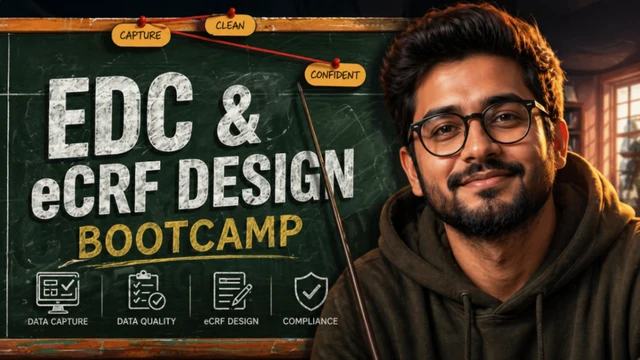
For those looking to build deep, specialist skills within this workflow, our EDC & eCRF Design Bootcamp provides an intensive, project-based immersion into the most critical upfront stage of data management. By mastering the art and science of eCRF design, you become an invaluable asset to any clinical trial team from the very beginning.
Together, these programs form a comprehensive system for transforming your academic knowledge into the practical, job-ready skills the industry demands.
Start Building Your Workflow Fluency
Your career as a Clinical Data Manager won't be defined by the facts you can memorize. It will be defined by the workflows you can execute. Stop studying theory and start building practical skills. Explore the projects you'll build and see the simulated environment where you'll develop the competence and confidence to step into your first CDM role. Your future team is waiting for someone who can do the work, not just talk about it.
Build These Skills Now
Programs from ZANE ProEd Academy that directly address the skill gaps discussed above.
Follow Zane ProEd on Google
Preferred SourceAdd our publication as a preferred source to get the latest clinical research guides, industry updates, and career intel directly in your Google Top Stories & AI Overviews.