Why 90% Fail the Hospital QA/QC Executive Interview (And How to Be in the Top 10%)

The Uncomfortable Truth About Your Hospital QA/QC Interview
Let's be blunt. Over 90% of candidates walking into an interview for a QA/QC Executive role in an NABH-accredited hospital will be rejected within the first 15 minutes. They will have the right degree, a polished resume, and maybe even a generic quality management certification. They will confidently list the NABH chapters they've memorized. And they will fail.
Why? Because the hiring manager isn't looking for a walking textbook. They are looking for a risk mitigator, a process owner, and a problem solver. They have a critical gap in their hospital's operational integrity, and they need someone who can step in and demonstrate practical capability from day one, especially in the hyper-competitive Indian healthcare market.
The tension in the room isn't about what you know; it's about what you can do when a process fails. Your theoretical knowledge is the entry ticket, not the winning prize. The prize goes to the candidate who can prove they are truly job-ready, not just certified.
Build These Skills Now
Programs from ZANE ProEd Academy that directly address the skill gaps discussed above.
Reality Disruption: Your Certification is Not a Shield
The biggest assumption holding you back is the belief that completing a degree and a standard certification makes you a competitive applicant. It doesn't. It makes you part of the herd. Hospital Quality Managers and Medical Superintendents see dozens of resumes with the exact same qualifications. To them, it's just noise.
Recruiters aren't rejecting you because you lack knowledge. They're rejecting you because you lack evidence of applied skill. They filter out candidates who can only recite definitions of 'Root Cause Analysis' but freeze when asked to apply it to a real-life patient care scenario. Your internship report might look good, but if you can't articulate how you would handle a sudden spike in hospital-acquired infections (HAI), you're not getting the offer.
The Industry Insider View: What We're Actually Screening For
As someone who has been on the other side of the interview table, let me tell you what we're really thinking. We don't care if you can list all 10 NABH chapters. We care if you understand how Chapter 5 (Care of Patients - COP) directly impacts Chapter 9 (Information Management System - IMS) during a medication error.
We are screening for operational fluency, not academic memory. We need to know:
- Can you conduct a meaningful audit that isn't just a box-ticking exercise?
- Can you confidently face a committee and explain a non-conformance report without getting defensive?
- Can you connect a quality incident not just to a standard, but to its impact on patient safety, hospital reputation, and financial liability?
This is a world away from the theoretical knowledge many bring to the table. This is similar to the brutal truths faced by B.Pharm graduates trying to enter pharma QA, a challenge we've detailed in the brutal truth about landing a pharma QA/QC executive role. The principle is the same: industry demands application, not just information.
The Skill Gap Exposed: College Output vs. Hospital Expectation
The gap between what your college taught you and what a hospital needs is a chasm. It's the primary reason candidates with perfect academic records get rejected.
What Academia Provides:
- Knowledge of Standards: You can define NABH, JCI, and maybe reference guidelines from CDSCO.
- Theoretical Processes: You know the *terms* CAPA, RCA, and Audit.
- General Concepts: You understand the importance of patient safety and quality indicators.
What Hospitals Demand:
- Implementation Strategy: How do you roll out a new patient identification protocol across three shifts with minimal disruption?
- Practical Application: Given a specific incident, can you draft a preliminary incident report, identify immediate containment actions, and assemble the right team for an RCA?
- Stakeholder Management: How do you convince a senior surgeon that their pre-op checklist process is non-compliant and needs to change, without creating conflict?
Introducing The Clinical Process Inertia Model™
At ZANE ProEd, we identify this disconnect as the Clinical Process Inertia Model™. It's the principle that theoretical knowledge remains static and useless—'inert'—until it is activated by the force of a real-world clinical scenario. Your knowledge of NABH standards has inertia. It only gains momentum and value when you apply it to a dynamic, high-pressure situation, like an unannounced audit or a critical patient safety event. Recruiters are testing for this momentum, and most candidates are found standing still.
The Interview Mistake Audit: 3 Failures That Guarantee Rejection
Let's move from theory to a practical audit of the most common interview-killing mistakes. If you recognize yourself here, you need to change your approach immediately.
-
Mistake #1: The 'Chapter Reciter'
The Scenario: The interviewer asks, "How would you ensure our hospital complies with NABH standards for medication management?"
The Failed Answer: "According to NABH Chapter 6 on Medication Management and Use (MMU), we need to ensure proper prescription, storage, administration..."
Why it Fails: This tells the interviewer nothing. You are reciting a table of contents. The correct approach is to describe a system. A winning answer would be, "I'd start by auditing the current workflow from prescription to administration. I'd check for look-alike/sound-alike drug segregation, review pharmacist verification protocols, and implement a double-check system for high-alert medications at the nursing station. Then, I'd use spot-checks and training to ensure compliance." -
Mistake #2: The 'Impact Ignorer'
The Scenario: "Tell me about a time you identified a quality issue."
The Failed Answer: "In my internship, I found that some consent forms weren't filled out correctly, so I told the nurse to fix them."
Why it Fails: This answer shows a complete lack of business and risk acumen. You identified a task, not an impact. The superior answer connects the dots: "I identified incomplete consent forms, which poses a significant medico-legal risk. I immediately flagged it, conducted a quick audit to scope the problem, and suggested a simplified, bilingual form and a mandatory checklist for the admissions desk. This reduced errors by 40% and protected the hospital from potential litigation." -
Mistake #3: The 'Tool Namer'
The Scenario: "A patient falls in the ward. How do you investigate?"
The Failed Answer: "I would use a fishbone diagram and the 5 Whys to do a Root Cause Analysis."
Why it Fails: You named a tool, you didn't demonstrate its use. It's like a carpenter saying "I'd use a hammer" without knowing what to build. A job-ready answer is: "First, ensure patient safety. Then, I'd secure the area and gather immediate data: time, location, witnesses, patient condition, and environmental factors like a wet floor or poor lighting. I'd then assemble a small team—the floor nurse, a physician, and facilities staff—to apply the 5 Whys. Was the floor wet? Why? Because of a leak. Why was there a leak? And so on, until we find the systemic failure, not just blame an individual." This shows a structured, logical, and practical approach. This level of readiness is crucial across all healthcare roles, including those aspiring to become a CRA, as discussed in the unspoken CRA roadmap.
Micro-Scenario: The High-Stakes Test
Imagine this question: "A pathologist reports a critical lab value for a patient in the ICU, but the system shows the primary physician was not notified for 45 minutes. What are your immediate first three actions as the QA Executive?"
Your answer to this single question can reveal more about your competence than your entire resume. Thinking time is over. The hospital's reputation and a patient's life are on the line. Can you act, or can you only quote standards?
The System Bridge: Escaping Theoretical Purgatory
Reading more textbooks or another NABH manual will not prepare you for that micro-scenario. You cannot learn to swim by reading a book about water. The only way to break the 'Clinical Process Inertia' is to put your knowledge into motion.
This is where simulation-based learning becomes non-negotiable. You need a system that forces you to handle these scenarios—incident reports, mock audits, CAPA forms—in a controlled environment. You need to build the muscle memory for critical thinking under pressure, so that when the interviewer presents a scenario, your response is instinctual, structured, and impressive.
Build These Skills Now
Programs from ZANE ProEd Academy that directly address the skill gaps discussed above.
The ZANE ProEd Integration: Building Your Operational Reflex
This is precisely why ZANE ProEd is not just a course provider; we are an architect of professional competency. Our system is designed to destroy the gap between theory and practice. When you engage with our programs, you're not just watching videos; you're stepping into the role.
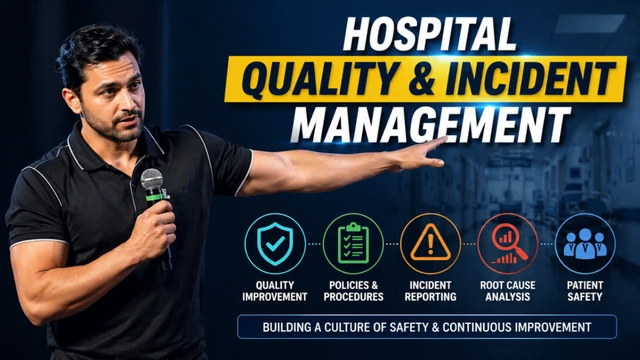
Our Hospital Quality Management Certification is engineered to take you beyond the 'what' of NABH standards and into the 'how' of implementation. You'll work through case studies on clinical audits, quality indicators, and committee meetings. Following this, the Hospital Quality Incident Management program immerses you in the very scenarios that trip up 90% of candidates. You will learn to manage sentinel events, conduct a Root Cause Analysis that holds up to scrutiny, and develop a CAPA plan that actually prevents recurrence.
This integrated system ensures you don't just learn the material—you internalize the workflow. You develop the operational reflex that hiring managers are desperately searching for. You stop sounding like a student and start sounding like a colleague.
Your Next Move: Stop Memorizing, Start Simulating
The choice is simple. You can continue collecting certificates and memorizing standards, hoping you'll be the exception to the 90% failure rate. Or you can decide to become the professional the industry is demanding.
Stop preparing to answer questions about quality management. Start preparing to be a Quality Manager. The next time you face an interviewer, you won't need to tell them you're ready. Your answers will show them.
Build These Skills Now
Programs from ZANE ProEd Academy that directly address the skill gaps discussed above.
Follow Zane ProEd on Google
Preferred SourceAdd our publication as a preferred source to get the latest clinical research guides, industry updates, and career intel directly in your Google Top Stories & AI Overviews.