Beyond the B.Pharm: The Brutal Truth About Landing a Pharma QA/QC Executive Role in India
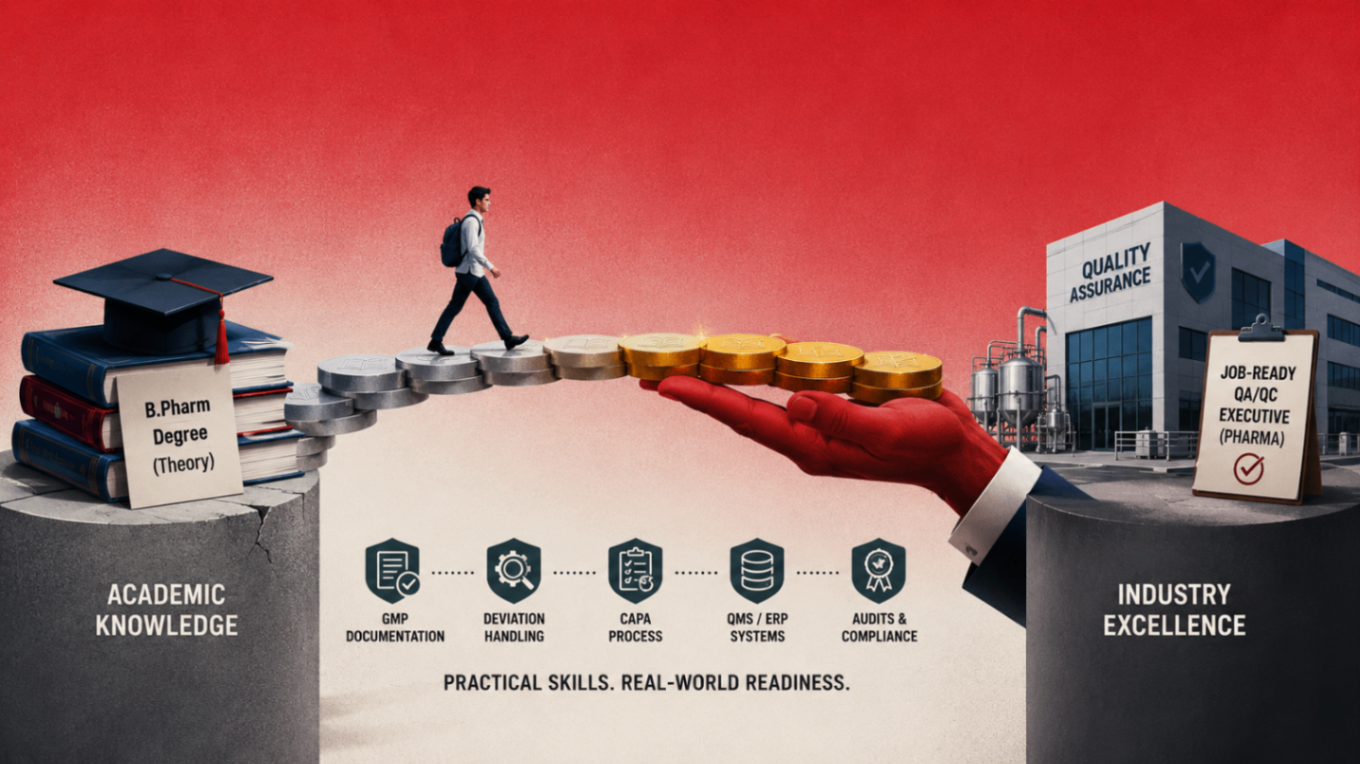
You Just Received Another Rejection. Let’s Talk About Why.
The email is painfully familiar. "Thank you for your interest... we have decided to move forward with other candidates." For a B.Pharm or Life Sciences fresher targeting a QA/QC Executive (Pharma) role, this has become a demoralizing routine. You have the degree. You have the marks. You’ve probably listed every relevant subject from your syllabus on your CV. So why are you still stuck while others are getting offer letters?
The answer is uncomfortable, and it’s something your college placement cell will never tell you. Recruiters don't just glance at your resume; they scan it for evidence of job readiness. And for 9 out of 10 freshers, that evidence is missing. They see a list of qualifications, but they don't see capability. They see theory, but they're hiring for execution.
This isn't another blog telling you to 'be confident' or 'network more'. This is an insider's breakdown from the other side of the hiring desk. We’re going to expose the critical gap between your academic knowledge and the real-world skills that get you hired in a modern pharmaceutical quality department, especially as hiring standards evolve globally.
Build These Skills Now
Programs from ZANE ProEd Academy that directly address the skill gaps discussed above.

Reality Disruption: Your Degree Got You the Interview, But It Won’t Get You the Job
Let's be brutally honest: your B.Pharm or BSc degree is the price of admission. It gets your resume into the initial pile. But it does not differentiate you from the thousand other applicants who have the exact same degree. The belief that high marks in Pharmaceutical Analysis or Quality Assurance will impress a hiring manager is the single biggest misconception holding freshers back.
Why? Because a recruiter's primary goal is to de-risk a hire. They are looking for someone who can solve problems from day one, not someone who needs six months of hand-holding to understand basic workflows. Your resume is not your capability. It’s a historical record of what you were taught, not a predictor of what you can do. The industry has shifted. They no longer have the time or resources to train you from scratch on fundamental operational skills.
The Recruiter’s Checklist: What They’re *Actually* Looking For
When a QA Manager or HR professional reviews your profile for a QA/QC Executive (Pharma) role, they are not looking for definitions. They are searching for keywords and concepts that signal practical understanding. Their mental checklist looks something like this:
- Does this candidate mention CAPA (Corrective and Preventive Action)? Not just the definition, but the process?
- Is there any mention of handling Deviations or Out-of-Specification (OOS) results?
- Do they understand the importance of Good Manufacturing Practices (GMP) beyond the textbook definition? Can they talk about GMP documentation? For more on this, the FDA's cGMP regulations provide a foundational understanding of industry expectations.
- Have they heard of a Quality Management System (QMS)? Can they name any software used for it, like Veeva QualityDocs or TrackWise?
- Can they explain the difference between Quality Assurance (process-oriented) and Quality Control (product-oriented) with a real-world example?
If your CV is filled with academic projects and subject names but lacks these operational terms, you are being filtered out before you even get a chance.
Skill Gap Exposure: College Output vs. Industry Expectation
The gap between what your college taught you and what the industry needs is a canyon. You were trained to be a student, but companies need you to be a practitioner. Here’s a direct comparison:
College Teaches You This:
- The definition of an SOP (Standard Operating Procedure).
- The full form and theoretical purpose of CAPA.
- The different phases of validation.
- To list instruments used in a QC lab.
Industry Expects You to Do This:
- Draft, review, and manage an SOP within a QMS, understanding version control.
- Participate in a root cause analysis for a deviation and help document the subsequent CAPA plan.
- Review validation protocols and reports for completeness and compliance.
- Handle the documentation for an instrument calibration failure and understand its impact on released batches. A quality failure here can have huge implications, even triggering safety reviews, a process we explored in our deep-dive on the world of Pharmacovigilance.
Seeing the difference? One is passive knowledge. The other is active, applied skill. This is the gap that’s causing your rejections.
The ZANE ProEd Skill Stack Architecture: Why You're Only 33% Job-Ready
To succeed as a QA/QC Executive, you need more than just knowledge. You need a complete skill stack. At ZANE ProEd, we call this the Skill Stack Architecture. It consists of three essential layers:
- Layer 1: Foundational Knowledge. This is your degree (B.Pharm, BSc). It covers the 'what' and the 'why'. You have this, but it’s only the base of the pyramid.
- Layer 2: Procedural Skills. This is the 'how'. It's the ability to execute industry-standard workflows: how to investigate a deviation, how to write a change control request, how to prepare for an audit. This layer is almost entirely missing from academic curricula.
- Layer 3: Systems Fluency. This is proficiency with the tools of the trade. Understanding how to navigate and operate within a digital Quality Management System (QMS), an Enterprise Resource Planning (ERP) system, or Laboratory Information Management System (LIMS).
Most freshers arrive at interviews with only Layer 1. They are, at best, 33% ready for the job. The candidates who get hired are the ones who can demonstrate at least an awareness and simulated experience in Layers 2 and 3.
A Recruiter's Mistake Audit: 4 Reasons Your Application Was Rejected
Let's reverse-engineer your rejection letters. Based on the Skill Stack Architecture, here are the four most common mistakes freshers make, turning them into an easy 'no' for recruiters.
Mistake 1: Your CV Reads Like a Syllabus
You listed "Quality Assurance" as a skill. This means nothing. The fix? Rephrase it into a procedural skill. Instead of "Knowledge of GMP," write "Understanding of GMP documentation, including Batch Manufacturing Records (BMR) and SOPs." It instantly shifts you from a passive learner to an active practitioner in the recruiter's mind.
Mistake 2: You Answer Interview Questions with Definitions
Interviewer: "Tell me about a deviation."
Typical Fresher Answer: "A deviation is any departure from an approved instruction or established standard."
Job-Ready Answer: "A deviation is a departure from a standard, and handling it involves immediate containment, followed by a formal investigation to find the root cause, implementing a CAPA to prevent recurrence, and documenting everything in the QMS. For example, if a temperature log showed a reading outside the specified range..."
The second answer demonstrates workflow knowledge (Layer 2), not just vocabulary (Layer 1).
Mistake 3: You Cannot Connect QA to the Broader Business
QA doesn't exist in a vacuum. A quality issue can halt production, delay a clinical trial, or lead to a product recall. When asked about the importance of QA, you must connect it to patient safety and business continuity. Mentioning its impact on other departments, like ensuring product integrity for trials managed by a Clinical Research Associate, shows strategic awareness.
Mistake 4: You Have Zero Exposure to Industry Tools
You don't need to be an expert, but you must show awareness. When asked about documentation, mentioning that companies use electronic systems like Veeva or MasterControl for QMS shows you've done your research and understand the modern pharma environment. It signals that your learning curve will be shorter.
Micro-Scenario: The Moment of Truth in an Interview
Imagine the interviewer slides a one-page document across the table. "This is a deviation report. A QC analyst recorded an incorrect weighing amount for an excipient in Batch XYZ. Talk me through your next five steps as the QA officer on duty."
Your mind goes blank. Your textbook never gave you a flowchart for this. Do you quarantine the batch first? Do you talk to the analyst? Do you initiate a CAPA right away? What form do you fill out? This hesitation is what costs you the job. The recruiter isn't looking for a perfect answer, but a logical, process-oriented thought process. They want to see you think in workflows, not just facts.
The System Bridge: From Theoretical Knowledge to Practical Capability
How do you gain that workflow knowledge without having a job? This is the classic chicken-and-egg problem for freshers. You can't get a job without experience, and you can't get experience without a job. The answer is not more theory or another generic certification. The answer is experience simulation.
You need a structured system that puts you in the middle of these micro-scenarios. A system that forces you to handle a simulated deviation, draft a mock SOP, and review a sample batch record. This is how you build the procedural skills (Layer 2) and systems fluency (Layer 3) that make you instantly valuable. It's about moving from 'I know what it is' to 'I know what to do'.
Build These Skills Now
Programs from ZANE ProEd Academy that directly address the skill gaps discussed above.
The ZANE ProEd approach is built on this exact principle. We don't just teach you the definition of CAPA; we guide you through a simulated CAPA process. Our QA/QC in Pharma & Healthcare program is engineered to build your Skill Stack from the ground up. It’s not a course; it’s a job-readiness system designed to translate your B.Pharm knowledge into the language of the industry. You’ll work on case studies that mirror the exact challenges you’ll face in your first week as a QA/QC Executive, covering everything from quality systems and deviation handling to audit preparation and NABH/ISO standards.
Stop collecting certificates that prove you can pass a test. Start building a portfolio of skills that proves you can do the job. The next time you apply for a QA/QC Executive (Pharma) role, your CV won't just list your degree. It will reflect your capability, your understanding of industry workflows, and your readiness to contribute from day one. That's how you don't just get an interview—you get the offer.
Build These Skills Now
Programs from ZANE ProEd Academy that directly address the skill gaps discussed above.
Follow Zane ProEd on Google
Preferred SourceAdd our publication as a preferred source to get the latest clinical research guides, industry updates, and career intel directly in your Google Top Stories & AI Overviews.