The Pharmacovigilance Shock: Why 90% of Freshers Won't Land a Drug Safety Job in 2026
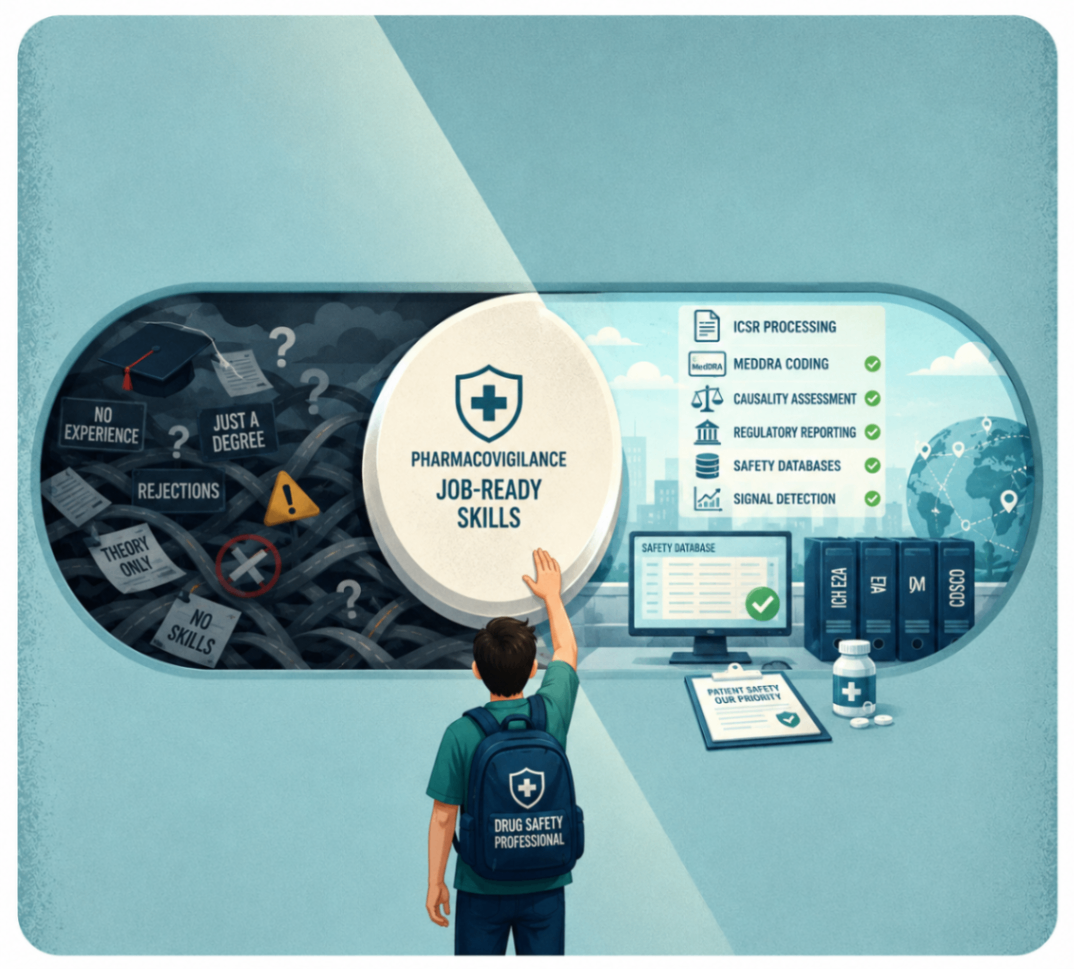
You graduated with a BSc, BPharm, or a Life Sciences degree. You’re passionate about healthcare, eager to contribute, and eyeing a career in Pharmacovigilance – a high-growth domain critical to drug safety globally. But here’s the brutal truth no one tells you: 90% of freshers will fail to secure a Drug Safety Associate role in 2026.
This isn't about your intelligence or your marks. It’s about a massive, unaddressed chasm between academic preparation and urgent industry demands. You feel stuck, bombarded by rejections, and increasingly confused by the sheer volume of conflicting advice. You might have even done an internship or two, only to find yourself still unqualified for the roles you desperately want. This isn’t a personal failing; it’s a systemic problem, and it’s costing you your career momentum.
The industry is transforming at breakneck speed, powered by AI and demanding immediate job-readiness. If you’re a fresher feeling lost, bewildered by the lack of opportunities despite your qualifications, this is the insider perspective you need to rewire your approach and seize control of your future.
Build These Skills Now
Programs from ZANE ProEd Academy that directly address the skill gaps discussed above.

The Brutal Reality: Degrees Alone Are Not Enough Anymore
Forget what you’ve been told about securing a job with just a degree. In today's highly competitive Indian pharmaceutical market, a BSc or BPharm is merely a ticket to the queue, not a pass to the front. Recruiters are not just looking for certifications; they're looking for capability. They want individuals who can hit the ground running, contribute from day one, and demonstrate a practical understanding of complex workflows.
The hard truth is, most fresh graduates are, by industry standards, unemployable in critical roles like Pharmacovigilance. Your theoretical knowledge of adverse events and drug mechanisms, while foundational, doesn't translate into the operational skills demanded by Pharma MNCs or CROs. Even internships, often superficial, rarely provide the depth of exposure needed to bridge this critical skill gap. You're competing against candidates who understand industry tools, processes, and real-world scenarios – a skillset rarely taught in traditional academia.
Beyond Textbooks: What a Drug Safety Associate ACTUALLY Does
To understand the gap, you must first understand the reality of the role. A Pharmacovigilance or Drug Safety Associate is not just logging adverse events. You are the frontline defender of patient safety, responsible for identifying, assessing, understanding, and preventing adverse effects or any other drug-related problems.
This involves intricate tasks such as:
- Individual Case Safety Report (ICSR) Processing: Meticulously extracting data from various sources (spontaneous reports, literature, clinical trials), performing MedDRA coding for adverse events and indications, and writing detailed clinical narratives.
- Causality Assessment: Evaluating the likelihood that a drug caused an adverse event, often using established algorithms and clinical judgment.
- Regulatory Reporting: Ensuring timely submission of ICSRs to regulatory authorities like CDSCO, FDA, or EMA, strictly adhering to ICH E2A guidelines and local regulations.
- Safety Database Management: Navigating and utilizing complex safety databases (e.g., Argus, ArisG) to input, manage, and query safety data.
- Contribution to Signal Detection: Assisting in the identification of new, unknown adverse reactions or changes in the frequency of known reactions.
This is a role that demands precision, critical thinking, and a deep understanding of global regulatory frameworks, not just memorized definitions.
The Skill Gap Exposed: College Output vs. Industry Expectation
Let's be brutally honest about where the disconnect lies:
| College Output | Industry Expectation (Pharmacovigilance Associate) |
|---|---|
| Theoretical understanding of PV principles. | Hands-on proficiency in ICSR processing, MedDRA coding, safety database entry. |
| Knowledge of drug classes and mechanisms. | Ability to perform causality assessment and write concise, medically accurate narratives. |
| Basic research paper analysis. | Understanding of signal detection methodologies and aggregate reporting processes. |
| General understanding of regulatory bodies. | Deep knowledge of global PV regulations (ICH, FDA, EMA, CDSCO) and their application. |
| No exposure to industry-standard software. | Working knowledge of PV safety databases (e.g., Argus, ArisG) and EDC systems. |
This stark contrast reveals why your resume, despite your academic achievements, might not be making the cut. The industry isn't asking for more degrees; it's asking for practical, demonstrable skills that translate directly into productivity.
The PV Job-Readiness Index: What Really Gets You Hired
To truly stand out, you need to understand the PV Job-Readiness Index. This isn't a theoretical concept; it's a practical assessment recruiters subconsciously apply to every candidate. It measures your immediate utility to a company, based on four critical pillars:
- Regulatory Acumen: Your deep, applied understanding of global PV regulations and guidelines. Can you navigate the nuances of reporting timelines and regional requirements?
- Technical Tool Proficiency: Your ability to competently use industry-standard software and databases, such as safety databases and MedDRA coding tools.
- Workflow Mastery: Your grasp of the end-to-end Pharmacovigilance process, from adverse event intake to ICSR submission and beyond. Can you step into a role and contribute without extensive hand-holding?
- Critical Application Skills: Your capability to analyze complex safety data, perform accurate causality assessments, and contribute to safety signal detection – moving beyond rote memorization to genuine problem-solving.
Most freshers score dismally low on this index, not due to lack of effort, but due to a fundamental Simulation vs. Theory Gap. Traditional education focuses heavily on theory, leaving you unprepared for the dynamic, application-heavy environment of a real PV department.
Your 3-Pillar Pathway to Pharmacovigilance Job-Readiness
Closing the Simulation vs. Theory Gap and boosting your PV Job-Readiness Index requires a strategic, structured approach. This is your playbook:
- Pillar 1: Master Industry Tools & Software: Don't just read about MedDRA; practice coding real-world adverse events. Don't just understand safety databases; get hands-on experience navigating and operating them. This practical competence is non-negotiable.
- Pillar 2: Immerse Yourself in End-to-End Workflows: Understand the entire lifecycle of a drug safety case. From initial receipt to follow-up queries, data entry, coding, narrative writing, quality control, and regulatory submission – each step is critical. You need to simulate these workflows repeatedly.
- Pillar 3: Develop Critical Application Skills: Learn to think like a PV professional. Practice interpreting safety data, making informed causality assessments, and drafting regulatory-compliant documents. This moves you from a data processor to a valuable contributor.
This pathway isn't about collecting more certifications; it's about building a robust portfolio of demonstrable, job-ready skills that recruiters actively seek.
The Real-World Test: A Micro-Scenario You've Never Faced
Let's put this into perspective with a common scenario. Imagine you receive a spontaneous adverse event report for a new cardiovascular drug. The report details a 65-year-old patient experiencing severe dizziness and blurred vision, leading to a fall and minor head injury, two weeks after starting the medication. Your task as a Pharmacovigilance Associate isn't simply to log 'dizziness' and 'blurred vision'.
You must meticulously:
- Extract all relevant clinical data, patient demographics, and drug details.
- Accurately apply appropriate MedDRA Preferred Terms and System Organ Classifications for each adverse event.
- Write a clear, concise, and medically coherent clinical narrative summarizing the event.
- Assess the causality of the drug to the adverse events based on available information, prior knowledge, and established criteria.
- Determine the seriousness criteria and expectedness of the event.
- Input all this data precisely into a validated safety database, ensuring data integrity.
- Flag the case for timely submission to relevant regulatory authorities, understanding the strict deadlines (e.g., 7-day or 15-day expedited reporting).
Have you ever executed this end-to-end process, using industry-standard tools and adhering to real regulatory timelines, in a simulated environment? Most freshers haven't, and this fundamental gap is why 90% are left behind.
Bridging the Gap: Your System for Industry Entry
To overcome this, you need a system that replicates the industry environment, allowing you to gain practical 'experience' even without a prior job. This isn't about more theoretical lectures; it's about active simulation, guided practice, and direct exposure to the tools and decisions made daily in pharmacovigilance departments.
This challenge isn't unique to Pharmacovigilance; as we've explored in our analysis of the CRA career path, a degree alone no longer guarantees entry into high-growth pharmaceutical roles. What's needed is a bridge: a structured training methodology that transforms theoretical understanding into operational excellence, equipping you with the confidence and competence to not just get hired, but to excel.
Build These Skills Now
Programs from ZANE ProEd Academy that directly address the skill gaps discussed above.
At ZANE ProEd, we understand this critical gap. Our system is engineered to elevate your PV Job-Readiness Index through rigorous, simulation-based training. We don't just teach Pharmacovigilance; we immerse you in its real-world application. Through our Pharmacovigilance & Drug Safety program, you'll master MedDRA coding, navigate safety databases, process ICSRs from diverse sources, perform causality assessments, and understand signal detection – all within a framework that mirrors actual industry workflows. This isn't just learning; it's building an undeniable portfolio of practical skills that recruiters are actively seeking.
Ready to transform your theoretical knowledge into undeniable industry capability? Don't be part of the 90%. Discover what true Pharmacovigilance job-readiness looks like and take the first step towards a stable, high-growth career in Drug Safety.
Build These Skills Now
Programs from ZANE ProEd Academy that directly address the skill gaps discussed above.
Follow Zane ProEd on Google
Preferred SourceAdd our publication as a preferred source to get the latest clinical research guides, industry updates, and career intel directly in your Google Top Stories & AI Overviews.