Your Complete Guide to the Clinical Operations Career Path in India

Clinical Operations Executive: The clinical operations career path in India involves managing clinical trials to ensure they run smoothly, on time, and within budget. It starts with roles like Clinical Trial Coordinator or Executive and progresses to Clinical Research Associate, Project Manager, and eventually, Clinical Operations Manager, focusing on trial execution and compliance.
Are you working in IT, BPO, or another non-healthcare field and looking for a change? You might be sitting on a hidden opportunity. The clinical operations career path in India is a fast-growing field that many BSc, BCA, or BTech graduates overlook, but it's a perfect place for a stable and rewarding career.
Many people think you need a pharmacy or medical degree for these roles. That's a myth. Your skills in process management, communication, and technology are highly valuable in this industry. You just need to learn the specific rules and processes of clinical research.
Build These Skills Now
Programs from ZANE ProEd Academy that directly address the skill gaps discussed above.
This guide is your step-by-step roadmap. We will break down what clinical operations is, what you'll do, how much you can earn, and exactly how you can make the switch from your current job into this high-growth domain, even without a life science background.
What does a Clinical Operations Executive do?
A Clinical Operations Executive is the backbone of a clinical trial. They don't conduct the scientific research themselves. Instead, they manage the 'operations' or the business side of the trial. Think of them as project managers for medical research.
The clinical operations job description focuses on making sure a clinical trial runs smoothly from start to finish. This is especially important in a Contract Research Organization (CRO), where efficiency is key. These companies, known for handling clinical operations in CRO settings, manage trials for major pharmaceutical giants.
Here are some of their daily tasks:
- Documentation: Preparing, handling, and organizing critical trial documents like the Trial Master File (TMF). Everything must be perfect for regulatory audits.
- Coordination: Working with hospitals, doctors (investigators), and other team members to ensure everyone follows the study plan (protocol).
- Tracking Progress: Monitoring trial timelines, patient enrollment numbers, and budgets to keep the project on track.
- Compliance: Ensuring the trial follows all rules and guidelines, like ICH-GCP. This is a non-negotiable part of the job. You can learn more about these guidelines directly from the source at ich.org.
- Vendor Management: Coordinating with labs, logistics companies, and other suppliers involved in the trial.
What is the salary of a Clinical Operations Executive in India?
Salary is a major factor when considering a career switch. The good news is that the clinical operations executive salary in India is competitive and grows quickly with experience. Your starting point depends on your city, the company (MNC vs. local CRO), and the quality of your training.
- Entry-Level (0-2 years): As a fresher or switcher, you can expect a starting salary between ₹3.5 Lakhs to ₹5.5 Lakhs per year. This is for roles like Clinical Operations Executive or Clinical Trial Coordinator.
- Mid-Level (3-6 years): After gaining experience and moving into roles like a Clinical Research Associate (CRA), your salary can jump significantly to ₹6 Lakhs to ₹12 Lakhs per year.
- Senior-Level (7+ years): The clinical operations manager career path is very lucrative. Managers and Project Leaders can earn upwards of ₹15 Lakhs to ₹25+ Lakhs per year.
Your ability to manage complex projects and ensure regulatory compliance directly impacts your salary growth. This is a field where skills, not just years of experience, determine your value.
How to start a career in clinical operations?
Switching from a non-healthcare background is very possible if you follow a clear plan. Your degree (BSc, BCA, BTech) is your entry ticket, but it's not enough to get the job. In the competitive Indian market, you need specialized skills.
Here is a simple roadmap to get started:
- Learn the Fundamentals: Understand the drug development process and the lifecycle of a clinical trial. You need to speak the language of the industry.
- Master the Regulations: The most important guideline is ICH-GCP (Good Clinical Practice). This is the rulebook for all clinical trials. You must know it inside and out. Indian regulations are managed by the CDSCO, which you can read about at cdsco.gov.in.
- Gain Practical Skills: This is where most freshers fail. You need hands-on knowledge of tasks like TMF management, site feasibility checks, and budget preparation. This is what employers are looking for.
- Update Your CV: Tailor your resume to highlight transferable skills from your IT or BPO job. Focus on project coordination, process management, documentation, and communication. Add your new clinical operations certifications.
- Network: Connect with professionals in the industry on LinkedIn. Follow CROs and pharmaceutical companies to learn about openings and industry trends.
What is the difference between clinical operations and clinical research?
This is a common point of confusion. Many use the terms 'clinical research' and 'clinical operations' interchangeably, but they have different meanings. Understanding clinical operations vs clinical research is key.
Clinical Research is the broad, scientific field. It includes everything from discovering a new drug molecule in a lab to studying its effects on a large population after it's been launched. It is the 'what' and 'why' of the science.
Clinical Operations is a specific part *within* clinical research. It is the 'how'. It deals with the practical, logistical, and business management of running the clinical trial. It's about execution, not discovery.
- Focus: Clinical Research focuses on scientific questions and patient health outcomes. Clinical Operations focuses on project management, timelines, budgets, and regulatory compliance.
- Roles: A scientist or a doctor is in clinical research. A Clinical Trial Coordinator or a Project Manager is in clinical operations.
- Analogy: If building a new car is 'Automotive Engineering' (the research), then running the factory floor efficiently is 'Automotive Operations'. Clinical operations is the factory floor of medical research.
What skills are needed for clinical operations roles?
Your background in IT, BPO, or a general science degree has already given you a strong foundation. You just need to build on it with industry-specific knowledge.
Skills You Already Have (from IT/BPO):
- Process Orientation: You understand workflows, SOPs, and the importance of following steps correctly. This is critical in clinical trials.
- Communication Skills: You are used to coordinating with different teams and clients, which is a daily task in clinical operations.
- Attention to Detail: Handling data and documents in your previous roles is excellent practice for managing trial documentation.
- Tech Savvy: You are comfortable with software and technology, which is useful for learning clinical trial management systems (CTMS).
Skills You Need to Learn:
- ICH-GCP Knowledge: This is the number one requirement. You must be an expert on these guidelines.
- Regulatory Understanding: Knowledge of Indian (CDSCO) and global (like FDA) regulations.
- Medical Terminology: You don't need to be a doctor, but you must understand basic medical and scientific terms.
- Trial Documentation: Practical knowledge of essential documents like the Trial Master File (TMF), Informed Consent Forms (ICF), and Case Report Forms (CRF).
The Skill Gap: What Your College Degree Didn't Teach You
A BSc or BTech degree gives you strong theoretical knowledge. But it doesn't prepare you for the practical realities of a clinical operations job. Employers expect you to know how to manage a Trial Master File, perform a site initiation visit, or review a budget from day one. This is the gap that holds most freshers back.
You need training that simulates the real work environment. Reading books isn't enough. You need to practice the actual tasks you will be paid to do. This is why specialized certification is no longer optional—it's essential for career switchers.
Your Step-by-Step Pathway to a Clinical Operations Career
- Commit to a Career Switch: Decide that this is the path for you. Research companies like IQVIA, Syneos Health, and Parexel to see the kinds of jobs available.
- Bridge Your Knowledge Gap: Enroll in a practical, industry-focused certification program. This is the fastest way to learn ICH-GCP, trial management, and documentation skills.
- Practice with Real-World Scenarios: Choose a program that uses simulations of real projects. This builds job-ready confidence and gives you concrete examples to discuss in interviews.
- Rebrand Your CV and LinkedIn: Change your professional summary from an 'IT Professional' to a 'Certified Clinical Research Professional specializing in Clinical Operations'.
- Apply for Entry-Level Roles: Target positions like 'Clinical Trial Coordinator', 'Clinical Operations Executive', or 'TMF Specialist'. These are excellent entry points for someone without a pharmacy background. Read our guide on the Clinical Research Associate career path to see the next step.
The System That Bridges the Gap
The biggest challenge for switchers is proving you can do the job without prior experience. How can you show a hiring manager you understand TMF management if you've never worked in a CRO? This is where simulation-based learning changes everything.
Instead of just memorizing theory, you work on projects that mirror what you would do in a real job at a top pharmaceutical company. This approach builds practical skills and the confidence to ace your interviews.
Build These Skills Now
Programs from ZANE ProEd Academy that directly address the skill gaps discussed above.
A System, Not Just a Course
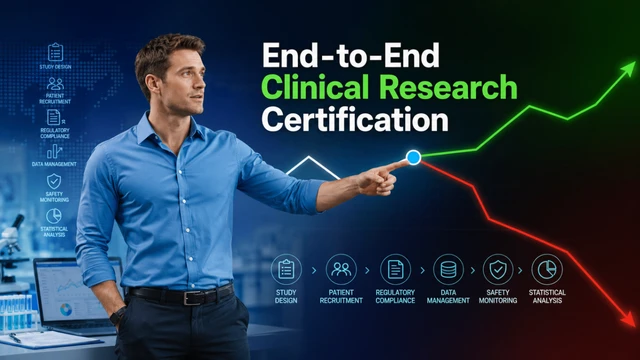
At ZANE ProEd, we focus on building a system for your career success. Our training, like the Clinical Operations Certification, is designed to make you proficient in the exact tasks employers need. We also provide an End-to-End Clinical Research Certification that covers the entire trial lifecycle, giving you a complete perspective.
Our goal is to make you so good at the practical work that your non-healthcare background becomes irrelevant. We help you build the skills that matter in the real world, turning your degree into a launchpad for a successful career in a stable and growing industry.
Are You Ready for a High-Growth Career?
The clinical operations career path in India offers tremendous growth for people with the right skills. Your background is not a disadvantage; it's a unique starting point. By adding specialized, practical knowledge, you can transition smoothly into this exciting field.
Wondering if you have what it takes? Take a moment to see how your current skills compare to what's needed for a role as a Clinical Operations Executive. Your next big career move might be closer than you think.
Build These Skills Now
Programs from ZANE ProEd Academy that directly address the skill gaps discussed above.
Follow Zane ProEd on Google
Preferred SourceAdd our publication as a preferred source to get the latest clinical research guides, industry updates, and career intel directly in your Google Top Stories & AI Overviews.