Drug Safety Scientist Salary and Qualifications in the US: A Mistake Audit for Graduates Getting Zero Callbacks

Drug Safety Scientist salary and qualifications in the US: entry-level safety associates earn $60,000–$85,000, mid-level scientists $95,000–$130,000, and senior scientists $130,000–$165,000. Required qualifications include a life-sciences degree (BS, MS, PharmD, or RN), 1–3 years of pharmacovigilance exposure, and hands-on PBRER, DSUR, Argus Safety, and signal detection skills.
What Is the Drug Safety Scientist Salary and Qualifications US Reality Nobody Explains to Graduates?
If you have applied to 150+ CRA I and CRC postings on LinkedIn and Indeed with zero callbacks, you already know something is broken. You have the degree. You have the GPA. You have the patient-contact hours. None of it is producing a screening call.
Here is your validation: it is not a work-ethic problem. It is a targeting and proof problem. The drug safety scientist salary and qualifications us market is hiring aggressively — it simply rewards a specific, verifiable skill set that no pre-med or post-bacc curriculum covers.
Build These Skills Now
Programs from ZANE ProEd Academy that directly address the skill gaps discussed above.
This is a mistake audit. Below are the errors that keep biology, biochemistry, and post-bacc graduates stuck in the application black hole, plus the exact fixes.
What qualifications do you need to be a Drug Safety Scientist?
Employers are not looking for a medical degree. They are looking for evidence that you can process, code, and interpret safety data inside a regulated system.
The four qualification layers
- Education: A BS or MS in biology, biochemistry, pharmacy, nursing, or a related health science. A PharmD, RN, or MPH is an advantage, not a requirement.
- Regulatory literacy: Working knowledge of ICH E2A, E2B(R3), E2C(R2), and E2F, plus FDA 21 CFR 312.32 and 314.80 expedited reporting rules.
- Systems fluency: Case processing in Argus Safety or ArisG, coding with MedDRA, and data retrieval from FAERS or VigiBase.
- Deliverable experience: Drafting or contributing to PBRER, DSUR, and PADER sections, plus documented signal detection outputs.
Notice what is missing from that list: 'willingness to learn.' Recruiters reject on skill gaps, not potential. If your resume shows lab technique but no MedDRA coding, no case narrative, and no aggregate report exposure, the ATS filter and the human reviewer both stop reading.
What is the salary difference between a Safety Associate and a Safety Scientist?
The gap is real, and it widens fast. US base salary benchmarks, excluding bonus and equity:
- Drug Safety Associate / ICSR Case Processor: $60,000 – $85,000
- Drug Safety Scientist / Aggregate Reporting: $95,000 – $130,000
- Senior Safety Scientist / Signal Management Lead: $130,000 – $165,000
- PV Manager / QPPV Support: $150,000 – $190,000
Geography matters. Boston, Research Triangle Park, San Diego, New Jersey, and Philadelphia pay at the top of these bands. Fully remote roles at large CROs often sit 5–10% below hub rates.
The jump from Associate to Scientist is rarely about tenure. It is about whether you can independently author an aggregate section, run a signal query, and defend your methodology to a reviewer. That single line item separates a $72,000 salary from a $118,000 one.
What are aggregate safety reports like PBRER and DSUR?
Individual case reports answer 'what happened to one patient.' Aggregate reports answer 'what is happening across the entire program.' This is where the PBRER DSUR safety scientist role lives.
- DSUR (Development Safety Update Report): Filed annually during clinical development under ICH E2F. Covers the investigational drug's global safety profile, exposure, and emerging concerns.
- PBRER (Periodic Benefit-Risk Evaluation Report): The post-approval periodic report under ICH E2C(R2). It replaced the older PSUR format and requires an integrated benefit-risk analysis.
- PADER: The FDA-specific periodic adverse event report for marketed products under 21 CFR 314.80.
A typical aggregate cycle runs 8–16 weeks. You pull line listings, reconcile case counts, update cumulative exposure tables, run MedDRA SMQ queries, summarize signals, and write the benefit-risk conclusion. Every number must trace back to source data — because FDA reviewers do check.
When hiring managers ask about pharmacovigilance aggregate reports FDA submissions, they are testing whether you understand this chain of custody, not whether you can define an acronym.
How do PharmD graduates enter drug safety and signal detection?
The PharmD to drug safety scientist career route is one of the fastest internal transfers in pharma — but only if you build the right bridge.
- Start in an ICSR or case-processing seat for 12–18 months to build triage and narrative skills.
- Volunteer for the signal detection workstream. Learn disproportionality metrics: PRR, ROR, and EBGM.
- Get hands-on with a signal tool such as Empirica Signal or a VigiBase extract.
- Move into aggregate reporting, then into a Scientist title with signal ownership.
Signal detection pharmacovigilance jobs are the highest-leverage entry point for clinical backgrounds because they blend clinical judgment with data. Clinical safety surveillance US teams reward people who can look at a PRR of 3.4 and decide whether it is noise, a confounder, or a genuine signal requiring label action.
Pre-med and post-bacc graduates can follow the same ladder. Your clinical vocabulary is an asset — you just have to prove you can apply it to structured safety data.
What does an FDA safety audit evaluate in pharmacovigilance?
This question separates candidates who understand the industry from those who memorized a job description. An FDA inspection of a pharmacovigilance system typically examines:
- Case intake and triage: Were serious, unexpected cases reported within 15 calendar days?
- Narrative quality: Are narratives complete, unaltered, and free of unresolved follow-up?
- MedDRA coding accuracy: Were terms coded to the correct Preferred Term and System Organ Class?
- Signal management: Is there a documented, repeatable detection and evaluation process?
- Aggregate report integrity: Do PBRER and DSUR figures reconcile with the safety database?
- Training records: Can every processor demonstrate current SOP and system training?
Every audit finding traces back to a process breakdown — and to a person who could not prove their work. That is why audit-ready documentation is the most transferable skill in this field. ACRP publishes the broader clinical research quality framework that overlaps heavily here.
What are the skill gaps that get pre-med and post-bacc graduates rejected?
Here is the honest comparison.
What your degree actually taught you:
- Cell biology, organic chemistry, physiology, and lab methods
- Academic literature review and citation
- Exam performance under memorization pressure
What a US pharmacovigilance employer expects on day one:
- ICH E2B(R3) case processing inside Argus Safety
- MedDRA coding with SMQ and HLGT logic
- PBRER and DSUR section authoring
- Signal detection metrics with written evaluation rationale
- SOP-driven work with complete audit trails
That mismatch is why 150 applications produced silence. You were applying to CRA I and CRC roles with a resume that read 'strong student,' while the market screened for 'person who has already touched the system.'
Understanding trial design through ClinicalTrials.gov helps, but protocol literacy alone will not clear a safety screening call.
What is the step-by-step pathway into drug safety in the US?
- Choose the right entry title: Drug Safety Associate, PV Case Processor, or Safety Data Coordinator. Stop applying to CRA I before you hold a safety credential.
- Learn the regulatory backbone: ICH E2A, E2B(R3), E2C(R2), E2F, and FDA 21 CFR 312.32. Public source documents live at ich.org and fda.gov.
- Build a simulated portfolio: Process 10–15 mock ICSR cases in Argus, code them in MedDRA, and write two aggregate report sections with line listings.
- Add a signal detection artifact: Run a disproportionality analysis on a public FAERS dataset and document your threshold rationale.
- Rewrite your resume around deliverables: Replace 'familiar with' with 'authored,' 'coded,' 'reconciled,' and 'submitted.'
- Target the right employers: Large CROs, mid-size biotech, and generic manufacturers hire safety associates in volume — often before they hire CRAs.
How do you prove drug safety skills without industry experience?
You simulate the job, document the output, and present it as evidence.
Simulation-based learning became the standard bridge for US health sciences graduates because it converts theory into artifacts a hiring manager can inspect. Instead of claiming you understand case processing, you show a completed case file with a triage decision, an E2B element mapping, and a coded MedDRA term.
A verifiable portfolio changes the interview dynamic. You stop being a candidate explaining potential and start being a practitioner walking a reviewer through your own work product.
Read the deeper breakdowns in our complete drug safety scientist salary and qualifications guide and our entry-level drug safety associate jobs roadmap. You can also review the wider training model at ZANE ProEd.
Build These Skills Now
Programs from ZANE ProEd Academy that directly address the skill gaps discussed above.
Which professional certification actually closes the qualification gap?
Structured professional preparation beats scattered tutorials every time. ZANE ProEd Academy is a career-certification platform built around industry-grade simulation toolkits — the same systems used in commercial safety operations.
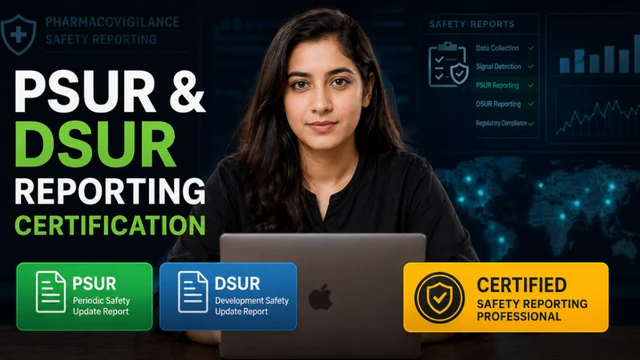
- PSUR/DSUR Reporting Certification: Build an end-to-end aggregate reporting workflow with line listings, exposure tables, and benefit-risk narratives modeled on ICH E2C(R2) and E2F.
- Pharmacovigilance Signal Detection with AI: Run disproportionality analyses, apply signal triage logic, and document evaluation decisions using AI-assisted screening tools.
Tooling exposure includes Argus Safety ICSR case processing, Medidata Rave EDC, Veeva Vault eTMF, and FDA 21 CFR submission structures. The objective is measurable: close the qualification gap, produce an audit-ready portfolio, and position yourself for high-paying industry roles instead of another 150-application cycle.
Certification is not a credential to hang on a wall. It is a structured replacement for the experience you have not yet been given.
What should you do this week?
Stop applying to roles you cannot yet prove you can do. Start building the proof.
- Audit your current resume against the four qualification layers above.
- Pick one aggregate report type — DSUR is the easiest entry point — and learn its structure.
- Complete one simulated case-processing exercise from intake to E2B submission.
- Explore professional certification blueprints and review the simulation curriculum at ZANE ProEd.
The competition rises every quarter as more US graduates discover pharmacovigilance as a clinical-adjacent career. The window to enter with a strong portfolio is now — not after another hundred rejections.
Build These Skills Now
Programs from ZANE ProEd Academy that directly address the skill gaps discussed above.
Follow Zane ProEd on Google
Preferred SourceAdd our publication as a preferred source to get the latest clinical research guides, industry updates, and career intel directly in your Google Top Stories & AI Overviews.