Hospital Quality Assurance Jobs India: Step-by-Step Guide for Chemistry Graduates

Hospital Quality Assurance Jobs India Hospital quality assurance jobs India focus on patient safety, infection control, and NABH compliance. Freshers with BSc or MSc Chemistry can start as QA executives by learning audits, documentation, and quality tools. Expected salary ranges from ₹3–6 lakh per year. Non-medical graduates are eligible.
If you are a BSc or MSc Chemistry graduate and feel stuck with no experience, you are not alone. Many science graduates in India think hospitals only hire nurses and doctors. But that is wrong. Hospital quality assurance jobs India are open to non-medical graduates like you.
Hospitals need people who can check patient safety, manage documents, and prepare for NABH accreditation. Your chemistry background gives you attention to detail and lab discipline. These skills matter more than you think. This guide shows you step by step how to enter this field.
Build These Skills Now
Programs from ZANE ProEd Academy that directly address the skill gaps discussed above.
What is NABH accreditation and why does it matter for hospital quality assurance jobs India?
NABH stands for National Accreditation Board for Hospitals & Healthcare Providers. It is a board under the Quality Council of India. NABH sets standards for hospitals to ensure safe and high-quality care.
When a hospital gets NABH accreditation, it proves the hospital follows strict rules for patient safety, infection control, and staff training. This is why hospital quality assurance jobs India are growing. Hospitals need QA officers to help them meet these standards.
A NABH accreditation career means you work on audits, checklists, and process improvements. Hospitals pay well for this. It is a stable and respected role.
- NABH standards cover 10 chapters like access, assessment, care of patients, and quality improvement.
- Accreditation is valid for 3 years.
- Hospitals must have a quality team to manage the process.
- Freshers can start as quality assistants or QA executives.
For more on global quality standards, see WHO patient safety guidelines.
How to become a Quality Officer in a hospital?
You do not need a medical degree. A BSc or MSc in Chemistry is enough to start. But you need specific knowledge of hospital quality systems.
Here is a clear path:
- Learn NABH standards. Read about the 10 chapters and key checklists.
- Take a certification course. A focused certification in hospital quality management helps you stand out.
- Practice documentation. Quality officers prepare SOPs, audit reports, and incident reports.
- Build computer skills. Excel, Power BI, and hospital software are used daily.
- Apply for entry-level roles. Look for titles like 'Quality Assistant', 'QA Executive', or 'Quality Coordinator'.
The quality officer hospital job description often includes:
- Conducting internal audits and clinical audits.
- Monitoring infection control protocols.
- Preparing reports for NABH assessments.
- Training staff on quality policies.
- Managing incident reports and CAPA (corrective and preventive action).
If you want to see how QA works in pharma, check this blog: QA/QC Pharma Jobs for Freshers.
What is the salary of a hospital QA executive in India?
The hospital QA executive salary depends on city, hospital size, and your certification. For freshers, it usually starts between ₹2.5 lakh to ₹4.5 lakh per year.
With 2-3 years of experience, you can earn ₹5 lakh to ₹8 lakh per year. NABH accredited hospitals pay more because they need skilled QA professionals.
- Fresher QA Executive: ₹2.5 – ₹4.5 LPA
- QA Officer (1-3 years): ₹4 – ₹6 LPA
- Senior QA Executive (3-5 years): ₹6 – ₹10 LPA
- Quality Manager (5+ years): ₹10 – ₹20 LPA
These numbers are from Indian job portals and hospital HR reports. Certification and NABH knowledge can push you to the higher end.
What are the key NABH standards a fresher should know?
You do not need to memorize all 600+ standards. But you must understand the main areas. Here are the NABH standards for freshers you should focus on:
- Access, Assessment and Continuity of Care (AAC): How patients are admitted, assessed, and discharged.
- Care of Patients (COP): Medication safety, nursing care, and patient rights.
- Management of Medication (MOM): Safe storage, prescription review, and high-alert medications.
- Infection Control (IC): Hand hygiene, sterilization, and biomedical waste management.
- Quality Improvement (QI): How hospitals track errors and improve processes.
As a chemistry graduate, you already understand chemicals and lab safety. That helps with infection control and medication standards.
What skills are needed for hospital quality assurance?
This is where many freshers miss the mark. You need more than just a degree. Employers want practical skills in healthcare quality management.
Key skills:
- Attention to detail: You will check every line of a SOP or audit report.
- Communication: You will train nurses and doctors on protocols.
- Data analysis: Use Excel to track infection rates, falls, and medication errors.
- Problem solving: Use tools like root cause analysis and fishbone diagrams.
- Documentation: Write clear SOPs, checklists, and incident reports.
These skills are not taught in your BSc/MSc Chemistry syllabus. That is why a certification or simulation training matters.
What colleges teach vs what hospitals actually expect
Your chemistry degree gives you a strong science foundation. But colleges rarely cover NABH accreditation career skills. You likely studied organic chemistry, physical chemistry, and lab techniques. None of that helps you prepare a hospital audit checklist.
Hospitals expect you to:
- Know NABH chapters and documentation.
- Understand medical terminology and patient flow.
- Use quality tools like PDCA, 5S, and FMEA.
- Handle real audit scenarios.
This gap is why many graduates apply but get rejected. They cannot show practical knowledge. The solution is to bridge this gap before applying.
A step-by-step roadmap to enter hospital quality assurance
Follow these 5 steps to get job-ready without experience:
- Step 1: Learn the basics of healthcare quality. Read free NABH guides and WHO patient safety modules. Focus on infection control and medication safety.
- Step 2: Get certified in hospital quality management. A short, practical certification teaches you the real work. Look for courses with simulation and case studies.
- Step 3: Build a mini portfolio. Create sample SOPs, audit checklists, and incident reports on your own. Put them on a Google Drive folder to share in interviews.
- Step 4: Practice with mock audits. Use free hospital audit templates online. Try to find gaps and suggest improvements.
- Step 5: Apply strategically. Target small and mid-size hospitals first. They often need QA staff but get fewer applications. Use LinkedIn and hospital career pages.
Remember, you are not competing with nurses. You bring a unique lab and documentation skill set.
Bridge the gap with simulation-based learning
Reading theory is not enough. Hospitals want proof you can do the job. Simulation-based learning puts you in real scenarios. You review a medication error, conduct an audit, and write a CAPA report.
This type of hands-on practice builds confidence. It also gives you stories to tell in interviews. Instead of saying 'I know NABH', you can say 'I simulated an ICU audit and identified three non-conformities'.
This is the fastest way for a non-medical graduate to enter hospital QA.
Build These Skills Now
Programs from ZANE ProEd Academy that directly address the skill gaps discussed above.
How ZANE ProEd builds your hospital QA skills
ZANE ProEd offers focused certifications in hospital quality management and incident management. These are not just theory courses. They use real hospital scenarios and simulation.
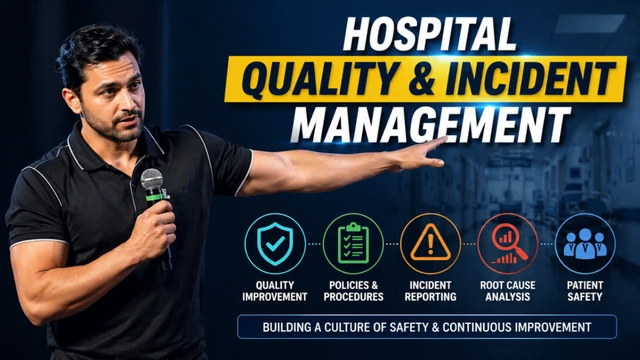
In the hospital-quality-management-certification, you learn NABH chapters, internal audits, and documentation. In the hospital-quality-incident-management, you practice root cause analysis and CAPA writing.
These courses are designed for science graduates with no hospital experience. They give you the system and templates to start applying confidently.
Check your job readiness. Ask yourself: Can you list 5 NABH standards? Can you write an incident report? If not, start building those skills today. See how your current skills compare to hospital QA requirements.
Build These Skills Now
Programs from ZANE ProEd Academy that directly address the skill gaps discussed above.
Follow Zane ProEd on Google
Preferred SourceAdd our publication as a preferred source to get the latest clinical research guides, industry updates, and career intel directly in your Google Top Stories & AI Overviews.