Hospital Quality Assurance Jobs India: A Fresher's Guide to Getting Shortlisted

QA/QC Executive (Hospital / NABH) Hospital quality assurance jobs India require BPharm/MPharm graduates to master NABH standards, root cause analysis, and audit techniques. Freshers can get shortlisted by learning healthcare quality management systems and incident reporting, not just textbook theory.
If you are a BPharm or MPharm graduate constantly facing rejection for hospital quality assurance jobs India, you are not alone. Recruiters see hundred of resumes every week. But most freshers sound the same – they list internships, mention ‘Good Communication Skills’, and hope to get a call. It never works. You feel burnt out. The system seems broken. But here is the truth – recruiters reject you based on skill gaps, not your degree. Hospitals now hire for competence, not potential.
\n\nWe went straight to the recruiters and asked: “What do you actually look for in a fresher for hospital QA/QC roles?” Their answers were surprising. It is not about knowing everything. It is about knowing the right things – specific NABH chapters, incident reporting workflows, and quality tools. This guide is a recruiter-level audit of the mistakes freshers make, and exactly what to fix to start getting shortlisted for hospital QA executive jobs.
Build These Skills Now
Programs from ZANE ProEd Academy that directly address the skill gaps discussed above.
What is NABH accreditation and why does it matter?
\n\nNABH stands for National Accreditation Board for Hospitals & Healthcare Providers. It is a board under the Quality Council of India that sets standards for patient safety and quality of care. Think of it like an ISO certification, but for hospitals in India. Over 800 hospitals are already NABH accredited, and many more are applying. When a hospital has NABH, it means they follow strict protocols for medication safety, infection control, patient rights, and continuous quality improvement.
\n\nWhy does this matter for your career? Simple – NABH accreditation career paths are growing fast because every NABH-accredited hospital needs a dedicated quality team. They must maintain those standards every day, not just during inspection. This is where you come in. Hospitals need QA executives to monitor compliance, train staff, investigate incidents, and prepare for audits. Understanding NABH is not a bonus; it is the basic requirement for hospital quality assurance jobs India.
\n\nStart by reading the NABH standards for freshers directly from official sources. Hospitals use these standards as the backbone of their quality management systems. If you can speak the language of NABH in an interview – mentioning chapters like Access, Assessment and Continuity of Care (AAC), Care of Patients (COP), or Management of Medication (MOM) – you instantly stand out.
\n\nHow to become a Quality Officer in a hospital?
\n\nThe role of a Quality Officer in a hospital is not an entry-level job that you can walk into with just a degree. But you can start as a QA/QC Executive or Junior Quality Associate and quickly move up. Here is the recruiter’s checklist to become a quality officer hospital job description match:
\n\n- \n
- Qualification: BPharm, MPharm, or life science degree. MPharm or a diploma in hospital management gives you an edge. \n
- Knowledge: Core NABH chapters, especially COP (Care of Patients), MOM (Management of Medication), and HIC (Hospital Infection Control). You should also know basic quality tools – PDCA, root cause analysis, FMEA, and clinical audit methods. \n
- Internship/Project Experience: Even a short project in a NABH-accredited hospital matters. It could be a 15-day observation on how they conduct rounds or fill checklists. Mention it clearly on your resume. \n
- Certifications: Recruiters actively search for candidates with a hospital quality management certification. It proves you have structured knowledge, not just Google-learned fragments. \n
- Soft Skills: You will be coordinating with doctors, nurses, and administrators. Communication, assertiveness, and attention to detail are non-negotiable. \n
The biggest mistake? Applying without knowing the job description. Study the quality officer hospital job description on portals carefully. Hospitals often ask for experience in drafting SOPs, conducting internal audits, and managing patient feedback. If you lack experience, build it through simulation courses that mimic real hospital quality tasks.
\n\nWhat is the salary of a hospital QA executive in India?
\n\nHospital QA executive salary in India varies by city, hospital size, and accreditation status. Based on current recruiter data and job portals:
\n\n- \n
- Fresher (0–1 year): ₹15,000 – ₹25,000 per month in tier-2 cities; ₹20,000 – ₹30,000 in metro cities like Mumbai, Delhi, Bengaluru. \n
- 1–3 years experience: ₹25,000 – ₹40,000 per month. \n
- Senior Executive / Quality Officer: ₹40,000 – ₹60,000 per month. \n
- Manager level: ₹60,000 – ₹1,00,000+ per month. \n
These are base salaries; many NABH hospitals also offer performance bonuses. The catch? Fresher salaries may look low, but growth is rapid if you acquire the right skills. A quality officer with strong audit and incident management skills can jump to a managerial role within 3–5 years. Large corporate hospital chains like Apollo, Fortis, or Manipal pay at the higher end. Small nursing homes might offer less but give you hands-on exposure to the entire quality cycle.
\n\nDo not fixate on the starting hospital QA executive salary. Instead, focus on the learning curve. A candidate with practical knowledge of healthcare quality management tools will negotiate a better package even as a fresher.
\n\nWhat are the key NABH standards a fresher should know?
\n\nYou cannot memorize all 600+ NABH standards. Recruiters do not expect that. But they do expect you to be familiar with the high-priority chapters that affect daily hospital operations. According to hiring managers for hospital QA roles, these are the NABH standards for freshers you must know:
\n\n- \n
- AAC (Access, Assessment and Continuity of Care): How a patient enters the hospital, how their risks are assessed, and how care is handed over between shifts or departments. \n
- COP (Care of Patients): Uniform patient care procedures, documentation of nursing plans, and medication administration protocols. \n
- MOM (Management of Medication): Prescription review, high-risk medication monitoring, and safe storage practices. This is critical for pharmacists applying for hospital quality assurance jobs India. \n
- HIC (Hospital Infection Control): Hand hygiene protocols, biomedical waste segregation, and staff vaccination compliance. \n
- QPI (Quality Improvement): Continuous quality indicators monitoring, patient satisfaction surveys, and clinical audit cycles. \n
One genius move? Go to a NABH hospital’s public quality report (many publish them online). See the indicators they track – medication errors, surgical site infection rates, patient falls. In your interview, talk about how you would monitor these indicators. This instantly signals that you think like a QA professional.
\n\nWhat skills are needed for hospital quality assurance?
\n\nColleges teach you pharmacology, pharmaceutics, and perhaps some pharmaceutical quality control tests. But hospital QA is a completely different world. Here are the skills that recruiters test for, and that most freshers lack:
\n\n- \n
- Incident Reporting: You must know how to write a clear, objective incident report (e.g., medication error, patient fall). Use the ‘what, when, where, impact’ format, never blame individuals. This is a core part of healthcare quality management. \n
- Root Cause Analysis (RCA): Basic tools like the 5-Whys, fishbone diagram, and Pareto chart. You will be asked to analyze mock incidents during interviews. \n
- Internal Audit Skills: How to prepare an audit checklist based on NABH standards, how to conduct a round, and how to document non-conformities. \n
- SOP Writing: Drafting a simple Standard Operating Procedure for, say, patient identification or handling of expired drugs. Recruiters often give a write-test. \n
- Data Analysis: Basic Excel, trend charts, and presenting quality indicators monthly. \n
- Soft Skills: Persuading busy doctors to fill forms, training nurses without offending them, and presenting reports to management. \n
Ironically, most BPharm curricula focus on manufacturing QA. For example, you might know how to test a tablet’s dissolution rate, but not how to investigate a patient receiving the wrong dose. This gap is why recruiters prefer candidates with a dedicated hospital quality management certification. It bridges the practical knowledge you never got in college.
\n\nThe brutal skill gap colleges won’t talk about
\n\nPharmacy colleges do an excellent job teaching drug molecules and industrial QA/QC. But when you walk into a hospital QA interview, the questions are about clinical workflows, not lab techniques. Recruiters shared specific gaps they constantly see:
\n\n- \n
- Taught: HPLC, calibration, GLP
Expected: How to handle a needlestick injury, how to audit a crash cart \n - Taught: Sterility testing
Expected: How to monitor infection control practices in ICUs \n - Taught: SOP writing for manufacturing
Expected: SOP for patient identification before blood transfusion \n
This mismatch is not your fault, but it is your problem to fix. The good news? You can close this gap in a few weeks by learning through hospital simulation exercises. Recruiters told us they often reject freshers who cannot even define a ‘sentinel event’ or ‘clinical audit’. Do not be that candidate.
\n\nA 5-step roadmap to get shortlisted for hospital QA jobs
\n\n- \n
- Build NABH literacy: Download the NABH standards from the official QCI site. Focus on the first five chapters. Create flashcards for key terms like ‘MTC’, ‘HICC’, ‘QPS’. \n
- Get hands-on simulation exposure: Do not wait for a job to learn. Use a structured healthcare quality management course that includes realistic incident reporting, root cause analysis, and audit simulations. This gives you specific examples to share in interviews. \n
- Create a quality portfolio: Draft two sample SOPs (e.g., hand hygiene protocol, medication error reporting), perform a mock root cause analysis (use a sample case study), and design a monthly quality indicator dashboard. Put these in a PDF and attach it to your job application. \n
- Target NABH job portals: Look for ‘Quality Executive’, ‘Quality Associate’, ‘NABH Coordinator’ roles on hospital career pages and platforms like LinkedIn. Use keywords from the job description in your resume. \n
- Network with quality professionals: Join LinkedIn groups on hospital quality and NABH accreditation. Comment thoughtfully on posts. Sometimes a recruiter will notice before you even apply. \n
Why simulation training is your unfair advantage
\n\nWatching a YouTube video on NABH is passive. Reading a book is passive. But when you simulate a real hospital quality scenario – say, conducting an internal audit of a mock ward or investigating a medication error case – your brain builds strong neural pathways. This type of active recall is exactly what you need to answer scenario-based interview questions with confidence.
\n\nZANE ProEd’s simulation-driven system puts you in the role of a QA executive for a NABH-bound hospital. You will review real incident forms, evaluate compliance gaps, and create corrective action plans. This is not a boring theory course; it is a safe space to make mistakes and learn without patient risk. When you can say in an interview, “I’ve already handled 10 mock audits and 15 incident investigations through simulation,” you are no longer a risky fresher – you are a pre-trained professional.
\n\nBuild These Skills Now
Programs from ZANE ProEd Academy that directly address the skill gaps discussed above.
The courses that build this exact competency
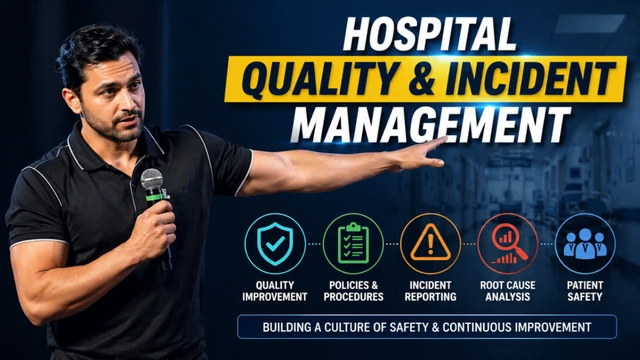
\n\nTwo specific certification programs align perfectly with what hospital recruiters want. The Hospital Quality Management Certification covers NABH standards mapping, quality indicator frameworks, and audit planning. You will build a ready-to-use quality toolkit that directly matches the hospital quality assurance jobs India skill requirement. It includes real case studies from Indian hospitals – not generic Western examples. The Hospital Quality & Incident Management program dives deep into one of the most asked-about skills: incident reporting and root cause analysis. Recruiters specifically test this area because medication errors and patient safety incidents are daily QA responsibilities. By mastering incident management, you demonstrate readiness for a QA/QC career path in healthcare.
\n\nThese are not academic lectures. They are practice-first systems designed with input from NABH auditors and hospital quality heads. When you complete them, you will have more relevant hands-on experience than 90% of applicants. The system is built around verified frameworks from World Health Organization patient safety guidelines and ICH quality management principles, adapted to Indian NABH context.
\n\nCheck your job readiness now
\n\nBefore you send another application, ask yourself: If a recruiter called you right now and asked to explain the steps of a clinical audit, could you do it? If they gave you a sample medication error and asked for a root cause analysis, would you have a structured method? Most candidates cannot. But you now know exactly what to learn and how to learn it. The gap is clear. The path is clear. The only question is whether you will do the uncomfortable work of simulating real hospital quality tasks or keep hoping your degree alone will be enough.
\n\nStart building your quality toolkit today. Your first shortlist is closer than you think.
Build These Skills Now
Programs from ZANE ProEd Academy that directly address the skill gaps discussed above.
Follow Zane ProEd on Google
Preferred SourceAdd our publication as a preferred source to get the latest clinical research guides, industry updates, and career intel directly in your Google Top Stories & AI Overviews.