Hospital Quality Assurance Jobs India: Freshers Guide to NABH Careers

Hospital Quality Assurance Jobs India: These roles involve ensuring patient safety and care quality by following NABH standards in hospitals. Freshers with BPharm/MPharm can start as Quality Executives with salaries of ₹2.5–4.5 LPA. Key skills include incident management, audits, and understanding healthcare quality protocols.
If you feel stuck after multiple placement failures, you’re not alone. Many BPharm and MPharm graduates face the same struggle — college didn’t prepare you for real-world hospital quality assurance jobs India. The good news? The hospital QA field is growing, and with the right skills, you can land a job in 3–6 months.
Recruiters often reject fresh graduates because of a skill gap. But knowing the exact steps and standards can turn things around fast.
Build These Skills Now
Programs from ZANE ProEd Academy that directly address the skill gaps discussed above.
What is NABH accreditation and why does it matter?
NABH (National Accreditation Board for Hospitals & Healthcare Providers) sets quality standards for Indian hospitals. It aligns with global patient safety goals from WHO and covers everything from infection control to patient rights. NABH certification is recognized across India and often required by insurance companies and patients. That's why hospitals invest in building a strong NABH accreditation career for their staff. For you, understanding NABH is a direct gateway to job-ready skills.
How to become a Quality Officer in a hospital?
Here's the step-by-step path:
- Complete your BPharm or MPharm degree.
- Learn NABH standards — focus on chapters like patient safety, infection control, and incident management. Many hospitals also value knowledge of CDSCO quality guidelines.
- Gain practical exposure through internships or simulation-based training in hospital QA.
- Build skills in auditing, root cause analysis, and documentation.
- Apply for junior roles like Quality Executive or Quality Officer in NABH-accredited hospitals.
Having a portfolio of mock audits and incident reports will set you apart.
What is the salary of a hospital QA executive in India?
The hospital QA executive salary for freshers typically ranges from ₹2.5 to ₹4.5 lakhs per annum. With 2–3 years of experience, you can earn ₹4–6 LPA. Senior positions like Quality Manager can reach ₹8–12 LPA. Salaries are higher in metro cities and large multi-specialty hospitals.
What are the key NABH standards a fresher should know?
As a NABH standards for freshers starting point, focus on these chapters:
- AAC: Access, Assessment, and Continuity of Care
- PRE: Patient Rights and Education
- HIC: Hospital Infection Control
- CQI: Continuous Quality Improvement
- FMS: Facility Management and Safety
Knowing these will help you answer interview questions and perform daily QA tasks.
What skills are needed for hospital quality assurance?
The quality officer hospital job description demands a mix of technical and soft skills in healthcare quality management:
- Auditing and gap analysis against NABH standards
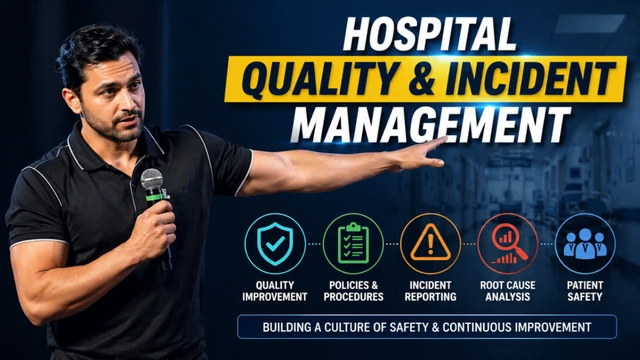
- Root cause analysis (RCA) and corrective actions
- Incident reporting and management
- SOP review and documentation control
- Communication and teamwork across clinical departments
- Proficiency in Excel and quality management tools (e.g., TrackWise)
Unlike pharma QA, hospital QA requires direct patient safety focus — but many skills overlap. See our guide on QA/QC pharma jobs for freshers to compare.
Why colleges don't prepare you for hospital QA roles
In pharmacy college, you studied drug mechanisms, but not how to conduct a quality audit or handle a patient safety incident. Employers expect you to know real-world protocols like NABH standards, incident management, and root cause analysis — but your curriculum barely covered them.
This gap is why many freshers fail interviews. They can’t answer practical questions like “What steps would you take if a medication error occurred in a ward?”
Your 5-step roadmap to a hospital QA job in 90 days
- Learn NABH fundamentals: Focus on 5 key chapters relevant to QA.
- Get simulation training: Practice mock audits and incident reports.
- Build a portfolio: Create sample SOPs, audit checklists, and root cause analysis reports.
- Earn a credential: Complete a program that verifies your QA skills.
- Apply strategically: Target NABH-accredited hospitals and network with quality professionals.
If you're also exploring clinical research quality, check this GCP auditor career path.
The missing bridge: hands-on practice before the interview
You can’t learn quality management just by reading. You need to simulate real hospital scenarios — like conducting an internal audit, handling a sentinel event, or filling out an incident report. This is where simulation-based learning comes in.
Programs that recreate the hospital QA environment help you build confidence and give you concrete examples to discuss in interviews.
Build These Skills Now
Programs from ZANE ProEd Academy that directly address the skill gaps discussed above.
Building your QA skillset with guided practice
For example, a hospital quality management certification can teach you NABH chapter-wise auditing steps and how to prepare documents for accreditation. An incident management course trains you on handling adverse events and root cause analysis — exactly what hospitals check in interviews.
At ZANE ProEd, our system focuses on doing rather than just watching videos. You work through case studies, audit simulations, and incident reports, so you walk into interviews with proven skills.
Check your job readiness for hospital QA roles
Ask yourself: Can I list the 10 chapters of NABH? Can I perform a gap analysis? If not, it’s time to bridge the gap with focused practice. See how your skills match real-world expectations — and take the next step toward your career.
Build These Skills Now
Programs from ZANE ProEd Academy that directly address the skill gaps discussed above.
Follow Zane ProEd on Google
Preferred SourceAdd our publication as a preferred source to get the latest clinical research guides, industry updates, and career intel directly in your Google Top Stories & AI Overviews.