Hospital Quality Assurance Jobs in India: A Guide for Life Science Graduates

QA/QC Executive (Hospital / NABH) roles are a growing field for Life Science graduates seeking hospital quality assurance jobs in India. These positions involve implementing and monitoring NABH standards, conducting audits, and ensuring patient safety protocols, offering a stable career path in healthcare quality management.
Are you a BSc or MSc graduate in Biotechnology, Microbiology, or Biochemistry, currently working in IT, BPO, or another non-healthcare field? You might feel like your science degree isn't being used. There is a hidden career path where your skills are in high demand: hospital quality assurance jobs in India.
This isn't about working in a lab. It's about being the brain behind a hospital's safety and efficiency. You ensure that every process, from patient admission to discharge, meets the highest standards. It's a stable, respected, and growing field, especially for career switchers looking for meaningful work.
Build These Skills Now
Programs from ZANE ProEd Academy that directly address the skill gaps discussed above.
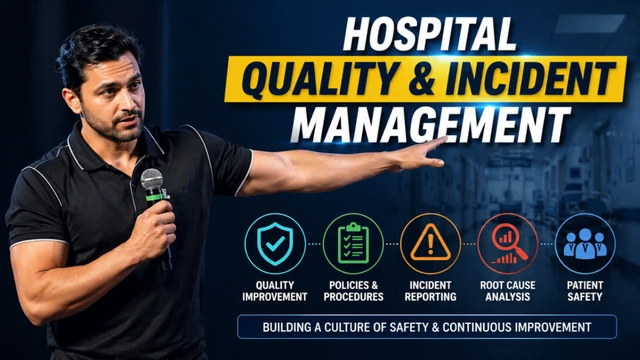
This guide provides a step-by-step roadmap to help you transition from your current role into a promising career in hospital quality management.
What is NABH accreditation and why does it matter?
NABH stands for National Accreditation Board for Hospitals & Healthcare Providers. Think of it as a quality certificate, like an ISO certification, but specifically for hospitals in India. It is a constituent board of the Quality Council of India (QCI).
Why is it so important? NABH accreditation signals that a hospital is committed to patient safety and high-quality care. For patients, it means trust. For the hospital, it means a better reputation and operational excellence.
For you, a NABH accreditation career is a huge opportunity. Hospitals need trained professionals to implement and maintain these standards. Your science background gives you a major advantage in understanding the clinical processes that need to be monitored and improved.
How to become a Quality Officer in a hospital?
Becoming a Quality Officer or QA Executive is a clear, achievable goal. You don't need a medical degree. Here’s how you can get started:
- Leverage Your Degree: Your BSc or MSc in a Life Science field is your foundation. It proves you have a scientific mindset.
- Learn the Framework: You must understand the core principles of healthcare quality management and NABH standards. Reading the official guidelines is a start.
- Get Certified: A certification in Hospital Quality Management is often the entry ticket. It shows employers you are serious and have the specific knowledge they need.
- Tailor Your CV: Your resume needs to scream 'quality'. Highlight skills like process analysis, documentation, and attention to detail from your previous jobs, even if they were in IT or BPO. The process is similar to what's described in our guide for PV career switchers.
- Apply for Entry-Level Roles: Look for titles like 'Quality Assistant', 'QA Trainee', or 'NABH Coordinator'. This is where you will get hands-on experience. The quality officer hospital job description typically includes assisting with audits, preparing documents, and training staff on quality procedures.
What is the salary of a hospital QA executive in India?
Salary is an important factor. The hospital QA executive salary in India is competitive and grows with experience. Here’s a realistic breakdown for you:
- Fresher / Entry-Level (0-1 year experience): You can expect a starting salary between ₹2.5 Lakhs to ₹4.5 Lakhs per annum. This depends on the city and the size of the hospital.
- Junior Executive (2-4 years experience): With some experience in audits and documentation, your salary can increase to ₹5 Lakhs to ₹8 Lakhs per annum.
- Senior Manager / Head of Quality (5+ years): Senior roles can command salaries well over ₹10 Lakhs to ₹15 Lakhs+ per annum, especially in large, multi-specialty hospitals.
Your ability to help the hospital achieve or maintain NABH accreditation directly impacts your value and earning potential.
What are the key NABH standards a fresher should know?
The full NABH standard book can be overwhelming. As a fresher, you don't need to memorize all 100+ standards. Instead, focus on understanding the core chapters that you will deal with daily. These are the key NABH standards for freshers to learn:
- Access, Assessment, and Continuity of Care (AAC): How patients are admitted, assessed, and transferred.
- Patient Rights and Education (PRE): Ensuring patients know their rights and are involved in their care.
- Hospital Infection Control (HIC): This is critical. It covers everything from hand hygiene to sterilization procedures. Your microbiology background is a huge asset here.
- Continuous Quality Improvement (CQI): How the hospital collects data, monitors performance, and makes improvements.
- Facility Management and Safety (FMS): Deals with building safety, fire safety, and equipment management.
Understanding the 'why' behind these chapters is more important than memorizing every single rule. For a broader view on quality principles, you can review our pharma QA/QC guide, as many concepts overlap.
What skills are needed for hospital quality assurance?
Success in this role requires a mix of technical and soft skills. Your degree gave you the foundation; now you need to build the practical skills employers want.
Technical Skills (The 'What')
- Documentation: Creating and managing Standard Operating Procedures (SOPs), policies, and records.
- Auditing: Ability to conduct internal audits to check if departments are following the set processes.
- Root Cause Analysis (RCA): Investigating incidents (e.g., a patient fall) to find the real cause and prevent it from happening again.
- Data Analysis: Using tools like Excel to track quality indicators, like infection rates or patient satisfaction scores.
Soft Skills (The 'How')
- Attention to Detail: One small error in a record can have big consequences.
- Communication: You need to clearly explain complex quality standards to doctors, nurses, and support staff.
- Problem-Solving: When an audit reveals a problem, you need to help find a practical solution.
- Teamwork: Quality is a team sport. You'll work with every department in the hospital.
The Skill Gap: College vs. Hospital Reality
Your college education taught you the theory. You learned about biochemistry and microbiology. But it didn't teach you how to create an audit checklist for a hospital pharmacy or how to write a Corrective and Preventive Action (CAPA) report.
Employers need people who can do the job from day one. They expect you to understand the practical application of quality standards within a hospital's complex environment. This is the gap that a degree alone doesn't fill, and it's why so many qualified graduates struggle to get their first job in this field.
Your 5-Step Pathway to a Hospital QA Career
Feeling overwhelmed? Don't be. Here is a clear, step-by-step plan to make the switch successfully.
- Build Foundational Knowledge: Systematically learn the NABH 5th Edition standards. Focus on the key chapters mentioned earlier.
- Learn the Practical Tools: Go beyond theory. Understand how to conduct an audit, manage documents, and handle incident reporting.
- Develop a 'Process Mindset': Start thinking in terms of processes. How can a task be done more safely and efficiently? This is the core of quality management.
- Create a Skill-Based Resume: Update your CV to highlight keywords like 'NABH', 'Quality Audits', 'SOPs', 'Patient Safety', and 'Process Improvement'. Quantify your achievements where possible.
- Gain Practical Experience: The fastest way to become job-ready is to practice what you've learned in a controlled environment.
Bridging the Gap with Simulation-Based Learning
How can you get experience without having a job? Reading about quality management is one thing. Actually doing it is another. You can't learn how to manage a quality incident just from a textbook.
This is where simulation-based learning changes everything. It allows you to work on real-world case studies and hospital scenarios in a virtual environment. You learn by doing, making you confident and ready for your first day on the job.
Build These Skills Now
Programs from ZANE ProEd Academy that directly address the skill gaps discussed above.
A System for Career Success
At ZANE ProEd, we don't just sell courses; we provide a system for career transition. Our programs are designed to give you the exact skills and confidence employers are looking for.
The Hospital Quality Management Certification program provides the complete theoretical framework of NABH and healthcare quality. But we don't stop there. The Hospital Quality Incident Management program puts you in the driver's seat, letting you handle simulated quality issues, conduct root cause analysis, and prepare reports, just like you would in a real hospital job.
This combination ensures you have both the knowledge (the 'what') and the practical skills (the 'how') to excel in your interviews and on the job.
Are You Ready for a Career in Hospital Quality?
Switching careers can feel like a big step, but a structured path makes it possible. A career in hospital quality assurance is a chance to use your science degree to make a real impact on people's lives.
See how your current skills match up with the requirements for a career in hospital quality. It might be the most important career move you ever make.
Build These Skills Now
Programs from ZANE ProEd Academy that directly address the skill gaps discussed above.
Follow Zane ProEd on Google
Preferred SourceAdd our publication as a preferred source to get the latest clinical research guides, industry updates, and career intel directly in your Google Top Stories & AI Overviews.