Hospital Quality Assurance Jobs India: How Life Science Freshers Crack NABH QA/QC Roles in 3-6 Months

QA/QC Executive (Hospital / NABH) Hospital quality assurance jobs in India involve maintaining NABH compliance, auditing clinical documentation, tracking incidents, and reporting quality indicators. Life science freshers typically start as Quality Executive or Quality Officer at ₹3.5-6 LPA, then grow into Quality Manager roles at ₹8.5-15 LPA within 4-6 years.
If you feel stuck, this is exactly why your hospital QA interviews keep ending at round two. You have an internship certificate, a project report, and a resume packed with lab techniques — yet hospital quality assurance jobs India keep going to someone else. That gap is not about talent. It is about exposure.
For BSc / MSc Biotechnology, Microbiology and Biochemistry graduates, the hospital quality route looks perfect on paper. You already understand sterilisation, infection control, sampling and documentation. Hospitals need exactly that. But the moment an interviewer asks about an incident report workflow or a NABH chapter audit, the conversation quietly dies.
Build These Skills Now
Programs from ZANE ProEd Academy that directly address the skill gaps discussed above.
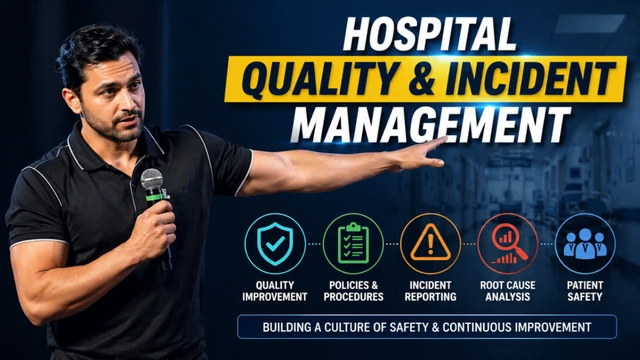
This playbook fixes the real problem: your internships gave you observation, not execution. Read it fully before your next interview.
What is NABH accreditation and why does it matter?
NABH (National Accreditation Board for Hospitals and Healthcare Providers) is the Indian body that certifies hospitals against defined patient-safety and quality standards. It works under the Quality Council of India and is recognised internationally.
For a hospital, accreditation means stronger clinical outcomes, insurance and corporate tie-ups, lower medico-legal risk, and smoother empanelment under government schemes.
Why this matters for your NABH accreditation career
- It creates permanent jobs. Every accredited hospital needs a quality department that writes SOPs, runs audits and survives assessments.
- It is non-clinical. Life science graduates are fully eligible — no MBBS or nursing degree required.
- Progression is fast. Quality Executive → Quality Officer → Quality Manager → Head of Quality in roughly 6-8 years.
Quality work is also linked to national regulation. Drug, device and IVD safety sits with CDSCO, while global patient-safety and hand-hygiene frameworks come from WHO. If you ever move into pharma or device quality, ICH guidelines become your second language. Interviewers notice candidates who can connect hospital quality to this wider regulatory world.
How to become a Quality Officer in a hospital?
A Quality Officer owns the day-to-day quality system: documents, audits, indicators and incident follow-ups. Here is the realistic route for a fresher.
- Build the vocabulary first. Learn NABH chapters, NABL basics, CAPA, incident reporting and clinical audit terminology.
- Get a certification with real deliverables. A simulation-based hospital quality management certification gives you artefacts you can show, not just a certificate.
- Target the right entry roles. Apply for Quality Executive, QA Coordinator, Documentation Executive, Infection Control Assistant and NABH Coordinator roles.
- Apply where hiring actually happens. Corporate chains and 100-500 bed private hospitals in Hyderabad, Bangalore, Pune, Mumbai, Chennai, Kochi and Delhi NCR.
- Walk in with a portfolio. Sample SOP, audit checklist, indicator dashboard and one completed incident report.
- Convert the interview. Expect questions on NABH chapters, your audit experience, root cause analysis and Excel reporting.
Quality officer hospital job description — what you will actually do
- Maintain document control: SOPs, policies, formats, revision history.
- Conduct daily and monthly rounds — hand hygiene, medication storage, biomedical waste, infection control.
- Collect and analyse quality indicators (infection rates, fall rates, medication errors, OT delays).
- Log incidents, run root cause analysis, and close CAPAs within timeline.
- Prepare the hospital for NABH assessments, internal audits and mock surveys.
- Train nursing and support staff on quality protocols.
If you want the longer version of this path, read our detailed guide on hospital quality assurance jobs India roadmap.
What is the salary of a hospital QA executive in India?
Compensation depends on bed strength, accreditation status and city. Accredited hospitals pay more because their quality team carries compliance risk. Here are typical hospital QA executive salary bands in India.
- Quality Executive (0-2 years): ₹3.5-6 LPA in Hyderabad, Bangalore, Pune, Mumbai. Tier-2 cities: ₹2.4-4 LPA.
- Quality Officer (2-4 years): ₹4.5-7.5 LPA.
- Senior Officer / Assistant Manager (4-7 years): ₹7-11 LPA.
- Quality Manager / Head of Quality (7-12+ years): ₹11-18 LPA. Large corporate hospitals in metro cities can cross ₹20 LPA.
Premium factor: candidates who can independently run an internal audit, handle NABH documentation and present indicator dashboards typically negotiate 15-25% above the band. Crossover roles in clinical research, pharmacovigilance and medical device quality often start 20-30% higher.
What are the key NABH standards a fresher should know?
You do not need to memorise everything. You need to know the structure and speak confidently about five chapters. This is the fastest NABH standards for freshers shortlist.
- AAC — Access, Assessment and Continuity of Care: registration, initial assessment, discharge process, handover.
- COP — Care of Patients: care protocols, pain management, blood transfusion, resuscitation.
- MOM — Management of Medication: storage, high-risk drugs, look-alike sound-alike, adverse drug events.
- HIC — Hospital Infection Control: hand hygiene, sterilisation, biomedical waste, sharps handling.
- QPS — Quality and Patient Safety: the department you will work in. Indicators, audits, incident reporting, CAPA.
Supporting chapters include PRE (patient rights), RMI (management responsibility), FMS (facility and safety), HRM (human resources) and IMS (information management). Learn the chapter codes, one example of evidence per chapter, and you will sound like someone who has already worked in a quality department.
In an interview, the winning answer sounds like this: 'In HIC, we track hand hygiene compliance monthly, trend it against the 90% benchmark, and raise a CAPA if it drops for two consecutive months.' That is healthcare quality management in one sentence.
What skills are needed for hospital quality assurance?
Technical skills
- Document control and SOP writing with version history.
- Internal audit technique: checklist design, sampling, evidence collection, non-conformity writing.
- Incident reporting and RCA using 5 Whys and Fishbone analysis.
- CAPA tracking from identification to effectiveness check.
- Quality indicator dashboards in Excel — pivot tables, run charts, trend graphs.
- HIS / EMR familiarity and basic biostatistics.
- Awareness of ISO 9001:2015, NABL requirements and patient-safety goals.
Behavioural skills
- Diplomatic communication with doctors, nurses and housekeeping staff.
- Attention to detail and tolerance for repetitive documentation work.
- Confidence to flag non-compliance without creating conflict.
Why do internships fail to convert into hospital QA jobs?
This is the part nobody tells you. Your degree taught theory; hospitals hire evidence of execution. Here is the exact mismatch.
- College taught: microbiology, biochemistry, instrumentation, sterilisation principles. Hospitals want: the ability to audit a CSSD log and write a non-conformity.
- College taught: how to conduct a lab experiment. Hospitals want: how to run a clinical audit cycle end to end.
- Internship gave you: observation and a signature. Hospitals want: artefacts with your name on them — SOP, checklist, dashboard, incident report.
- You practised: viva answers. Interviewers ask: 'Show me how you handled a medication error.'
That is why two candidates with identical marksheets get different outcomes. One has stories; the other has only a certificate. The good news is that this gap is built in weeks, not years — and it is exactly what simulation training exists to close.
What is the step-by-step roadmap to get a hospital QA job in 3-6 months?
- Month 1 — Learn the framework. Master NABH chapter structure, quality indicators and incident terminology. Target 3-4 hours a day.
- Month 1-2 — Build simulation artefacts. Write a real SOP, design an audit checklist, build an indicator dashboard, complete one full RCA and CAPA report.
- Month 2-3 — Add a specialisation. Incident management, infection control surveillance or NABL lab quality. Cross-skill with pharma validation if you want a wider net — see our pharma validation specialist career roadmap.
- Month 3-4 — Rebuild your resume around deliverables. Replace 'internship in microbiology lab' with 'developed 12-point hand hygiene audit checklist and RCA for a simulated medication error'.
- Month 4-5 — Apply in volume and with precision. 15-20 targeted applications per week across corporate hospital chains, NABH-accredited mid-size hospitals and diagnostic lab networks.
- Month 5-6 — Convert interviews. Practise the 20 standard NABH interview questions and rehearse your portfolio walkthrough until it takes 90 seconds.
How does simulation-based training build a verifiable QA portfolio?
Simulation-based learning replaces 'I watched this happen' with 'I did this myself, here is the file'. You work on realistic hospital scenarios — a needle-stick injury, a wrong-drug administration, a failed hand hygiene audit — and produce the exact documentation a real quality department produces.
The output is a verifiable portfolio: completed incident reports, audit checklists, CAPA trackers, indicator dashboards and SOP drafts. In an interview, this shifts the conversation from what you know to what you can deliver on day one.
That single shift is what separates candidates stuck at round two from candidates who receive offers in 3-6 months.
Build These Skills Now
Programs from ZANE ProEd Academy that directly address the skill gaps discussed above.
How does ZANE ProEd Academy prepare you for hospital quality roles?
ZANE ProEd Academy is a professional career-certification platform built around industry-grade simulation toolkits, not passive video lectures. Every module produces an artefact you can attach to your applications.
Two programmes map directly to this career path:
- Hospital Quality Management Certification — NABH chapter framework, indicator design, audit technique, SOP and document control, dashboard building, and mock assessment preparation.
- Hospital Quality Incident Management — incident taxonomy, severity grading, RCA tools, CAPA writing, effectiveness verification and reporting to quality committees.
The same simulation philosophy powers our wider industry toolkits, including Argus Safety ICSR case processing, Medidata Rave EDC, Veeva Vault eTMF and FDA 21 CFR submission workflows. If your goal is a wider quality and regulatory career, that crossover fluency is a serious advantage.
The ROI of professional certification
- Closes the qualification gap that internships leave behind.
- Creates an audit-ready portfolio you can present in an interview.
- Improves salary positioning within the ₹3.5-6 LPA entry band and beyond.
- Gives structured interview preparation for domain-specific technical rounds.
Ready to stop waiting and start executing?
You already have the science background. What you are missing is exposure you can prove. That is a fixable problem, and it does not take years.
Explore the Professional Certification Blueprints for Hospital Quality Management and Incident Management, or audit your industry readiness against a real quality officer job description first. Choose the structured path, build the artefacts, and walk into your next interview with evidence instead of excuses.
Build These Skills Now
Programs from ZANE ProEd Academy that directly address the skill gaps discussed above.
Follow Zane ProEd on Google
Preferred SourceAdd our publication as a preferred source to get the latest clinical research guides, industry updates, and career intel directly in your Google Top Stories & AI Overviews.