Pharmacovigilance Case Processing Jobs for Freshers: Step-by-Step Guide

Pharmacovigilance Case Processing Jobs for Freshers are entry-level roles where pharmacy and life science graduates review and process individual case safety reports (ICSRs) of adverse drug events. Freshers can start with ₹2.5–₹4 LPA, requiring knowledge of MedDRA coding and ICSR workflows. Employers prioritize hands-on skills over degrees alone.
Just graduated with a BPharm or MPharm and feeling lost about your career? You are not alone. Many pharmacy graduates face this confusion. The good news: pharmacovigilance case processing jobs for freshers offer a clear, rewarding path. This guide will show you exactly how to get started.
Pharma companies and clinical research organizations (CROs) are hiring more PV case processors than ever. In today's AI-driven healthcare industry, drug safety monitoring is critical. But your degree alone won't land you the job. Employers expect practical skills in ICSR processing, MedDRA coding, and signal detection. This step-by-step roadmap will help you bridge that gap.
Build These Skills Now
Programs from ZANE ProEd Academy that directly address the skill gaps discussed above.
What does a Pharmacovigilance Case Processor do?
A PV case processor reviews reports of side effects (adverse events) from drugs. They enter data into safety databases, code medical terms using MedDRA, and ensure reports meet regulatory timelines. It’s an office-based role, requiring attention to detail. This is the pharmacovigilance case processor job description at its core.
Daily tasks include:
- Triaging incoming adverse event reports
- Data entry into safety systems like Argus or ArisG
- MedDRA coding of adverse events and medical history
- Writing case narratives
- Quality checks and follow-ups
Depending on the company, you may handle both serious and non-serious cases from clinical trials or post-marketing sources.
What is the salary of a PV Case Processor in India?
For freshers, the PV case processor salary India ranges from ₹2.5 to ₹4 lakhs per annum. With 1-2 years of experience, it can rise to ₹5-7 LPA. Top CROs like IQVIA, Parexel, and Syneos Health pay higher. Salaries vary by city: Hyderabad, Bengaluru, and Mumbai offer the best packages. Certifications and hands-on skills can push your starting salary towards the higher end.
Commission-based or shift allowances may also add to your income. The demand for skilled PV professionals is growing steadily, so salary growth is promising.
How to get a PV case processing job as a fresher?
Landing your first job in pharmacovigilance requires a focused approach. Here is a realistic 6-step plan:
- Learn the basics of pharmacovigilance from free resources like ICH guidelines and CDSCO regulations.
- Get practical training in ICSR case processing and MedDRA coding. Simulation-based systems (like ZANE ProEd) let you practice without real patient data.
- Build a skill-focused resume highlighting projects, not just degrees. Mention any simulated ICSR handling or coding exercises.
- Apply to entry-level adverse event reporting jobs on job portals. Use keywords like “drug safety associate” or “PV trainee”.
- Network on LinkedIn with PV professionals. Join groups and follow companies.
- Prepare for interviews with common case scenarios and coding exercises.
For more depth, read our full guide: Pharmacovigilance Case Processing Jobs for Freshers – Full Guide.
What is ICSR processing in pharmacovigilance?
ICSR stands for Individual Case Safety Report. It’s the core document in drug safety. An ICSR processing career involves receiving, validating, and entering these reports into global databases. You check for completeness, identify duplicate cases, and follow up for missing information.
The standard for ICSR is set by ICH E2B(R3) guidelines. Every adverse event report must be coded, assessed for seriousness, and submitted to regulators within strict timelines (e.g., 15 days for serious cases). In India, the CDSCO oversees adverse event reporting and PV compliance.
Common tools used include Oracle Argus, ArisGlobal’s LifeSphere, and AB Cube’s PvEdge. Familiarity with any one gives you an edge.
What is MedDRA coding and how is it used in PV?
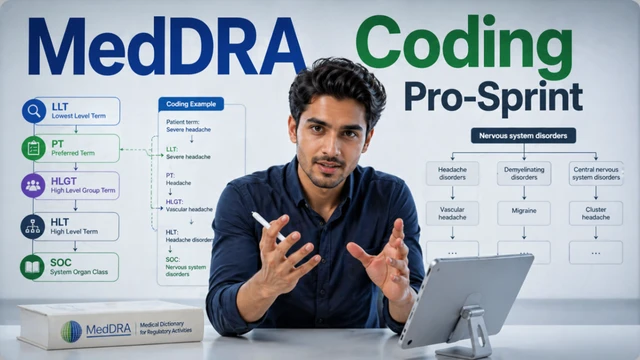
MedDRA (Medical Dictionary for Regulatory Activities) is a standardized medical terminology. It is used to code adverse events, medical history, and drug indications. MedDRA coding for freshers is a critical skill. You map the reported symptom (e.g., “difficulty breathing”) to the closest MedDRA term (e.g., “Dyspnoea”).
This ensures consistency across global databases and regulatory submissions. MedDRA is maintained by ICH. The latest version, MedDRA 26.0, has over 80,000 terms. Coding is done using a browser tool. During interviews, you may be asked to code a few sample terms.
Mastering MedDRA takes practice. Simulation platforms let you code hundreds of realistic cases, building speed and accuracy.
The Gap: What College Didn’t Teach You
Your pharmacy degree covered pharmacology, pharmaceutics, and drug interactions. But employers expect you to know:
- How to navigate a safety database
- ICSR triage and data entry protocols
- MedDRA coding rules and conventions
- Case narrative writing (medical writing basics)
- Regulatory submission timelines (e.g., SUSAR within 7 days)
These are not taught in most colleges. That’s why fresher hiring rates are low unless you bridge the gap through specialized training.
Your Step-by-Step Roadmap to a PV Job
Follow this structured pathway to become job-ready:
- Phase 1: Foundations (Week 1–2)
Study ICH E2D, E2B guidelines. Understand the drug safety lifecycle. Free resources from WHO and FDA help. - Phase 2: Build Core Skills (Week 3–6)
Enroll in hands-on programs like ZANE ProEd’s ICSR triage and MedDRA simulators. Practice on dummy cases until it becomes second nature. - Phase 3: Create Your Portfolio (Week 7)
Document your simulated case processing work. Show metrics: cases processed per day, coding accuracy, etc. - Phase 4: Apply & Interview (Week 8 onwards)
Target CROs and pharma companies. Use your portfolio to prove you can do the job from day one.
Why Simulation-Based Learning Wins
Textbooks and theory won’t make you a case processor. You need a system that mimics real PV operations. Imagine logging into a dashboard where you receive dummy ICSRs, perform triage, code events, and write narratives. You get instant feedback. By the time you face an interview, you’ve already done the job virtually.
This is how ZANE ProEd’s approach works. It's a system, not just a course. You build muscle memory for the actual tasks, making you productive from week one at work.
Build These Skills Now
Programs from ZANE ProEd Academy that directly address the skill gaps discussed above.
Inside ZANE ProEd’s Pharmacovigilance Systems
Two core systems build your expertise:
- ICSR Case Processing & Triage Simulator: You learn end-to-end case handling – from intake to submission. Practice with global and India-specific cases.
- MedDRA Medical Coding Certification: A deep dive into medical coding rules, conventions, and speed-building exercises. Realistic adverse event scenarios get you interview-ready.
Both are used by top CROs to train their own hires. Now accessible to freshers, they offer a clear path to stand out among 1000+ applicants.
Not sure where you stand? Learn more about our methodology and assess your readiness.
Ready to take the next step? Check your job readiness with ZANE ProEd’s free skill benchmark.
Build These Skills Now
Programs from ZANE ProEd Academy that directly address the skill gaps discussed above.
Follow Zane ProEd on Google
Preferred SourceAdd our publication as a preferred source to get the latest clinical research guides, industry updates, and career intel directly in your Google Top Stories & AI Overviews.