How to Get Pharmacovigilance Case Processing Jobs for Freshers: A Guide for Medical Graduates

Pharmacovigilance Case Processor jobs for freshers are entry-level roles focused on processing drug safety reports. You will collect, enter, and code adverse event data into a safety database. These roles are ideal for BPharm, BSc, BDS, and other life science graduates looking for a career in drug safety.
If you're a BDS, BHMS, BAMS, or Nursing graduate, you might feel like your career path is fixed. But there's a huge industry looking for your skills that you may not know about. This guide is about pharmacovigilance case processing jobs for freshers, a stable and growing field where your medical knowledge is a major advantage.
Many graduates think they need to work in a clinic or hospital. But the truth is, pharmaceutical companies are struggling to find people with a medical background who can understand and process drug safety information. Your degree has prepared you for more than you think.
Build These Skills Now
Programs from ZANE ProEd Academy that directly address the skill gaps discussed above.
This is not just another job; it's a career transition into a high-growth domain. Let’s break down exactly what this job is and how you can get started, step by step.
What does a Pharmacovigilance Case Processor do?
A Pharmacovigilance (PV) Case Processor is a drug safety detective. Your main job is to handle reports of adverse events – unwanted medical occurrences that a patient experiences after taking a medicine. The pharmacovigilance case processor job description is focused on accuracy and detail.
Think of it like this: when someone reports a side effect, that information needs to be collected, understood, and recorded correctly. This is critical for ensuring medicines on the market are safe for everyone. This is one of the most common types of adverse event reporting jobs.
Your daily tasks typically include:
- Case Intake: Receiving adverse event reports from sources like doctors, patients, and hospitals.
- Data Entry: Accurately entering all the information from the report into a special safety database (like Oracle Argus Safety).
- Triage: Assessing the seriousness of the case to see if it needs to be reported to regulatory authorities quickly.
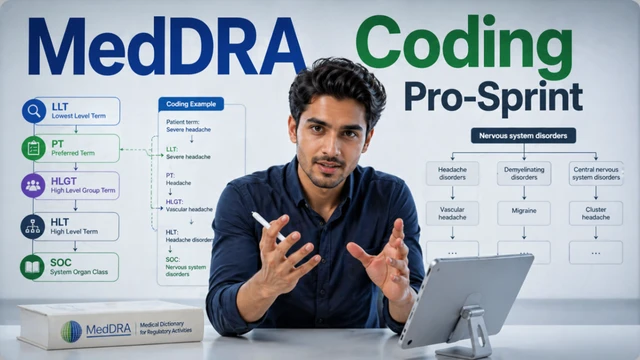
- Medical Coding: Using a standard medical dictionary called MedDRA to code the patient's medical history, event terms, and drug information.
- Narrative Writing: Writing a clear and concise summary of the case, from start to finish.
- Quality Check: Reviewing cases for completeness and accuracy before they are submitted.
You are the first, most important link in the entire drug safety chain. Your work directly helps companies and health authorities like the FDA and EMA monitor a drug's safety profile.
What is the salary of a PV Case Processor in India?
Salary is a major question for any fresher. The good news is that pharmacovigilance offers a competitive starting salary that grows quickly with experience. Understanding the typical PV case processor salary India can help you set your expectations.
Here’s a general breakdown:
- Fresher (0-1 year): As a fresher entering the field, you can expect a starting salary between ₹2.8 Lakhs to ₹4.5 Lakhs per annum. This can vary based on the company (MNC vs. a smaller CRO) and your location (Mumbai, Bengaluru, and Hyderabad often pay more).
- Experienced (1-3 years): Once you have a couple of years of experience in case processing, your salary can increase significantly to ₹4.5 Lakhs to ₹7 Lakhs per annum. At this stage, you might specialize in a specific area or start reviewing the work of junior processors.
The real value in an ICSR processing career is the growth path. From a Case Processor, you can move into roles like Signal Detection, PV Audits, or Medical Writing. These advanced roles come with much higher salaries and responsibilities. Check our detailed guide on pharmacovigilance jobs for freshers for more career paths.
How to get a PV case processing job as a fresher?
Getting your first job requires more than just a degree. Companies today want freshers who are 'job-ready' from day one. This means you need to show them you have the specific skills they are looking for.
Here is a simple roadmap to follow:
- Understand the Fundamentals: Your degree in dentistry, homeopathy, or nursing gives you a strong medical foundation. Now, you need to learn the basics of pharmacovigilance, including regulations set by bodies like the ICH.
- Learn Key Skills: Focus on the two most important skills for a case processor: ICSR processing and medical coding with MedDRA. These are non-negotiable skills for any entry-level PV job.
- Get Certified in Practical Skills: A certification that proves you have hands-on experience is more valuable than a purely theoretical one. Look for programs that teach you how to use safety databases and perform MedDRA coding.
- Build a Skills-First Resume: Instead of just listing your degree, create a resume that highlights your practical PV skills at the top. Mention your knowledge of ICSR, MedDRA, and any safety database software.
- Apply to the Right Companies: Target major IT service providers (like TCS, Cognizant, Wipro), pharmaceutical companies (like Novartis, Pfizer), and Contract Research Organizations (CROs) like IQVIA and Syneos Health.
What is ICSR processing in pharmacovigilance?
ICSR stands for 'Individual Case Safety Report'. It is the foundation of all pharmacovigilance work. An ICSR is a detailed report of a single patient's experience with an adverse event after using a drug.
An ICSR must contain four minimum pieces of information to be valid:
- An identifiable patient
- An identifiable reporter (like a doctor or the patient themselves)
- A suspect drug
- An adverse event
The process of handling these reports from start to finish is called ICSR processing. It's a structured workflow that ensures every report is handled according to global standards. The journey of an ICSR includes triage, data entry, coding, quality review, and final submission to regulatory bodies like the Central Drugs Standard Control Organisation (CDSCO) in India.
An ICSR processing career is an excellent entry point into the world of drug safety because it teaches you the core operational skills required in the industry. Every senior role in PV, from signal detection to risk management, builds on the foundation of ICSR processing.
What is MedDRA coding and how is it used in PV?
MedDRA stands for Medical Dictionary for Regulatory Activities. It is a standardized, international medical terminology used to code and classify adverse event information.
Think of it as a universal language for drug safety. If a doctor in Japan reports 'headache' and a patient in the USA reports 'sore head', MedDRA allows a PV professional to code both of these to the same standardized term. This consistency is crucial for analyzing safety data from around the world.
In case processing, you will use MedDRA to code:
- Adverse Events: The specific side effects reported.
- Medical History: The patient's past and current illnesses.
- Test Results: Any relevant lab or diagnostic findings.
For freshers, learning MedDRA coding for freshers is one of the most powerful ways to stand out. It is a technical skill that companies actively search for on resumes. Having this skill shows that you understand how raw data is converted into analyzable information, which is a key part of the job.
The Gap: What Your College Degree Didn't Teach You
Your BDS, BAMS, or Nursing degree taught you anatomy, physiology, and pathology. This knowledge is invaluable. However, it did not teach you the specific, practical skills that pharmaceutical companies require for a PV Case Processor role.
Companies expect you to know:
- The complete end-to-end ICSR processing workflow.
- How to perform medical coding using the MedDRA browser.
- The basics of a safety database like Oracle Argus.
- Good Clinical Practices (GCP) and ICH guidelines.
This is the gap that most freshers face. Your degree makes you eligible, but these practical skills are what make you hirable.
Your Step-by-Step Pathway to a PV Career
Feeling overwhelmed? Don't be. Here is a clear, actionable pathway you can start today.
Step 1: Master the ICSR Workflow. Before anything else, learn the journey of an adverse event report. Understand what happens at each stage: intake, triage, data entry, coding, and submission.
Step 2: Learn MedDRA Coding. This is not optional. You must learn how to navigate the MedDRA hierarchy and apply coding conventions. This is a hard skill you can put on your resume immediately.
Step 3: Gain Hands-On Software Exposure. You don't need to be an expert, but you should understand the purpose and layout of a safety database. Knowing what the fields mean and why they are there is a huge advantage.
Step 4: Build a Project Portfolio. Create a sample case processing project. Document your process for a mock ICSR, including the narrative you wrote and the MedDRA codes you assigned. This is proof of your ability.
Step 5: Optimize Your LinkedIn & Resume. Update your profiles to scream 'Pharmacovigilance'. Use keywords like "ICSR Processing," "MedDRA Coding," "Drug Safety," and "Adverse Event Reporting."
Bridging the Gap with Simulation-Based Learning
How can you learn these practical skills when you don't have a job yet? Reading theory is not enough. You need to perform the tasks yourself. This is where simulation-based learning comes in.
Instead of just watching videos, you get to work on real-world case scenarios in a simulated environment. You practice making decisions, coding events, and writing narratives, just like you would on the job. This is the fastest way to build the confidence and competence that employers are looking for.
Build These Skills Now
Programs from ZANE ProEd Academy that directly address the skill gaps discussed above.
A System to Make You Job-Ready
At ZANE ProEd, we don't just offer courses; we provide a system designed to make you job-ready. Our approach is built on hands-on simulation that mirrors the work you will do in a real pharmaceutical company.
Our ICSR Case Processing & Triage module lets you work on diverse and complex cases, teaching you how to think critically and apply regulatory guidelines. You don't just learn what triage is; you perform it.
Similarly, the MedDRA Medical Coding Certification module is not about memorizing terms. It's about developing the skill of accurate coding through practice on hundreds of real-world verbatims. You learn the 'why' behind every code selection, a skill that sets you apart from other freshers.
By integrating these skills, you build a complete competency profile that directly matches the job descriptions for pharmacovigilance case processing jobs for freshers.
Are Your Skills Ready for the Job Market?
The opportunity in pharmacovigilance for medical graduates is immense, but it favors those who are prepared. Your degree is the key that opens the door, but your practical skills are what will get you inside.
Take a moment to compare your current skills against the requirements we've discussed. Identifying your gaps is the first step toward a successful career transition. You can learn more about our unique teaching methods by understanding our mission at ZANE ProEd.
Check how your skills compare to what top pharma companies are looking for. Your journey into a rewarding PV career starts with building the right skills, right now.
Build These Skills Now
Programs from ZANE ProEd Academy that directly address the skill gaps discussed above.
Follow Zane ProEd on Google
Preferred SourceAdd our publication as a preferred source to get the latest clinical research guides, industry updates, and career intel directly in your Google Top Stories & AI Overviews.