Pharmacovigilance Case Processing Jobs for Freshers: A Complete Guide

Pharmacovigilance Case Processor – a vital entry-level role for life science freshers. These jobs involve receiving, reviewing, and processing reports of adverse drug events. With the right skills in ICSR processing and MedDRA coding, freshers can get hired in India's growing drug safety industry.
You've probably seen pharmacovigilance case processing jobs for freshers posted online, but you're not sure what the job really is. As a BSc, BPharm, or any life science graduate, you face a tough reality: colleges teach you the theory of drugs, but not the practical skills employers demand.
\n\nI've been on the hiring side. I know exactly what makes a candidate stand out. And it's not your degree certificate. It's what you can do on day one. This guide gives you the insider scoop—no jargon, just clear steps.
Build These Skills Now
Programs from ZANE ProEd Academy that directly address the skill gaps discussed above.
What does a Pharmacovigilance Case Processor do?
\nA pharmacovigilance case processor is the first person to handle reports of side effects from medicines. You gather details from patients or doctors, enter them into a safety database, and ensure they are accurate and complete. Your work helps keep medicines safe for everyone.
\n- \n
- Receive adverse event reports from emails, calls, or online forms. \n
- Check if the report is valid and if all required information is present. \n
- Code the medical terms using standard dictionaries like MedDRA. \n
- Create a case narrative summarizing the event. \n
- Submit the case within strict deadlines following ICH guidelines. \n
This role is the backbone of drug safety. Without accurate case processing, companies cannot detect new safety signals or meet regulatory requirements.
\n\nWhat is the salary of a PV Case Processor in India?
\nFor freshers, the PV case processor salary India typically ranges from ₹2.5 to ₹4.5 lakhs per annum. The exact figure depends on the company, location, and your skills. MNCs and CROs like IQVIA, Accenture, and Wipro often pay higher. With just 1-2 years of experience, salaries can jump to ₹5-7 lakhs.
\nHere's a quick breakdown:
\n- \n
- Fresher: ₹2.5 - 3.5 LPA (mid-tier firms), ₹3.5 - 4.5 LPA (top CROs/MNCs). \n
- 1-2 years experience: ₹4.5 - 7 LPA. \n
- 3+ years: ₹7 - 12+ LPA, especially if you specialize in complex cases or medical review. \n
Adding MedDRA coding and ICSR processing skills can push your starting salary higher.
\n\nHow to get a PV case processing job as a fresher?
\nGetting your first adverse event reporting job doesn't have to be hard. Break it into clear steps:
\n- \n
- Understand the job: Read job descriptions carefully. Know what ICSR, MedDRA, and regulatory timelines mean. Look at our guide on PV case processing for detailed insights. \n
- Learn the tools: Most companies use safety databases like Argus, ArisG, or Veeva. You don't need to master them, but familiarity helps. Simulation-based training can give you that. \n
- Get certified: A certificate in ICSR processing and MedDRA coding signals to recruiters that you can hit the ground running. \n
- Build a project: Process mock cases and create a portfolio. Show it during interviews. \n
- Apply smartly: Target CROs, IT-BPO firms with PV divisions, and pharma companies. LinkedIn, Shine, and Naukri are your friends. Customize your resume with keywords like pharmacovigilance case processor job description phrases. \n
What is ICSR processing in pharmacovigilance?
\nICSR stands for Individual Case Safety Report. ICSR processing is the step-by-step handling of a single adverse event report from start to finish. It is the core of a case processor's daily work and a crucial skill for building an ICSR processing career.
\nHere's what it involves:
\n- \n
- Triage: Quickly decide if the case is serious and needs urgent reporting (e.g., within 7 or 15 days). \n
- Data entry: Enter patient details, drug names, and event descriptions into a safety database. \n
- Medical coding: Convert the reported event into standard terms using MedDRA. Code the drug names using WHO-DD. \n
- Narrative writing: Write a clear, concise clinical summary of what happened. \n
- Quality review: Check for accuracy and completeness before submission to regulators. \n
Regulators like the US FDA and CDSCO mandate strict timelines. Mastering ICSR processing means you understand these guidelines and can work under pressure.
\n\nWhat is MedDRA coding and how is it used in PV?
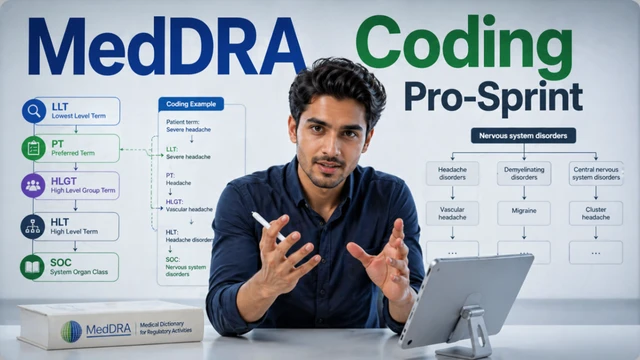
\nMedDRA (Medical Dictionary for Regulatory Activities) is a standard international dictionary for medical terms used in drug safety. MedDRA coding for freshers is a must-learn skill because every adverse event report must be coded to a MedDRA term.
\nHow it works:
\n- \n
- A patient reports 'cold sweat and tightness in chest'. You need to find the correct MedDRA term, like 'Chest pain' or 'Hyperhidrosis'. \n
- MedDRA has 5 levels, from very general to very specific. You choose the lowest level term (LLT) that matches the report, then the system links it to higher levels for analysis. \n
- Accurate coding helps safety teams detect patterns and signal new risks. \n
Employers test this skill in interviews. Knowing how to navigate ICH-endorsed dictionaries like MedDRA immediately sets you apart.
\n\nWhy your degree isn't enough: The skill gap reality
\nColleges give you subject knowledge—pharmacology, anatomy, chemistry. But a pharmacovigilance case processor job description asks for skills that textbooks don't cover:
\n- \n
- Theory vs. Practice: You studied adverse drug reactions, but have you ever created an actual case narrative? Ever used a safety database? Probably not. \n
- Tools: Employers expect you to be comfortable with tools like Oracle Argus or ArisGlobal. These are not taught in BPharm or BSc courses. \n
- Regulations: Knowing ICH E2B guidelines and reporting timelines isn't optional. It's the daily rulebook. \n
- Speed and accuracy: Real-world cases come in volume. You need to process them fast without errors. \n
This is why many non-healthcare graduates (BCA, BTech) who upskill in these areas often land PV jobs. They fill the exact skill gap recruiters are looking for.
\n\nYour step-by-step roadmap to a PV case processing job
\n- \n
- Learn the language of PV: Start with free resources from WHO and EMA. Understand what a case processor does daily. Bookmark the recruiters' guide for inside tips. \n
- Get hands-on with simulations: Use mock cases to practice ICSR triage, data entry, and MedDRA coding. This builds confidence. \n
- Earn a skill certificate: A focused credential in ICSR processing and MedDRA shows commitment. It also gives you project work to showcase. \n
- Prepare your job toolkit: Write a resume that mirrors pharmacovigilance case processor job description keywords. Create a small portfolio of mock cases. \n
- Interview with confidence: Be ready to explain how you would handle a serious adverse event case. Share your simulation experience. \n
Bridge the gap with simulation-based learning
\nReading about PV is not enough. You need to do it. Imagine processing 50 mock ICSRs before your interview. You'd walk in knowing exactly what to expect. That's the power of simulation.
\nPrograms that offer case-processing sandboxes let you work on real-life scenarios. You learn to use MedDRA browsers, draft narratives, and meet mock regulatory deadlines. This transforms you from a fresher with a degree to a candidate with demonstrable skills.
\nBuild These Skills Now
Programs from ZANE ProEd Academy that directly address the skill gaps discussed above.
How ZANE ProEd fits into your journey
\nThe ICSR Case Processing & Triage system at ZANE ProEd is built like a virtual apprenticeship. You'll process cases just like in a CRO, using standard workflows. The MedDRA Medical Coding Certification system trains you to code accurately and quickly, with real-time feedback. Together, these systems fill the exact skill gap employers see in freshers.
\nThink of them not as courses, but as a launchpad. You gain the practical muscle memory that makes interviews easy and your first week on the job smooth. Learn more about our approach at ZANE ProEd.
\n\nAre you job-ready? Test yourself
\nTry answering this: A patient on a new diabetes drug reports severe skin rash and breathing difficulty. How would you triage this case? What MedDRA terms would you use? If you stumbled, it's time to build that muscle. See how your current skills compare with what employers demand.
Build These Skills Now
Programs from ZANE ProEd Academy that directly address the skill gaps discussed above.
Follow Zane ProEd on Google
Preferred SourceAdd our publication as a preferred source to get the latest clinical research guides, industry updates, and career intel directly in your Google Top Stories & AI Overviews.