Your Guide to Pharmacovigilance Case Processing Jobs for Freshers

Pharmacovigilance Case Processor jobs for freshers are entry-level roles focused on drug safety. Responsibilities include collecting, documenting, and processing adverse event data from clinical trials and patients. This role is ideal for medical and life science graduates seeking a career in the pharmaceutical industry.
If you have a BDS, BHMS, BAMS, or Nursing degree and are looking back at your career after a gap, you might feel stuck. You have a strong medical foundation, but finding the right path into the corporate world can be confusing. Many promising roles seem to require experience you don't have, and that's where pharmacovigilance case processing jobs for freshers offer a clear and rewarding opportunity.
This is not just another job. It's a career where your medical knowledge is valued and directly applied to ensure patient safety worldwide. The pharmaceutical industry needs people like you who understand human biology and medical terminology.
Build These Skills Now
Programs from ZANE ProEd Academy that directly address the skill gaps discussed above.
But your degree alone is not enough anymore. Companies need practical skills. This guide provides a step-by-step roadmap to bridge that gap and help you become a job-ready candidate, not just a certified one.
What does a Pharmacovigilance Case Processor do?
A Pharmacovigilance (PV) Case Processor is like a detective for drug safety. Their main job is to handle reports of adverse events—unwanted medical occurrences that a patient experiences after taking a medicine. The pharmacovigilance case processor job description focuses on creating detailed, accurate, and compliant safety reports.
Here are the typical daily tasks:
- Triage: Receiving and sorting incoming adverse event reports from various sources like doctors, patients, and hospitals.
- Data Entry: Entering all relevant information from the source documents into a specialized safety database (like Argus or ArisG).
- Case Narrative Writing: Writing a clear, concise summary of the adverse event, explaining what happened in a structured format.
- Medical Coding: Using standardized medical dictionaries, like MedDRA, to code the patient's medical history, adverse events, and drug names.
- Quality Check: Reviewing the case for accuracy, completeness, and consistency before it is submitted to regulatory authorities.
Essentially, you are responsible for the first critical step in the drug safety process. Your work helps pharmaceutical companies and regulatory bodies like the FDA and EMA monitor a drug's safety profile after it's on the market. This is a core part of all adverse event reporting jobs.
What is the salary of a PV Case Processor in India?
The salary for a PV Case Processor is competitive, especially for medical and allied health graduates. The PV case processor salary India depends on the company, location, and your skills.
Here is a general breakdown:
- Fresher (0-1 year experience): As a fresher entering the field, you can expect a starting salary ranging from ₹3.0 Lakhs to ₹4.5 Lakhs per annum. Companies that hire freshers often provide on-the-job training.
- Experienced (1-3 years experience): With a few years of experience, your salary can increase significantly. Professionals in this range typically earn between ₹4.5 Lakhs to ₹7.0 Lakhs per annum.
Your ability to demonstrate practical skills in areas like MedDRA coding and familiarity with safety databases can help you negotiate a higher starting salary. It's a field where skills directly translate to value.
How to get a PV case processing job as a fresher?
Getting your first job in this field, especially after a break, requires a focused strategy. Your degree gives you a strong foundation, but companies are looking for job-ready skills. Here’s how you can stand out:
- Understand the Core Concepts: Go beyond your college syllabus. Learn the fundamentals of Good Pharmacovigilance Practices (GVP) and the guidelines set by authorities like the ICH.
- Master ICSR Processing: This is the heart of the job. You need to understand the entire lifecycle of an Individual Case Safety Report (ICSR), from receipt to submission.
- Learn MedDRA Coding: This is a non-negotiable skill. MedDRA is the universal language for coding adverse events. Gaining proficiency in this is crucial for MedDRA coding for freshers.
- Get Familiar with Safety Databases: While you may not have access to commercial software like Oracle Argus, understanding its workflow and principles is a huge advantage.
- Build a Skills-Based Resume: Instead of just listing your degree, highlight practical skills. Mention your knowledge of ICSR processing, narrative writing, and MedDRA coding.
For more career paths, you can also explore related fields like clinical data management, which also values a medical background.
What is ICSR processing in pharmacovigilance?
ICSR stands for 'Individual Case Safety Report'. It is a detailed report of a single patient's adverse event suspected to be caused by a drug. ICSR processing is the systematic procedure of managing this report. It is the foundation of an ICSR processing career.
The process follows strict international guidelines to ensure every report is handled consistently, no matter where in the world it comes from. The goal is to create a high-quality, standardized report that can be analyzed by scientists and regulators.
The main steps in ICSR processing are:
- Case Receipt: Receiving the initial information.
- Triage & Prioritization: Checking if the case is valid and determining its seriousness and expectedness to define submission timelines.
- Data Entry & Coding: Entering details into the safety database and coding terms using MedDRA.
- Narrative Writing: Creating a medical story of the case.
- Quality Review: Ensuring the data is accurate and complete.
- Medical Review: A medical doctor reviews the case for clinical context.
- Submission: Electronically submitting the report to regulatory authorities like the Indian Pharmacopoeia Commission (IPC) in India, as per guidelines from bodies like CDSCO.
What is MedDRA coding and how is it used in PV?
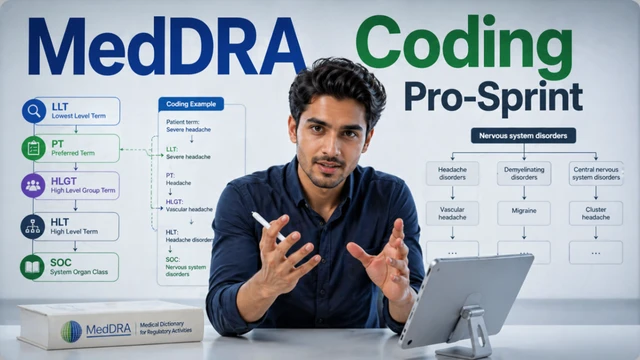
MedDRA stands for Medical Dictionary for Regulatory Activities. Think of it as a universal medical language used by all pharmaceutical companies and regulatory bodies worldwide. It ensures that everyone describes the same medical concept in the exact same way.
In pharmacovigilance, MedDRA is used to code adverse events, medical history, and test results. For example, a doctor might report a patient's symptom as 'heart pounding', while another might say 'palpitations'. With MedDRA, both of these would be coded to the same standardized term. This consistency is critical for analyzing safety data from thousands of patients across the globe.
For anyone looking into pharmacovigilance case processing jobs for freshers, learning MedDRA is essential. It's not just about finding a term in a dictionary; it's about understanding the hierarchy and coding conventions to select the most accurate term based on the case details. This is a skill that makes you immediately valuable to an employer.
The Gap: Your Degree vs. The Job Requirement
Your BDS, BAMS, or BHMS degree taught you anatomy, physiology, and pathology. You understand the 'what' and 'why' of diseases. However, the industry operates on the 'how'. Employers expect you to know how to process a case in a safety database, how to write a case narrative, and how to apply MedDRA coding rules from day one.
This is the gap. Your college prepared you to be a clinician, not a corporate professional in pharmacovigilance. This is why many graduates feel unprepared, as companies today demand job-ready talent, not just academic knowledge. See our detailed guide on pharmacovigilance jobs for more insights.
Your 4-Step Roadmap to Becoming a Job-Ready PV Case Processor
Here is a clear, actionable plan to bridge that gap:
- Build Foundational Knowledge: Start by learning the core principles of pharmacovigilance, including GVP guidelines and the drug development lifecycle.
- Develop Practical ICSR Skills: Focus on the hands-on tasks. Learn how to perform triage, data entry, and write a clear, compliant case narrative. This is the most critical part of the job.
- Master MedDRA Coding: Dedicate time to learning MedDRA. Understand its structure (SOC, HLGT, HLT, PT, LLT) and practice coding different medical terms.
- Practice on Simulated Systems: The best way to learn is by doing. Work on platforms that simulate the real-world safety databases and case processing workflows used by top pharma companies.
The Bridge: From Theory to Practical Application
How do you gain practical skills without a job? The answer is simulation-based learning. Instead of just watching videos or reading PDFs, you need to work on systems that mimic the real work environment. This approach allows you to process mock cases, write narratives, and perform MedDRA coding, building muscle memory and confidence.
This is how you move from knowing the theory to being able to perform the job. It’s what makes you a valuable hire from day one.
Build These Skills Now
Programs from ZANE ProEd Academy that directly address the skill gaps discussed above.
A System for Building Job-Ready Skills
At ZANE ProEd, we don't just offer courses; we provide a system designed to make you job-ready. Our training is built on real-world case scenarios and simulation platforms. For aspiring PV Case Processors, the journey involves two key pillars.
First, our ICSR Case Processing & Triage program teaches you the end-to-end workflow of handling adverse event reports. You learn to think and act like a case processor. Second, our MedDRA Medical Coding Certification program gives you mastery over the most critical coding skill in the industry.
Together, they form a complete system to build the exact skills employers are looking for. To learn more about our philosophy, you can read about us here.
Are You Ready for the Job?
The demand for skilled PV professionals is growing. As a medical or allied health graduate, you are perfectly positioned to build a successful career in this stable and rewarding field. The only thing standing between you and your first job is the practical skill gap.
It's time to stop collecting certificates and start building real-world capabilities. See how your current skills compare to what the industry demands and take the first step towards your new career.
Build These Skills Now
Programs from ZANE ProEd Academy that directly address the skill gaps discussed above.
Follow Zane ProEd on Google
Preferred SourceAdd our publication as a preferred source to get the latest clinical research guides, industry updates, and career intel directly in your Google Top Stories & AI Overviews.