Pharmacovigilance Case Processing Jobs for Freshers: Complete Career Guide

Pharmacovigilance Case Processor reviews and codes reports of side effects (adverse events) from medicines. Freshers can enter these jobs by learning ICSR processing, MedDRA coding, and safety database basics. A life science degree plus targeted skills can get you hired in 3–6 months.
Are you a BSc or MSc graduate in Biotechnology, Microbiology, or Biochemistry? You have sent dozens of job applications. You keep hearing 'we need experienced candidates' or you get no reply at all. It feels like your degree is not enough. You are not alone. The truth is that pharmacovigilance case processing jobs freshers are opening up right now. But you need a specific skill set that colleges don't teach. This guide shows you the exact path to get hired.
Pharma companies in India receive thousands of side effect reports every day. They need trained people to process these reports. The demand is real. But there is a gap. Your degree gives you biology knowledge, not the practical tools of PV. Here is how to bridge that gap and land your first job.
Build These Skills Now
Programs from ZANE ProEd Academy that directly address the skill gaps discussed above.
What does a Pharmacovigilance Case Processor do?
A Pharmacovigilance Case Processor handles the first stage of safety data management. You take a report of a side effect (called an adverse event) from a patient or doctor. You then enter it into a safety database using a standard format. Your main tasks include:
- Reviewing source documents (emails, forms, call transcripts)
- Entering data into safety databases like Argus, ArisG, or Veeva Vault
- Checking for missing or unclear information
- Coding medical terms using MedDRA
- Assessing seriousness and expectedness of the event
- Preparing the case for medical review
This is an entry-level role. It is not about making medical decisions. You follow strict guidelines from ICH and WHO. Your accuracy and speed matter. Most commonly, you work in a pharmacovigilance service provider (like Accenture, Cognizant, TCS) or a pharma company. The job is desk-based, process-driven, and has clear career progression.
What is the salary of a PV Case Processor in India?
The PV case processor salary India ranges widely based on company, location, and your skills. For freshers, here is a realistic picture:
- Entry-level (0–1 year): ₹2.5 LPA to ₹4.5 LPA
- With 1–3 years experience: ₹4.5 LPA to ₹7 LPA
- Senior case processor or reviewer: ₹7 LPA to ₹10 LPA+
Companies in Mumbai, Pune, Hyderabad, and Bangalore typically pay more than smaller cities. But remember: salary grows fast once you gain experience and prove accuracy. Many freshers start around ₹3 LPA and jump to ₹5 LPA in two years if they master ICSR processing career skills. Some companies also offer night shift allowances, which add to your take-home pay.
How to get a PV case processing job as a fresher?
Here is a simple step-by-step approach that works for life science graduates:
- Learn the basics of pharmacovigilance. Understand key terms: adverse event, serious adverse event, causality, expectedness. Read FDA and CDSCO guidelines.
- Get trained on ICSR processing. ICSR stands for Individual Case Safety Report. You must know the data fields, validation rules, and workflow. This is the core of the job.
- Practice MedDRA coding. MedDRA is the medical dictionary for regulatory activities. You must learn to code symptoms and diseases correctly. Even basic practice helps.
- Familiarize yourself with safety databases. Many companies use Oracle Argus or ArisG. You may not have access to the actual software, but you can learn the logic through simulations and free resources.
- Build a PV-specific resume. Highlight any certification, project, or simulation work. Use keywords like 'ICSR case processing', 'MedDRA coding', 'adverse event reporting'.
- Apply to entry-level roles. Look for titles like 'Drug Safety Associate', 'PV Trainee', 'Case Processor'. Also consider contract roles to get a foot in the door.
For a deeper dive, read this detailed guide on PV case processing jobs. It covers resume tips and interview questions.
What is ICSR processing in pharmacovigilance?
ICSR stands for Individual Case Safety Report. It is a report of a side effect that happened to one specific patient. ICSR processing is the step-by-step handling of that report from receipt to submission to regulators. The process usually includes:
- Triage: Check if the report is valid. Does it have an identifiable patient, reporter, drug, and adverse event?
- Data entry: Enter all details into the safety database. Follow the exact fields required by EMA or CDSCO.
- Duplicate search: Ensure this report is not already in the system.
- Coding: Assign MedDRA codes to the adverse event and medical history.
- Assessment: Check seriousness, expectedness, and causality (under guidance).
- Quality check: Senior reviewer verifies accuracy.
- Submission: Send the report to regulatory authorities within required timelines.
This is the heart of adverse event reporting jobs. Employers need people who can do this accurately and quickly. You can practice with sample cases online.
What is MedDRA coding and how is it used in PV?
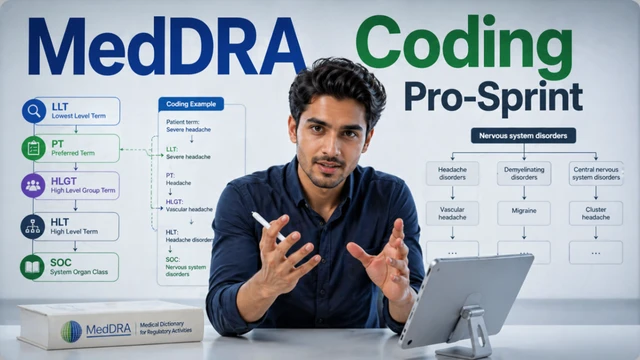
MedDRA stands for Medical Dictionary for Regulatory Activities. It is a standardized vocabulary used worldwide to describe medical terms in safety reports. When a patient says 'I had a heart attack', you cannot type that freely. You must find the correct MedDRA term, like 'Myocardial infarction'. That term has a specific code.
MedDRA coding for freshers is essential. You don't need to memorize the entire dictionary (it has over 80,000 terms). You need to understand the hierarchy:
- System Organ Class (SOC) – highest level, e.g., 'Cardiac disorders'
- High Level Group Term (HLGT)
- High Level Term (HLT)
- Preferred Term (PT) – most used in coding, e.g., 'Myocardial infarction'
- Lowest Level Term (LLT) – the exact reported term
Your job is to map the reported term to the correct PT. This requires logic and practice. Free MedDRA training is limited, but some resources exist. You can also take a structured certification course to get hands-on practice.
What colleges teach vs. what employers actually expect
Your BSc or MSc curriculum covers microbiology, biochemistry, genetics, and maybe some pharmacology. But employers don't ask you to culture bacteria in a PV job. They ask you to:
- Navigate a safety database
- Apply regulatory guidelines
- Code medical terms accurately
- Understand case processing workflow
- Meet daily productivity targets
Colleges rarely teach these. That's why you face rejections. You are not underqualified; you are under-equipped. The good news: you can learn these skills in a few weeks with focused training. Many freshers who get hired have done a certification or simulation course.
A 5-step roadmap to your first PV job
Follow this plan consistently for 3–6 months:
- Foundation (Weeks 1–2): Study basic PV concepts. Read ICH E2A, E2B guidelines. Watch free webinars. Understand what a case processor does daily.
- Skill building (Weeks 3–6): Enroll in a focused course on ICSR processing and MedDRA coding. Practice with sample cases. Aim to complete at least 20 practice cases.
- Tool familiarization (Weeks 7–8): Learn the logic of safety databases. Some courses provide simulations. Watch demos of Argus or ArisG on YouTube. You don't need to master the software, but you must understand fields and workflow.
- Resume and LinkedIn optimization (Week 9): Rewrite your resume with PV keywords. Add your certification, skills, and any case processing projects. Set your LinkedIn to 'Open to Work'. Connect with PV professionals.
- Apply and interview (Weeks 10–12): Apply to at least 10 jobs per week. Prepare answers for common questions: 'What is a valid ICSR?' 'How do you code hypertension?' 'What is the difference between serious and severe?'
Also check this article on PV jobs for chemistry graduates – the process is similar and offers extra tips.
Why simulation-based learning is your fastest bridge
Reading theory is not enough. Employers want you to handle a case on day one. Simulation-based learning puts you in a virtual PV environment. You see mock source documents. You enter data into a simulated database. You make mistakes safely and learn from them. This builds real confidence and skill. It is the closest thing to actual work experience without a job.
Build These Skills Now
Programs from ZANE ProEd Academy that directly address the skill gaps discussed above.
How ZANE ProEd prepares you for the real job
ZANE ProEd focuses on practical, simulation-driven training for PV roles. Two specific programs directly address the skill gaps discussed:
- ICSR Case Processing & Triage: This program puts you through real-world case scenarios. You learn to triage cases, check validity, enter data, and perform duplicate searches. You practice the exact workflow used in industry.
- MedDRA Medical Coding Certification: This program trains you to code adverse events accurately. You work with real reported terms and learn to map them to Preferred Terms. The certification proves your coding ability to employers.
These are not just lectures. You get hands-on assignments, feedback, and performance tracking. The goal is to make you job-ready, not just certificate-ready. Many learners complete these and then clear interviews at service companies and CROs.
Ready to check your job readiness?
Stop applying blindly. First, assess where you stand. Do you know the difference between an AE and an SAE? Can you code a simple symptom like 'chest pain'? Can you describe the ICSR workflow? If you hesitate, you need to build those skills. Start today. Your next hiring cycle is closer than you think.
Build These Skills Now
Programs from ZANE ProEd Academy that directly address the skill gaps discussed above.
Follow Zane ProEd on Google
Preferred SourceAdd our publication as a preferred source to get the latest clinical research guides, industry updates, and career intel directly in your Google Top Stories & AI Overviews.