Pharmacovigilance Case Processing Jobs for Freshers: A Complete Guide to Your First PV Role

Pharmacovigilance Case Processor roles involve reviewing, coding, and reporting adverse drug events. For freshers, pharmacovigilance case processing jobs freshers are entry-level positions requiring knowledge of ICSR processing, MedDRA coding, and regulatory guidelines. Starting salary is ₹2.5–4 LPA in India.
If you're a BPharm or MPharm graduate and have faced multiple placement rejections, you're not alone. Over 90% of freshers fail to land pharmacovigilance case processing jobs freshers not because they lack potential, but because they don't know what the industry actually wants. Colleges teach theory. Employers need practical skills.
The gap is real. But here's the good news: you can close it in just a few months. Let’s break down exactly what a PV case processor does, the salary you can expect, and the step-by-step path to your first job.
Build These Skills Now
Programs from ZANE ProEd Academy that directly address the skill gaps discussed above.
What does a Pharmacovigilance Case Processor do?
A Pharmacovigilance Case Processor is the person who handles Individual Case Safety Reports (ICSRs). When a patient has a side effect from a medicine, a case processor enters that data into a safety database, codes it using MedDRA, and writes a medical narrative. It’s a detail-oriented and rule-driven job.
Daily tasks include:
- Triage: Sorting and prioritizing incoming adverse event reports based on seriousness.
- Data Entry: Entering patient demographics, drug details, and reaction information into systems like Argus or ArisGlobal.
- MedDRA Coding: Assigning standardized medical codes to symptoms, diagnoses, and lab findings.
- Narrative Writing: Creating a clear medical summary of the case from the reporter’s description.
- Regulatory Submission: Preparing the report for FDA, EMA, or CDSCO as per ICH guidelines.
What is the salary of a PV Case Processor in India?
The PV case processor salary India varies by city, company, and experience. For a fresher, the range is ₹2.5 to ₹4.0 lakhs per annum (LPA). With 1-3 years of experience, you can expect ₹4.5–6.5 LPA. Senior case processors or team leads earn ₹8 LPA and above. Bangalore, Hyderabad, and Pune usually offer higher packages due to the concentration of CROs and global pharmaceutical companies.
How to get a PV case processing job as a fresher?
Most freshers apply randomly and get rejected. A structured approach works better. Here’s how:
- Learn the basics: Understand ICSR processing, MedDRA coding, and the ICH E2B standard. Read our comprehensive guide to pharmacovigilance jobs for a full picture.
- Get certified: A short practical certification in case processing or MedDRA coding shows employers you're job-ready.
- Target the right companies: Apply to CROs (IQVIA, Syneos, Parexel), pharmacovigilance service providers (Accenture, Tata Consultancy Services), and pharma companies (Cipla, Dr. Reddy's).
- Prepare for interviews: Expect questions on seriousness criteria, causality assessment, and MedDRA hierarchy.
What is ICSR processing in pharmacovigilance?
ICSR processing is the core of a pharmacovigilance career. An Individual Case Safety Report is a document that captures all details about a single adverse event. Processing involves data entry, coding, narrative writing, and quality review before submission to health authorities. It follows strict global guidelines, mainly the ICH E2B specification. This is an adverse event reporting job that needs accuracy and speed.
What is MedDRA coding and how is it used in PV?
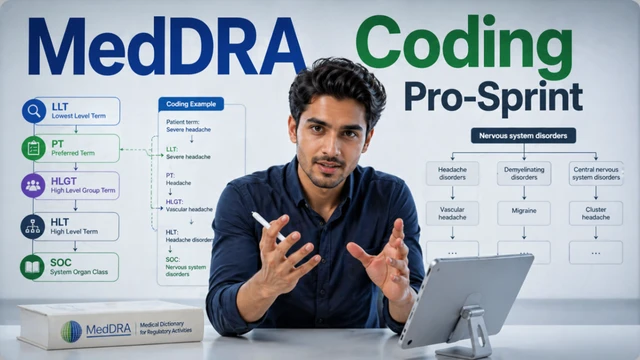
MedDRA (Medical Dictionary for Regulatory Activities) is a globally used medical terminology. In PV, after you read a case, you pick the most accurate code for each adverse event, medical history, and lab finding. For a fresher, MedDRA coding for freshers is often a separate skill to master. Coding decides how a case is classified and reported. Mistakes lead to regulatory queries. You can practice MedDRA using the browser tool provided by the ICH.
The Skill Gap: College vs. Industry
Pharmacy colleges teach you pharmacology, toxicology, and maybe a chapter on pharmacovigilance. But employers expect you to already know how to process a case in a safety database, code it in MedDRA, and draft a narrative. This is the reality trigger—a massive gap that placements don't bridge. Most students fail because their resume lists ‘knowledge of PV’ but cannot demonstrate real-world skills.
A Step-by-Step Pathway to Your First Job in 3–6 Months
- Self-Assess: Gauge your current understanding of adverse event reporting and MedDRA. Be honest.
- Master the Fundamentals: Take a structured program that covers ICSR triage, data entry, MedDRA coding, and narrative writing—all with hands-on practice.
- Build a Practice Portfolio: Work on simulated cases that mimic real PV databases. This proves your skill.
- Optimize Your Resume: Highlight practical certifications and tools (Argus, MedDRA browser) instead of just college projects.
- Apply During Hiring Cycles: Many companies hire in January–March and July–September. Use LinkedIn and job portals actively.
- Interview Like a Pro: Talk about cases you processed, coding decisions made, and your understanding of good pharmacovigilance practices.
Bridging the Gap with Simulation-Based Learning
Reading alone won't get you hired. You need to do the job before you get the job. Simulation-based programs, like those offered by ZANE ProEd, let you work in a virtual PV environment—same as industry. You triage mock cases, code them in MedDRA, write narratives, and submit reports. This builds confidence and competence that employers value.
Build These Skills Now
Programs from ZANE ProEd Academy that directly address the skill gaps discussed above.
How ZANE ProEd Prepares You
The ICSR Case Processing & Triage course takes you through real-world cases, from intake to submission. The MedDRA Medical Coding Certification teaches you to code accurately using the latest version of MedDRA. Both are designed by industry experts and map exactly to job descriptions. You don't just learn; you practice. This is not a typical theory class. It's a system to make you job-ready.
Your next hiring cycle is approaching. Check your job readiness now. Stop waiting and start building the skills that will finally land you that pharmacovigilance case processing offer.
Build These Skills Now
Programs from ZANE ProEd Academy that directly address the skill gaps discussed above.
Follow Zane ProEd on Google
Preferred SourceAdd our publication as a preferred source to get the latest clinical research guides, industry updates, and career intel directly in your Google Top Stories & AI Overviews.