Pharmacovigilance Case Processing Jobs for Freshers: Complete Career Guide

Pharmacovigilance Case Processing Jobs for Freshers involve reviewing adverse drug reaction reports, entering data into safety databases, coding medical terms using MedDRA, and ensuring compliance with regulations. Freshers can enter via training in ICSR processing and MedDRA coding, with starting salaries ranging from ₹2.7L to ₹4.5L per year in India.
If you've failed campus placements multiple times, you're not alone. Many BPharm and MPharm graduates face the same shock: your degree didn't prepare you for pharmacovigilance case processing jobs freshers need right now. Colleges load you with theory, but employers demand hands-on skills in adverse event reporting, ICSR processing, and MedDRA coding. The gap is brutal—but bridgeable.
You're probably angry. You studied hard, yet every interview ends with 'We need someone with experience'. Here's the inside truth: the industry isn't waiting for you to catch up. But the next hiring cycle is coming. In 3 to 6 months, you can be ready. Let's break down exactly what you need, no fluff.
Build These Skills Now
Programs from ZANE ProEd Academy that directly address the skill gaps discussed above.
What does a Pharmacovigilance Case Processor do?
A pharmacovigilance case processor is the backbone of drug safety. Here's the job in plain English:
- Receives individual case safety reports (ICSRs) from patients, doctors, or clinical trials.
- Reviews reports for completeness and accuracy.
- Enters data into global safety databases like Argus or ARISg.
- Codes adverse events, medical history, and drugs using MedDRA (Medical Dictionary for Regulatory Activities).
- Assesses seriousness, causality, and expectedness of the adverse event.
- Submits validated reports to regulatory authorities like the FDA or CDSCO.
In short, you turn messy, real-world drug side effects into structured data that protects millions. No two cases are alike, and attention to detail is everything. This is the core pharmacovigilance case processor job description.
What is the salary of a PV Case Processor in India?
The PV case processor salary India for freshers is modest but grows fast. Here are the numbers:
- Fresher (0-1 year): ₹2.7 Lakhs to ₹4.5 Lakhs per year. Most start around ₹3 LPA.
- After 2-3 years: ₹5 Lakhs to ₹7 Lakhs per year.
- Senior case processor (5+ years): ₹8 Lakhs to ₹12 Lakhs per year.
Top employers like Accenture, IQVIA, and Parexel pay slightly more. The real jump comes when you move into aggregate reporting or signal detection. For now, focus on the entry point—adverse event reporting jobs are booming in India.
How to get a PV case processing job as a fresher?
Stop relying on your degree alone. Follow this proven path:
- Master ICSR processing: Understand the entire life cycle—from receipt to submission. Practice with dummy cases.
- Learn MedDRA coding: This is the language of PV. Companies test your coding speed and accuracy.
- Get hands-on with safety databases: Even a free trial of Argus or a live simulation counts. Check out our guide on pharmacovigilance jobs for freshers.
- Build a portfolio of 10–15 case reports: Show employers you've done the work before day one.
- Apply for pharmacovigilance case processing jobs freshers openings with tailored resumes that highlight your ICSR and MedDRA skills.
Most job ads for freshers require 'knowledge of ICH-GCP'—that's the global standard from ICH. Bookmark it.
What is ICSR processing in pharmacovigilance?
ICSR processing is the engine of pharmacovigilance case processing jobs. An ICSR is an Individual Case Safety Report. Processing it involves:
- Triage: Prioritizing cases by seriousness and timeframe.
- Data entry: Filling the report into standardized forms (e.g., CIOMS, MedWatch).
- Coding: Assigning MedDRA codes to adverse events and WHO-DD codes to drugs.
- Narrative writing: Crafting a clear medical summary.
- Quality review: Checking for errors before submission.
This is the ICSR processing career you'll build. Employers test your ability to handle high volumes without mistakes. Start practicing now—the WHO guidelines are your foundation.
What is MedDRA coding and how is it used in PV?
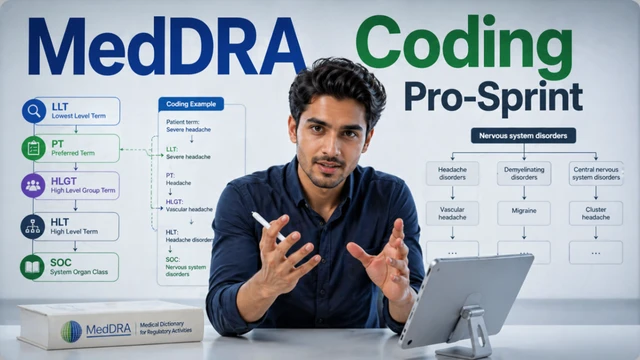
MedDRA (Medical Dictionary for Regulatory Activities) is a massive, hierarchical dictionary used to standardize medical terms. Here's how it works:
- Lowest Level Terms (LLTs): The most specific (e.g., 'pain in left foot').
- Preferred Terms (PTs): Standardized descriptors (e.g., 'Pain in extremity').
- Higher Levels: Group PTs into system organ classes (SOCs) for analysis.
In MedDRA coding for freshers, you'll learn to map a doctor's verbatim term to the correct LLT/PT. Accuracy here directly affects drug safety signals. Practice with free browser-based tools or certified courses. It's non-negotiable for adverse event reporting jobs.
The Skill Gap Your College Never Mentioned
Here's what BPharm and MPharm teach versus reality:
- College: Focus on medicinal chemistry, pharmacology theory, and clinical trials in textbooks.
- Reality: Employers expect you to navigate Argus, code in MedDRA within 2 minutes per term, and write medical narratives on day one.
Your degree proves you can learn. But it doesn't prove you can do. The gap is practical. You must bridge it yourself. The good news? It's smaller than you think—with the right system.
Your 5-Step Roadmap to a Job in the Next 3-6 Months
- Week 1-4: Complete a structured ICSR processing and triage simulation. Focus on the end-to-end flow.
- Week 5-8: Master MedDRA coding with at least 50 practice cases. Aim for >90% accuracy.
- Week 9-10: Update your resume with specific PV keywords and build a portfolio dashboard.
- Week 11-14: Apply to 10–15 jobs weekly. Target contract research organizations (CROs) and pharma companies.
- Month 4-6: Ace the interview by walking through your simulated cases. Show your work, not just your degree.
This timeline is aggressive but realistic. Our analysis of placement data shows that freshers who follow this path land jobs 3x faster.
Still, self-study can be chaotic. That's where simulation-based learning changes the game.
Build These Skills Now
Programs from ZANE ProEd Academy that directly address the skill gaps discussed above.
ZANE ProEd's ecosystem includes focused modules on icsr-case-processing-triage and meddra-medical-coding-certification. These aren't just theory videos—they're hands-on labs where you process real-feel cases, code verbatim terms, and get instant feedback. Think of it as a virtual internship that fits your schedule. No passive learning, no empty certificates.
You're not buying a course; you're plugging into a system that mirrors the industry's workflow. It's the fastest way to demonstrate job readiness without prior experience. For a deeper dive, read our guide on medical coding jobs for freshers—many skills overlap.
Ready to find out where you stand? Check your job readiness against a real PV case processor checklist. See how your skills compare to what top CROs demand. The next hiring cycle won't wait.
Build These Skills Now
Programs from ZANE ProEd Academy that directly address the skill gaps discussed above.
Follow Zane ProEd on Google
Preferred SourceAdd our publication as a preferred source to get the latest clinical research guides, industry updates, and career intel directly in your Google Top Stories & AI Overviews.