Pharmacovigilance Case Processing Jobs for Freshers: A Step-by-Step Roadmap

Pharmacovigilance Case Processor Pharmacovigilance case processing jobs for freshers involve reviewing adverse event reports, entering safety data into databases, performing MedDRA coding, and ensuring regulatory compliance. Medical graduates like BDS, BHMS, BAMS, and Nursing can start this career after targeted training in ICSR handling and safety tools.
You hold a BDS, BHMS, BAMS, or Nursing degree. You have deep medical knowledge. But when you scan pharmacovigilance case processing jobs for freshers, you notice a gap. Recruiters ask for skills like ICSR processing, MedDRA coding, and safety database experience. Your college never taught these. This leaves many overqualified but under-skilled graduates feeling stuck.
The truth is, degrees alone are no longer enough. The pharmacovigilance industry needs candidates who can hit the ground running. But here is the good news: you can close this skill gap faster than you think. This step-by-step roadmap shows you exactly how.
Build These Skills Now
Programs from ZANE ProEd Academy that directly address the skill gaps discussed above.
What does a Pharmacovigilance Case Processor do?
If you’re aiming for pharmacovigilance case processing jobs for freshers, you first need to understand the role. A pharmacovigilance (PV) case processor is the first line of drug safety. Your daily work revolves around case intake, data entry, coding, and submission. A typical job description includes:
- Reviewing adverse event (AE) reports from various sources like emails, literature, or phone calls.
- Entering case details into safety databases like Argus or ArisG.
- Coding medical terms using MedDRA and drug names using WHODrug.
- Assessing case seriousness, expectedness, and causality.
- Submitting reports to regulatory authorities within strict timelines.
This role demands attention to detail and a solid grasp of medical terminology—exactly where your degree gives you an edge. For more on the field, read our guide on pharmacovigilance jobs for freshers.
What is the salary of a PV Case Processor in India?
The PV case processor salary India varies by city, company, and experience. For freshers, starting salaries typically range between ₹2.5 to ₹4.5 lakhs per annum. With 1-2 years of experience, this can jump to ₹5-7 LPA. Metro cities like Mumbai, Bengaluru, and Hyderabad often offer higher packages. Companies like Accenture, TCS, Cognizant, and IQVIA are top recruiters.
Remember, salaries increase significantly when you gain certifications and hands-on tool exposure. A short-term training can boost your starting offer by 20-30%.
How to get a PV case processing job as a fresher?
Follow these actionable steps:
- Learn the basics of pharmacovigilance: Understand the lifecycle of a case from intake to submission. Free resources like ICH website and CDSCO guidelines are good starting points.
- Get certified in core tools: Employers look for candidates trained in MedDRA coding and ICSR processing. These certifications show you are job-ready.
- Practice on real-world cases: Use simulation-based platforms to handle dummy adverse event reports and enter them into a mock safety database.
- Optimize your resume: Highlight relevant medical knowledge and any PV training. Use keywords like 'adverse event reporting', 'case narrative writing', and 'MedDRA coding'.
- Apply strategically: Target entry-level roles like 'Drug Safety Associate', 'PV Trainee', or 'Case Processor I' at CROs and IT-BPM companies.
Check our detailed medical coding guide for freshers to see how adjacent skills can complement your PV career.
What is ICSR processing in pharmacovigilance?
ICSR processing stands for Individual Case Safety Report processing. It is the backbone of pharmacovigilance. An ICSR is a structured document that captures all information about a single adverse event. As a case processor, you will:
- Perform case triage and book-in.
- Check for duplicate cases.
- Extract clinical information and write a narrative.
- Code the event, medical history, and medications.
- Quality check and submit to the regulator.
Mastering ICSR processing can open doors to an ICSR processing career with global companies. It's a skill that's in high demand because regulators constantly update their formats like E2B R3.
What is MedDRA coding and how is it used in PV?
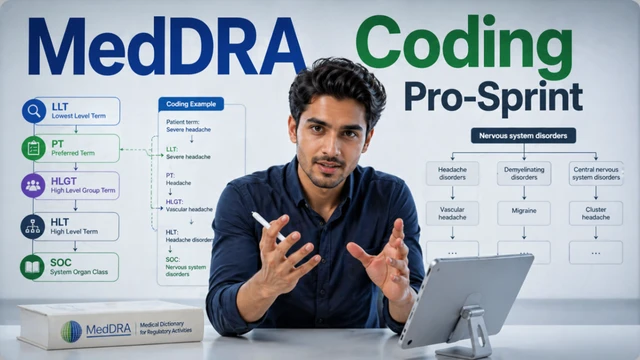
MedDRA (Medical Dictionary for Regulatory Activities) is a standardized medical terminology used worldwide. In pharmacovigilance, you use MedDRA to code reported adverse events, medical history, and indications. For example, 'heart attack' becomes 'Myocardial infarction' under MedDRA coding. This ensures consistency across cases and countries.
For freshers, learning MedDRA coding for freshers can be intimidating. But with practice, you master the hierarchy from System Organ Class (SOC) to Lowest Level Term (LLT). The ICH maintains MedDRA, and you can explore more at ich.org. Certification in MedDRA will make your profile stand out immediately for adverse event reporting jobs.
Why Your Degree Alone Is Not Enough
Your BDS/BHMS/BAMS/Nursing education gave you strong clinical knowledge. You understand disease pathways, drug interactions, and patient care. But employers in pharmacovigilance have a different checklist:
| What College Taught You | What Employers Actually Demand |
|---|---|
| General pharmacology and therapeutics | Specific regulatory frameworks like ICH E2B, GVP modules |
| Clinical diagnosis and treatment | Safety database hands-on (Argus, ArisG) |
| Medical terminology basics | Advanced MedDRA coding with SMQ and LLT selection |
| Ward-based patient management | Case narrative writing and causal assessment scales |
This gap explains why many medical graduates find it hard to land pharmacovigilance case processing jobs for freshers. The good news? You can bridge this gap in weeks, not years.
Your 5-Step Roadmap to Become a PV Case Processor
- Build Familiarity with Regulations: Study the basics of pharmacovigilance from WHO and FDA resources. Understand reporting timelines and global safety standards.
- Get Hands-On with Tools and Processes: Enroll in structured certification programs that simulate real ICSR processing and MedDRA coding. Look for courses that let you practice on dummy cases.
- Master Case Processing Skills: Focus on triage, data entry, narrative writing, and quality review. These are the daily tasks you’ll perform.
- Create a Portfolio: Document your training and any mock cases you’ve processed. A portfolio speaks louder than a degree during interviews.
- Apply and Interview with Confidence: Tailor your resume for each role. In interviews, discuss how your medical background makes you a better case processor—for example, your ability to quickly spot inconsistencies in clinical data.
The Missing Link: Simulation-Based Learning
Reading theory is not enough. You need to feel the pressure of a real case: a report landing in your queue, a clock ticking for submission, and a database awaiting your entry. Traditional colleges can't offer this. Simulation-based systems can.
Modern training platforms replicate the exact workflows used in industry. You process de-identified real-world cases, code them in MedDRA, and submit them in E2B format. This builds muscle memory and confidence that sets you apart on day one of your job.
At ZANE ProEd, we have designed a system that does exactly this. But before we dive into specifics, check the next section for targeted programs.
Build These Skills Now
Programs from ZANE ProEd Academy that directly address the skill gaps discussed above.
How ZANE ProEd Fits Into Your Plan
Our ICSR Case Processing and Triage program covers end-to-end case handling. You’ll learn to triage incoming reports, identify duplicates, write narratives, and understand global submission rules. Meanwhile, the MedDRA Medical Coding Certification makes you a coding expert—from basic LLT selection to complex SMQ searches. Both programs are built on a simulation engine that mirrors real industry databases.
These aren't just courses; they are practice environments. The kind that bridges the gap between your degree and the job you want. Explore them to see how your skills measure up.
Ready to Test Your PV Skills?
Take a moment to self-assess: Can you code a simple adverse event in MedDRA? Do you know the difference between an expedited and a periodic report? If the answer is no, it's time to upskill. Our programs let you practice until you're job-ready. Learn more about our training approach and start building your future today.
Build These Skills Now
Programs from ZANE ProEd Academy that directly address the skill gaps discussed above.
Follow Zane ProEd on Google
Preferred SourceAdd our publication as a preferred source to get the latest clinical research guides, industry updates, and career intel directly in your Google Top Stories & AI Overviews.