Pharmacovigilance Jobs for Freshers in India: Step-by-Step Career Guide

Pharmacovigilance jobs for freshers in India are entry-level roles where you monitor drug safety, collect adverse event reports, and ensure medicines are safe. Life science graduates can start as Drug Safety Associates with salaries of ₹2.5–4 LPA. With the right certification in ICSR case processing and medical coding, you can land a job in 3–6 months.
What is pharmacovigilance and why is it important?
\nPharmacovigilance (PV) is the science of detecting, assessing, and preventing side effects of medicines. The goal is to keep patients safe. In India, the field is growing fast because the pharma industry needs to follow global safety regulations from ICH, US FDA, and EMA. You will often hear the term drug safety associate job description — it covers exactly this monitoring and reporting work. Even freshers can enter this field because companies train you on the job. However, employers now prefer candidates who already understand the basics. That’s why learning pharmacovigilance case processing before applying gives you an edge.
\nWhat is the salary of a Drug Safety Associate in India?
\nThe pharmacovigilance salary in India for a fresher as a Drug Safety Associate (DSA) ranges from ₹2.5 lakhs to ₹4 lakhs per year. With 2–3 years of experience, salaries rise to ₹5–7 LPA. Senior associates and managers can earn ₹10 LPA or more. These numbers depend on the city and company — MNCs like Parexel, IQVIA, and Accenture usually pay higher than smaller CROs. The good news is that even with a non-medical background (like BSc Biotechnology or MSc Microbiology), you can earn a stable income while building a long-term PV career path.
Build These Skills Now
Programs from ZANE ProEd Academy that directly address the skill gaps discussed above.
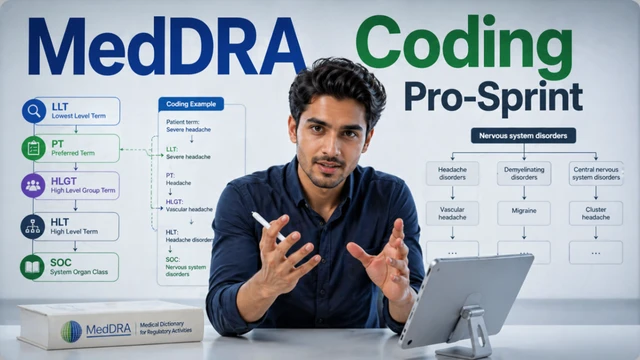
How to start a career in pharmacovigilance?
\nHere is a simple step-by-step plan:
\n- \n
- Learn the basics: Understand what adverse events, ICSR, and medical coding (MedDRA) mean. Follow updates from CDSCO and WHO. \n
- Get certified: Complete a pharmacovigilance course for BPharm or life science graduates. ZANE ProEd offers hands-on simulations in ICSR triage and MedDRA coding — exactly what recruiters expect. \n
- Build practical skills: Practice using databases like Argus and ArisG. Employers want you to understand case processing flow, not just theory. \n
- Prepare your resume: Highlight your PV certification and any hands-on case processing experience. Use keywords like “drug safety associate roles and responsibilities” so that your resume gets noticed. \n
- Apply smartly: Target entry-level roles titled “Drug Safety Associate” or “PV Trainee” on job portals and company websites. \n
What are the job responsibilities of a PV Associate?
\nThe drug safety associate job description includes these daily tasks:
\n- \n
- Collect adverse event reports from patients, doctors, or clinical trials. \n
- Enter data into safety databases (like Argus or ArisG) and perform initial quality checks. \n
- Code medical terms using MedDRA (Medical Dictionary for Regulatory Activities). \n
- Assess seriousness, causality, and expectedness of adverse events. \n
- Write concise case narratives and prepare reports for regulatory submission. \n
- Ensure compliance with ICH guidelines and local regulations (CDSCO). \n
This role is the foundation of the PV career path. With experience, you can move into medical review, aggregate reporting, or signal detection.
\nIs pharmacovigilance a good career for BPharm freshers?
\nYes, absolutely. Pharmacovigilance is one of the fastest-growing sectors for life science graduates. It offers a stable desk job, good work-life balance, and global career opportunities. Even if you come from BSc Biotechnology, MSc Microbiology, or Biochemistry, you are welcome. The industry needs detail-oriented minds who can learn fast. However, your degree alone is often not enough. Employers want proof that you understand processes like ICSR triage and MedDRA coding. That’s where a skill-first approach helps you stand out — especially if you have no industry connections.
\nThe hidden skill gap: What college leaves out
\nColleges teach theory — drug mechanisms, cell biology, genetics. But in a PV job, you won’t use a micropipette. Instead, you must know:
\n- \n
- How to navigate a safety database (Argus, ArisG, or Veeva Vault). \n
- How to apply MedDRA hierarchy — System Organ Class (SOC) down to Lowest Level Term (LLT). \n
- How to write a clear, concise case narrative that regulatory bodies accept. \n
- How to prioritize cases based on seriousness and timelines. \n
- Understanding of global regulations: ICH E2B, FDA 21 CFR Part 11, EU GVP modules. \n
If you don’t acquire these skills, you’ll struggle in interviews. Employers test practical knowledge, not just your degree.
\nYour 4-step roadmap to a PV job in 3–6 months
\nStep 1 — Build Awareness (Week 1–2): Read the ICH E2B guideline, explore the WHO-UMC website, and watch free webinars on pharmacovigilance. Understand the life cycle of an ICSR.
\nStep 2 — Get Hands-on (Week 3–6): Enroll in a structured simulation program that lets you practice duplicate detection, triage, and MedDRA coding on real-world case scenarios. ZANE ProEd’s system gives you these exact simulations.
\nStep 3 — Master the Tools (Week 7–8): Learn to enter data in a mock database, generate reports, and perform quality checks. This is where you turn knowledge into confidence.
\nStep 4 — Apply Strategically (Week 9 onward): Create a resume that lists your certification and hands-on skills. Mention specific workflows: “Processed 100+ mock ICSRs, performed MedDRA coding, and wrote narratives.” Start applying to fresher roles in top CROs and MNCs.
\nWhy simulation-based learning works
\nBooks can’t simulate the pressure of a real case with a regulatory deadline. Simulation puts you in the driver’s seat. You work on safety cases just like a real DSA would — from receipt to submission. You make mistakes, learn, and improve in a risk-free environment. This method builds muscle memory. Employers notice the difference instantly when you talk about your experience with confidence. That’s why we designed our system around hands-on practice, not just video lectures.
\nBuild These Skills Now
Programs from ZANE ProEd Academy that directly address the skill gaps discussed above.
Skills that get you hired: ICSR triage and MedDRA coding
\nTwo skills appear in almost every PV job description: ICSR case processing and MedDRA coding. Our ICSR Case Processing & Triage simulation teaches you how to receive, validate, and prioritize safety cases. You learn duplicate search, case book-out, and submission tracking. The MedDRA Medical Coding Certification module dives deep into coding conventions, multiaxial hierarchy, and common pitfalls. Both are aligned with current industry demands. When you complete these, you can demonstrate real competence, not just theoretical knowledge.
\nReady to test your skills?
\nMost freshers apply to PV jobs without knowing what a case narrative looks like. Don’t make that mistake. Take a moment to assess where you stand. Check your job readiness today — see how your skills compare to what top employers ask for. The path to your first pharmacovigilance job is clear; you just need to take the first step.
Build These Skills Now
Programs from ZANE ProEd Academy that directly address the skill gaps discussed above.
Follow Zane ProEd on Google
Preferred SourceAdd our publication as a preferred source to get the latest clinical research guides, industry updates, and career intel directly in your Google Top Stories & AI Overviews.