Pharmacovigilance Case Processing Jobs for Freshers: Complete Career Guide

Pharmacovigilance Case Processor jobs for freshers involve reviewing, coding, and reporting adverse drug events. You need training in ICSR processing, MedDRA coding, and global safety regulations. Starting salary ranges from ₹2.5 to ₹4.5 LPA in India. Non-medical backgrounds can enter with the right skill-building.
You have a BSc, BPharm, or Life Science degree. Maybe you come from IT or BPO and want a stable healthcare career. You hear about pharmacovigilance case processing jobs freshers but think they are only for doctors or pharmacists. That is not true. This field is open to many backgrounds if you build the right skills.
Companies need case processors to handle safety reports. They train you if you already know the basics. In the next hiring cycle, you can be ready. This guide breaks down everything step by step.
Build These Skills Now
Programs from ZANE ProEd Academy that directly address the skill gaps discussed above.
What does a Pharmacovigilance Case Processor do?
A Pharmacovigilance Case Processor reviews reports of side effects from drugs. You check if the information is complete and accurate. Then you enter it into a safety database. The main tasks are:
- Receiving adverse event reports from patients, doctors, or clinical trials.
- Checking the report for missing details like patient age, drug dose, or reaction.
- Coding medical terms using MedDRA coding (Medical Dictionary for Regulatory Activities).
- Writing a narrative summary of the event.
- Assessing the seriousness and causality of the case.
- Submitting the report to health authorities like FDA or EMA within strict timelines.
You work with global teams and follow guidelines from ICH and WHO. This job is the entry point to a career in drug safety.
What is the salary of a PV Case Processor in India?
PV case processor salary India starts at ₹2.5–4.5 LPA for freshers. With 1–2 years of experience, it can grow to ₹5–7 LPA. Senior roles like safety scientists or team leads earn above ₹10 LPA. Many companies also offer night shift allowances and bonuses.
Your exact salary depends on:
- Company type: MNCs like Accenture or IQVIA pay higher than small CROs.
- Location: Bangalore, Hyderabad, and Pune have more jobs and better pay.
- Certifications: Trained in ICSR processing or MedDRA coding boosts your offer.
Compared to general BPO jobs, this path offers faster growth and more stability.
How to get a PV case processing job as a fresher?
Getting a pharmacovigilance case processor job description match is not hard if you follow a plan. Here is a practical roadmap:
- Learn PV fundamentals: Understand the drug safety lifecycle. Read about adverse event reporting jobs and regulations like ICH E2B.
- Get trained in ICSR processing: Courses like Pharmacovigilance Jobs for Freshers India Roadmap teach you exactly what employers need.
- Master MedDRA coding: Practice coding medical terms. Use free tools or simulations.
- Gain practical experience: Work on mock cases. Understand how to handle real-world scenarios.
- Build a strong resume: Highlight your PV skills. Use keywords like 'ICSR processing', 'MedDRA coding', and 'safety database'.
- Apply smartly: Target job portals with precise searches. Reach out to HR on LinkedIn.
Degrees alone are not enough anymore. Employers want proof you can do the job from day one.
What is ICSR processing in pharmacovigilance?
ICSR processing stands for Individual Case Safety Report processing. When a side effect occurs, an ICSR is generated. Your role is to process this report from start to finish. The steps include:
- Triage: Determine if the report is valid. Check if it meets minimum criteria (patient, drug, reaction).
- Data entry: Enter all details into a safety database like Argus or ArisG.
- Coding: Convert the adverse event and medical history into standard codes using MedDRA.
- Narrative writing: Summarize the case in a clear, chronological paragraph.
- Quality review: Ensure accuracy and compliance before submission.
An ICSR processing career is fast-paced. You might handle 10–15 cases daily. Attention to detail is crucial. Mistakes can delay regulatory reporting. Our Medical Coding Jobs Freshers India Career Guide explains how coding fits into this workflow.
What is MedDRA coding and how is it used in PV?
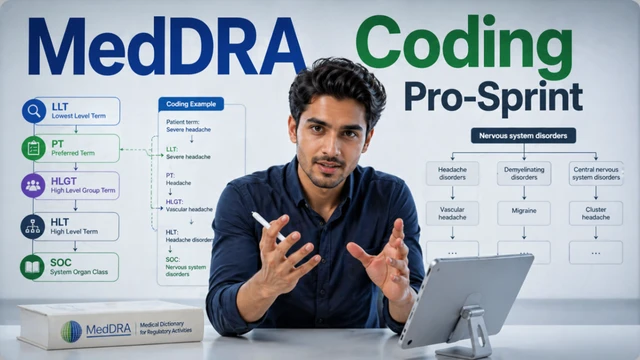
MedDRA coding is the process of assigning standardized medical terms to reported events. MedDRA (Medical Dictionary for Regulatory Activities) is a global dictionary maintained by the ICH. It has five levels:
- System Organ Class (SOC) – e.g., 'Cardiac disorders'
- High Level Group Term (HLGT) – e.g., 'Coronary artery disorders'
- High Level Term (HLT) – e.g., 'Ischaemic coronary artery disorders'
- Preferred Term (PT) – e.g., 'Myocardial infarction'
- Lowest Level Term (LLT) – e.g., 'Heart attack'
For MedDRA coding for freshers, you learn to pick the closest PT for a reported symptom. For example, if a patient says 'chest pain', you might code 'Chest pain' (PT) under 'General disorders'. This coding ensures every report is analyzed uniformly worldwide. It is a core skill for anyone in adverse event reporting jobs.
The Skill Gap: What Colleges Don't Teach
Your degree gave you theory. But employers need more. Here is what they actually expect:
| What Colleges Teach | What Employers Expect |
|---|---|
| Pharmacology concepts | Hands-on ICSR processing |
| General computer skills | Proficiency in safety databases (Argus, ArisG) |
| Medical terminology basics | Accurate MedDRA coding |
| Regulatory overview | Knowledge of ICH E2B(R3) guidelines |
| Individual assignments | Team collaboration on global cases |
Freshers from BSc or BCA often lack these practical skills. But the good news: you can bridge this gap in 3–6 months with focused training.
Your Step-by-Step Pathway to a PV Job
Follow this plan to become job-ready:
- Month 1: Build Foundations
Study PV basics. Read the ICH E2B guidelines. Understand the flow of a safety case. - Month 2: Master ICSR Triage
Take a course on ICSR processing. Learn to identify valid cases and perform data entry. - Month 3: Get Hands-on with MedDRA
Practice coding with real-world scenarios. Use simulations to code adverse events. - Month 4: Work on Mock Cases
Join a program that offers simulated case processing. Build confidence in handling high volumes. - Month 5: Polish Your Resume and Apply
Highlight your new skills. Target entry-level PV case processor roles. - Month 6: Ace the Interview
Prepare for questions on ICSR, MedDRA, and regulatory timelines.
This pathway is tested. Many non-medical graduates have used it to enter the field.
The Missing Piece: Simulation-Based Learning
Reading theory is not enough. You must practice in a real-world environment. Simulation-based learning puts you in front of a safety database. You process dummy cases, code with MedDRA, and write narratives. You make mistakes and learn without risk. This experience is what sets your resume apart.
Build These Skills Now
Programs from ZANE ProEd Academy that directly address the skill gaps discussed above.
How ZANE ProEd Fills the Gap
ZANE ProEd offers a practical system. Their program includes the ICSR Case Processing and Triage module where you learn end-to-end case handling. The MedDRA Medical Coding Certification gives you hands-on coding practice. You are not just watching videos. You are doing the job in a simulated environment. It is like an internship, but from home.
Graduates from non-medical backgrounds like BCA or BSc have successfully moved into PV. They now work at top companies. You can too if you commit to building these skills.
Learn more about our approach to skill-building.
Are You Ready for the Next Step?
The next hiring cycle is approaching. Check your job readiness. See how your skills compare to what employers want. Even if you think your degree does not fit, this career path can welcome you. Take the first step today.
Build These Skills Now
Programs from ZANE ProEd Academy that directly address the skill gaps discussed above.
Follow Zane ProEd on Google
Preferred SourceAdd our publication as a preferred source to get the latest clinical research guides, industry updates, and career intel directly in your Google Top Stories & AI Overviews.