Pharmacovigilance Case Processing Jobs for Freshers: Complete Career Guide

Pharmacovigilance Case Processing Jobs for Freshers: You review, code, and report adverse drug reactions (ADRs) from patients and healthcare providers. You enter safety data into databases, perform MedDRA coding, and assess case seriousness. Entry roles need attention to detail and basic ICSR workflow knowledge. Practical training with real case scenarios helps you get hired faster.
You finished BDS or BHMS. You paid for three PV certifications. Yet you still get rejected for pharmacovigilance case processing jobs freshers. Why? Because certificates without practice are just paper. Companies want job-ready talent, not more theory.
Your frustration is valid. The problem isn’t you. The problem is the training gap between what courses teach and what employers actually test. This blog breaks down the reality, the salary, the skills, and the exact path to get hired.
Build These Skills Now
Programs from ZANE ProEd Academy that directly address the skill gaps discussed above.
Pharmacovigilance Case Processing Jobs for Freshers: What Does a Case Processor Do?
A pharmacovigilance case processor handles individual case safety reports (ICSRs). Your day involves:
- Receiving adverse event reports from doctors, patients, or clinical trials.
- Entering data into safety databases like Argus, ArisG, or Veeva Vault.
- Performing MedDRA coding for adverse events and medical history.
- Assessing case seriousness, expectedness, and causality based on guidelines from ICH and FDA.
- Writing case narratives and submitting reports to CDSCO or EMA.
The pharmacovigilance case processor job description focuses on accuracy. One wrong code can delay a safety signal. Employers test your ability to process a mock case under time pressure.
For a deeper breakdown, read our complete guide on case processing jobs.
What is the salary of a PV Case Processor in India?
The PV case processor salary India varies by city, company, and your practical skill level. Freshers earn between ₹2.5 LPA and ₹4 LPA. With 2–3 years of experience, you can reach ₹5 LPA to ₹8 LPA.
But here’s the catch: candidates who can demonstrate real case processing speed during interviews often negotiate 20–30% higher. Companies pay for output, not certificates.
- Fresher (0–1 year): ₹2,50,000 – ₹4,00,000 per year
- 1–3 years: ₹4,00,000 – ₹6,00,000 per year
- 3–5 years: ₹6,00,000 – ₹9,00,000 per year
Salary also depends on whether you work in a CRO (Contract Research Organization) like IQVIA or a pharma company. CROs often pay slightly higher for freshers.
How to get a PV case processing job as a fresher?
Most freshers make the same mistake: they learn theory but never touch a real case. To get hired, you need a job-ready skill set. Follow this roadmap:
- Learn the ICSR processing workflow from source document to submission.
- Practice MedDRA coding on real adverse event terms.
- Understand seriousness criteria and causality assessment.
- Build a portfolio of 10–15 practice cases you can show in interviews.
- Apply to entry-level roles like “Pharmacovigilance Trainee” or “Case Processing Associate”.
Our freshers guide for PV jobs covers application tips and interview questions.
What is ICSR processing in pharmacovigilance?
ICSR stands for Individual Case Safety Report. It’s the core document in pharmacovigilance. An ICSR processing career means you manage the life cycle of a safety report:
- Intake: Receive report via email, phone, or database.
- Triage: Check if report is valid, duplicates, and needs expedited reporting.
- Data entry: Enter patient details, drug details, and adverse events into the safety database.
- Coding: Assign MedDRA codes to medical terms.
- Assessment: Evaluate seriousness, expectedness, and causality.
- Submission: Send final report to regulatory authorities within timelines.
Companies like to test your understanding of expedited reporting criteria from WHO and ICH. A simple mistake in triage can lead to compliance issues.
What is MedDRA coding and how is it used in PV?
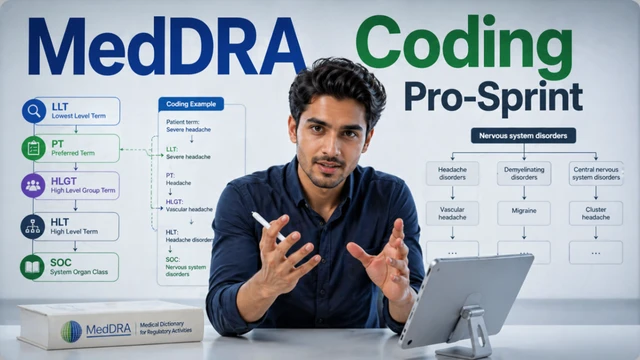
MedDRA stands for Medical Dictionary for Regulatory Activities. It’s a standard vocabulary for medical terms used in safety reports. MedDRA coding for freshers means learning to map a doctor’s note like “heart attack” to the correct MedDRA term “Myocardial infarction”.
You must understand the hierarchy:
- System Organ Class (SOC): Cardiac disorders
- High Level Group Term (HLGT): Coronary artery disorders
- High Level Term (HLT): Ischaemic coronary artery disorders
- Preferred Term (PT): Myocardial infarction
- Lowest Level Term (LLT): Heart attack
Employers expect you to code common terms quickly. Practice with real-world examples from MedDRA (but visit the official site to subscribe).
The Skill Gap: Why Your Degree Feels Useless
You studied anatomy, pharmacology, and patient care. But colleges rarely teach you how to use Argus Safety or perform narrative writing. Here’s what employers actually test:
- Can you spot a duplicate case?
- Can you code a serious adverse event in under 5 minutes?
- Do you know the difference between “listed” and “unlisted” events?
Certifications cover definitions. Simulation covers speed and accuracy. That’s why job-ready talent wins over certified candidates.
A Step-by-Step Pathway to Become Job-Ready
Stop buying more certificates. Start building real skills.
- Master the ICSR workflow. Know every field in a safety form.
- Practice MedDRA coding daily. Use publicly available lists of adverse events.
- Learn database basics. Watch tutorials on Argus or ArisG.
- Do mock case processing. Use sample ICSRs from FDA or EMA websites.
- Get feedback. Have a mentor review your case narratives and coding choices.
Why Simulation Beats Certification
You cannot learn swimming by reading a book. Same with case processing. You need to process real cases, under time pressure, with feedback. That’s where simulation-based learning changes the game.
ZANE ProEd builds a system that simulates real ICSR triage, MedDRA coding, and narrative writing. You practice until it becomes muscle memory.
Build These Skills Now
Programs from ZANE ProEd Academy that directly address the skill gaps discussed above.
The ZANE ProEd System: From Practice to Job Offer
Instead of another theory course, ZANE ProEd offers a system built around two core practice modules:
- ICSR Case Processing & Triage: You handle 30+ real-world case scenarios, learning how to prioritize, validate, and enter data.
- MedDRA Medical Coding Certification: You code hundreds of terms, build speed, and understand hierarchy like a working professional.
These are not passive video lessons. You work through cases, get instant feedback, and see where you went wrong. That’s how you become job-ready.
Learn more about ZANE ProEd’s approach.
Check Your Job Readiness
Ask yourself: Can you process a valid ICSR from a messy source document in 20 minutes? Can you code “liver damage” to the correct MedDRA term without Googling? If not, you’re not ready.
Compare your skills against the job description. If you see gaps, fix them with practice, not another certificate.
See how your skills compare. Start your job-readiness check today.
Build These Skills Now
Programs from ZANE ProEd Academy that directly address the skill gaps discussed above.
Follow Zane ProEd on Google
Preferred SourceAdd our publication as a preferred source to get the latest clinical research guides, industry updates, and career intel directly in your Google Top Stories & AI Overviews.