How to Get Pharmacovigilance Case Processing Jobs for Freshers (BDS, BAMS)

Pharmacovigilance Case Processor roles are ideal entry points into the pharma industry for medical graduates. To get pharmacovigilance case processing jobs as a fresher, you must demonstrate practical skills in ICSR processing, MedDRA coding, and understanding of global drug safety regulations beyond your degree.
If you have a BDS, BAMS, BHMS, or Nursing degree but are stuck in an unrelated job, this guide is for you. We will break down how to find and secure pharmacovigilance case processing jobs for freshers. Many graduates with strong medical knowledge fail to get these jobs, and it's not because of their degree.
The shocking truth is that 90% of applicants are rejected because their resume shows only academic knowledge. Companies today need people who can handle the job from day one. They need you to understand the real-world workflow of drug safety, not just what's in a textbook.
Build These Skills Now
Programs from ZANE ProEd Academy that directly address the skill gaps discussed above.
This is your playbook. We will cover the exact skills, salary expectations, and steps you need to take to move from your current role into a stable, high-growth pharmacovigilance career.
What does a Pharmacovigilance Case Processor do?
A Pharmacovigilance Case Processor is a frontline professional in drug safety. Their main job is to manage reports of adverse events (side effects) from patients and doctors. This is a critical role in the world of adverse event reporting jobs.
The pharmacovigilance case processor job description usually includes these daily tasks:
- Triage: Receiving and sorting incoming adverse event reports to determine their seriousness and priority.
- Data Entry: Accurately entering all case information into a specialized safety database. This includes patient details, the drug involved, and the reported side effect.
- Case Narrative Writing: Writing a clear, concise summary of the adverse event in a specific medical format.
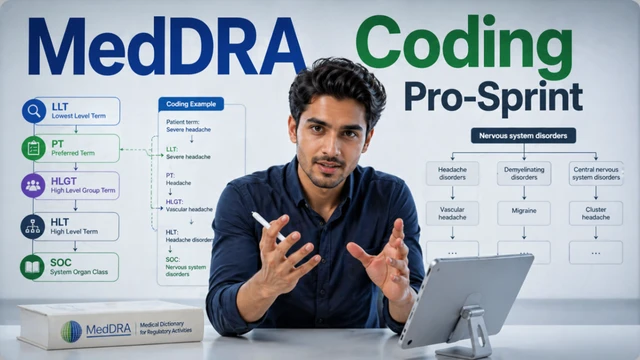
- Medical Coding: Using MedDRA (Medical Dictionary for Regulatory Activities) to classify the reported medical events and patient history into standard codes.
- Quality Check: Reviewing cases processed by other team members to ensure accuracy and completeness before submission to health authorities like the FDA.
Essentially, you are a medical data detective. You ensure every piece of safety information is recorded perfectly so that companies and regulators can monitor a drug's safety profile.
What is the salary of a PV Case Processor in India?
The PV case processor salary India offers is quite competitive for freshers, especially for those with a medical background. It provides a stable entry into the corporate pharmaceutical world.
Here is a typical salary range you can expect:
- Entry-Level (Fresher): ₹3.0 Lakhs to ₹4.5 Lakhs per annum.
- With 1-3 Years of Experience: ₹4.5 Lakhs to ₹7.0 Lakhs per annum.
- Senior Case Processor / Team Lead: ₹7.0 Lakhs and above.
Your starting salary can depend on the company (MNCs often pay more), the city (Mumbai, Bengaluru, and Hyderabad are major hubs), and most importantly, the practical skills you bring. A candidate who can demonstrate knowledge of MedDRA coding and the ICSR workflow during an interview has a much higher chance of getting a better offer.
How to get a PV case processing job as a fresher?
Getting your first of many pharmacovigilance case processing jobs for freshers requires a focused strategy. Your medical degree gives you a strong foundation, but you need to build on it with job-specific skills. Companies know you understand medicine; they want to know if you understand their workflow.
Here’s how to position yourself for success:
- Master the Terminology: Go beyond your college syllabus. Understand terms like ICSR, MedDRA, WHO-DD, causality assessment, and narrative writing. These are the language of the job.
- Learn the Workflow: Study the step-by-step process of how an adverse event report is handled from the moment it arrives to when it is submitted to a regulator like the European Medicines Agency. This is the core of an ICSR processing career.
- Gain Practical Skills: Theory is not enough. You need to learn how to code events using MedDRA, how to enter data into a safety database, and how to write a medical narrative. This is the biggest gap for most freshers.
- Update Your Resume: Don't just list your degree. Create a skills-based resume. Highlight your knowledge of pharmacovigilance processes, MedDRA, and regulatory guidelines from bodies like the ICH.
- Prepare for Interviews: Be ready to answer questions about the PV workflow. If an interviewer asks you to describe the steps of ICSR processing, you must be able to answer confidently and in detail. For more tips, check our guide on pharmacovigilance jobs for medical graduates.
What is ICSR processing in pharmacovigilance?
ICSR stands for Individual Case Safety Report. It is the foundation of pharmacovigilance. An ICSR is a detailed report of a single patient's adverse experience with a drug or medical product.
ICSR processing is the end-to-end management of these reports. It is a highly regulated and structured process. The goal is to create a complete, accurate, and standardized record that can be analyzed for safety signals and submitted to global health authorities.
The typical ICSR workflow includes:
- Case Receipt: Receiving reports from various sources (doctors, patients, literature).
- Triage: Assessing the case for validity and seriousness to determine the reporting timeline (e.g., 7-day or 15-day reports).
- Data Entry & Coding: Inputting all information into the company's safety database and coding medical terms using MedDRA.
- Narrative Writing: Creating a medical story of the event.
- Quality Review: A senior team member checks the case for any errors.
- Medical Review: A physician reviews the case for medical accuracy and causality.
- Submission: Submitting the final report to regulatory bodies like CDSCO in India.
This systematic process ensures that all safety data is uniform and high-quality, which is essential for public health.
What is MedDRA coding and how is it used in PV?
MedDRA stands for the Medical Dictionary for Regulatory Activities. Think of it as a universal language for describing medical conditions, symptoms, and procedures. It is a highly structured and standardized medical dictionary.
In pharmacovigilance, MedDRA is used to code adverse event reports. When a patient reports feeling 'dizzy' and having a 'headache', the case processor uses MedDRA to find the specific, standardized codes for these terms. This is a critical skill for MedDRA coding for freshers to learn.
Why is this so important? It ensures consistency. A 'headache' is coded the same way in India, the USA, and Japan. This allows companies and regulators to pool data from around the world and analyze it accurately. Without MedDRA, everyone would use slightly different terms, making it impossible to spot safety trends. This is a crucial part of the safety analysis process, which can lead to more complex activities like signal detection.
The Skill Gap: What Your Degree Didn't Teach You
Your BDS, BAMS, or BHMS degree taught you the 'what' of medicine—anatomy, physiology, and pathology. But it didn't teach you the 'how' of the pharmaceutical industry's workflow. Employers expect you to know the practical steps of ICSR processing, how to navigate a safety database, and how to apply MedDRA codes correctly.
This is the gap that prevents bright medical graduates from landing jobs. Companies don't have months to train you on the absolute basics. They need you to be job-ready and contribute from the first week.
Your 4-Step Pathway to a PV Case Processing Job
Here is a clear, actionable plan to bridge that gap and become the candidate companies want to hire.
- Build Foundational Knowledge: Start by understanding the complete drug life cycle and the specific role of pharmacovigilance within it.
- Learn the ICSR Workflow Practically: Don't just read about it. Find a way to learn the step-by-step process of handling a case, from triage to submission.
- Master MedDRA Coding: This is a non-negotiable skill. You must learn the structure of MedDRA and practice coding real-world medical terms.
- Practice in a Simulated Environment: The best way to learn is by doing. Gaining experience with tools that mimic real safety databases will set you far apart from other freshers.
Bridging the Gap with Simulation-Based Learning
How can you gain workflow experience without having a job? The answer is simulation. Modern training systems allow you to work on realistic case scenarios in an environment that feels just like a real company's safety database. You get to practice data entry, MedDRA coding, and narrative writing on your own, building confidence and real skills.
This approach moves you from a 'fresher' to a 'skilled professional' in the eyes of a recruiter. It proves you have taken the initiative to become job-ready.
Build These Skills Now
Programs from ZANE ProEd Academy that directly address the skill gaps discussed above.
A System for Building Real-World Skills
At ZANE ProEd, we have built a complete system designed to make you job-ready. Our programs are not just video lectures; they are interactive simulations of the real work you will do as a Case Processor.
Our ICSR Case Processing & Triage program takes you through the entire workflow, from receiving a case to preparing it for medical review. The MedDRA Medical Coding Certification provides hands-on practice, helping you master the most critical skill for a case processor. This system is designed to build the exact skills listed in job descriptions.
Check Your Job Readiness Today
Stop wondering why you aren't getting interview calls. It's time to build the practical skills the industry demands. Compare the skills you have with the skills outlined in this guide.
See how your current knowledge stacks up against what top pharmaceutical companies expect from a Pharmacovigilance Case Processor. Taking the first step to understand this gap is the most important move you can make for your career.
Build These Skills Now
Programs from ZANE ProEd Academy that directly address the skill gaps discussed above.
Follow Zane ProEd on Google
Preferred SourceAdd our publication as a preferred source to get the latest clinical research guides, industry updates, and career intel directly in your Google Top Stories & AI Overviews.