How to Get Pharmacovigilance Case Processing Jobs for Freshers in India

Pharmacovigilance Case Processor roles are entry-level positions focused on managing drug safety data. To get pharmacovigilance case processing jobs for freshers in India, you need practical skills in ICSR processing, narrative writing, and MedDRA coding. Companies prioritize hands-on experience over theoretical certificates.
If you have a BDS, BAMS, BHMS, or Nursing degree, you might feel stuck. You've completed courses, earned certificates, but the interview calls for pharmacovigilance case processing jobs for freshers are not coming. This is a common and frustrating problem in India's competitive job market.
You were told your medical background was perfect for pharmacovigilance. But every job description asks for experience you don't have. The truth is, most online courses give you theory, but companies hire for practical skills. They want people who can do the job from day one.
Build These Skills Now
Programs from ZANE ProEd Academy that directly address the skill gaps discussed above.
This guide breaks down the brutal reality of what it takes. We will show you the exact skills you need and how to build them, so you can finally get the job you deserve.
What does a Pharmacovigilance Case Processor do?
A Pharmacovigilance (PV) Case Processor is the foundation of drug safety. Your main job is to handle Individual Case Safety Reports (ICSRs). These are reports of adverse events or side effects that a patient experiences after taking a medicine. This is a key part of all adverse event reporting jobs.
The pharmacovigilance case processor job description includes these daily tasks:
- Triage: Receiving and sorting incoming adverse event reports from doctors, patients, and other sources. You decide which cases are serious and need urgent processing.
- Data Entry: Entering all the details from the report into a special safety database like Argus or ArisG. This includes patient details, the drug taken, and the adverse event.
- Medical Coding: Using a medical dictionary called MedDRA to code the adverse events. This standardizes the data so it can be analyzed globally.
- Narrative Writing: Writing a clear, concise summary of the case in a specific medical format. This narrative tells the complete story of the adverse event.
- Quality Check: Reviewing the case to ensure all information is accurate and complete before it is submitted to regulatory authorities like the CDSCO in India or the FDA in the USA.
What is the salary of a PV Case Processor in India?
The salary is a major attraction for many freshers. For a PV Case Processor in India, the starting salary typically ranges from ₹2.5 Lakhs to ₹4.5 Lakhs per year. This is one of the most searched queries related to PV case processor salary India.
Several factors can influence your starting salary:
- Company Size: Large multinational corporations (MNCs) and top Contract Research Organizations (CROs) usually offer higher salaries than smaller companies.
- Location: Major pharma hubs like Mumbai, Bangalore, Hyderabad, and Pune may offer better pay, but also have a higher cost of living.
- Skills: A fresher with proven, practical skills in MedDRA coding and experience with safety database simulations will always have an advantage and can negotiate a better salary.
As you gain experience, your salary can grow quickly. After 2-3 years, a senior case processor or a quality review specialist can earn ₹6 Lakhs to ₹9 Lakhs per year.
How to get a PV case processing job as a fresher?
This is the most critical question. Getting your first break feels impossible, but it's about strategy, not just luck. Certifications alone are useless if you cannot perform the job tasks during the technical interview.
Here is what recruiters are actually looking for:
- Practical Knowledge of ICSR: You must understand the entire lifecycle of a case, from receipt to submission. This is the core of an ICSR processing career.
- Hands-on MedDRA Coding Skills: You need to be able to accurately code medical terms. This is a non-negotiable skill. You can learn more about the guidelines from the official ICH website.
- Familiarity with Safety Databases: You don't need to be an expert, but you should understand the structure and fields of a database like Oracle Argus Safety.
- Strong Narrative Writing Ability: Can you write a medical summary that is clear, accurate, and follows a specific format? This is tested in interviews.
To learn more about the overall job landscape, check out our detailed guide on pharmacovigilance jobs for freshers in India.
What is ICSR processing in pharmacovigilance?
ICSR stands for Individual Case Safety Report. It is the central document in pharmacovigilance. ICSR processing is the step-by-step workflow of managing this document.
Think of it like being a detective for a medical event:
- Step 1: Case Receipt: You receive a report about a patient's side effect. This can come via email, phone, or a form.
- Step 2: Triage & Booking: You log the case into the system, check for duplicates, and assess its seriousness and expectedness.
- Step 3: Data Entry & Coding: You enter all the information into the safety database and perform MedDRA coding for freshers and experts alike.
- Step 4: Narrative Writing: You create the medical story of the event.
- Step 5: Quality Review: A senior member checks your work for accuracy.
- Step 6: Submission: The final report is sent electronically to health authorities like the European Medicines Agency (EMA).
This systematic process ensures that all drug safety information is captured correctly and can be used for further analysis, like signal detection.
What is MedDRA coding and how is it used in PV?
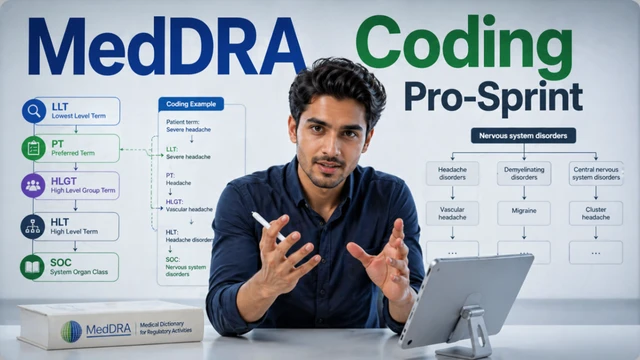
MedDRA stands for Medical Dictionary for Regulatory Activities. It is a globally standardized medical dictionary. It is not just a list of words; it is a complex, hierarchical system used to classify adverse event information.
Imagine a patient reports 'feeling dizzy'. Another reports 'lightheadedness'. MedDRA allows a case processor to code both of these under a single, preferred term like 'Dizziness'. This ensures that all data, no matter how it was described, is grouped together for analysis.
For a fresher, understanding MedDRA is critical. You must know:
- The 5-level Hierarchy: System Organ Class (SOC), High-Level Group Term (HLGT), High-Level Term (HLT), Preferred Term (PT), and Lowest Level Term (LLT).
- Coding Conventions: The rules for selecting the right term. For example, how to code a diagnosis versus a symptom.
- Practical Application: You will be given short case scenarios in an interview and asked to provide the correct MedDRA codes.
The Skill Gap: What Your Degree Didn't Teach You
Your BDS, BAMS, or BHMS degree is valuable. It gave you a strong foundation in human anatomy, physiology, and pathology. But it did not prepare you for the specific, workflow-based tasks of a corporate PV job.
Companies know you understand medicine. They don't need to test you on that. They need to know if you can navigate a safety database, apply MedDRA coding rules under pressure, and write a regulatory-compliant narrative. This is the gap that holds most medical graduates back.
Your Step-by-Step Pathway to a PV Job
Feeling overwhelmed? Don't be. Here is a clear, actionable path to bridge that skill gap and become job-ready.
- Forget Rote Learning: Stop collecting certificates. Focus on one end-to-end workflow: ICSR Case Processing.
- Master the Workflow, Not Just Theory: Learn the complete journey of a case, from Triage to Submission. Understand how each step connects to the next.
- Practice Medical Coding Daily: Get hands-on with MedDRA. Practice coding real-world case scenarios, not just memorizing terms.
- Simulate the Real Job: The most crucial step. You must practice processing cases in a simulated environment that mimics a real company's safety database.
- Build a Work Portfolio: Process 15-20 different types of cases (serious, non-serious, literature, spontaneous). This becomes your proof of skill, far more valuable than any certificate.
The Bridge from Theory to a Real Job
The only way to learn a practical job is by doing it. Reading about swimming won't teach you how to swim. Similarly, watching videos about case processing won't prepare you for a technical interview.
This is why simulation-based learning is the only effective solution. It allows you to work on realistic case studies in a controlled environment, make mistakes, get feedback, and build real-world skills and confidence before you even face an interviewer.
Build These Skills Now
Programs from ZANE ProEd Academy that directly address the skill gaps discussed above.
A System for Building Skills, Not Just a Course
At ZANE ProEd, we don't just sell courses; we provide a system for career transformation. Our programs are designed to replicate the exact environment and workflow of a top pharmaceutical company.
Our ICSR Case Processing & Triage program gives you hands-on experience managing the entire case lifecycle. Paired with our MedDRA Medical Coding Certification, you learn to apply coding rules to complex, real-world scenarios. This combination ensures you have the two most critical skills recruiters are looking for.
You build a portfolio of work that you can discuss confidently in interviews, proving you are ready for the job from day one. It's about building competence, not just collecting another piece of paper.
Are You Ready for the Job?
Stop wondering why you aren't getting hired. It's time to shift your focus from passive learning to active skill-building.
Instead of applying for more jobs with the same resume, find out how your current skills compare to what companies demand. See the workflow in action and understand what it truly takes to succeed as a Pharmacovigilance Case Processor.
Build These Skills Now
Programs from ZANE ProEd Academy that directly address the skill gaps discussed above.
Follow Zane ProEd on Google
Preferred SourceAdd our publication as a preferred source to get the latest clinical research guides, industry updates, and career intel directly in your Google Top Stories & AI Overviews.