Pharmacovigilance Jobs for Freshers in India: A Complete Guide

Pharmacovigilance jobs for freshers in India offer a strong career for BPharm, BDS, BHMS, and life science graduates. These roles, like Drug Safety Associate, involve monitoring drug safety, processing adverse event reports, and ensuring regulatory compliance. Freshers need practical skills in case processing and medical coding to get hired.
Are you a BDS, BHMS, BAMS, or Nursing graduate feeling stuck? You have a professional degree, but the top pharmacovigilance jobs for freshers in India seem out of reach. It's a frustrating feeling: you're overqualified on paper but feel under-skilled for the actual job.
You see thousands of applicants for every entry-level role and wonder how to stand out. This isn't your fault. Your college degree gave you a strong foundation, but the industry now demands specific, job-ready skills that aren't taught in traditional classrooms.
Build These Skills Now
Programs from ZANE ProEd Academy that directly address the skill gaps discussed above.
This guide is your step-by-step roadmap to bridge that gap and land your first role as a Drug Safety Associate.
What is pharmacovigilance and why is it important?
Pharmacovigilance (PV) is the science and activity related to the detection, assessment, understanding, and prevention of adverse effects or any other drug-related problem. In simple terms, it's about making sure medicines are safe for patients to use.
Think of it as a watchdog for drugs. After a new drug is approved and sold, PV professionals monitor its performance in the real world. They collect and analyze data on side effects (adverse events) reported by patients and doctors.
This is critical because clinical trials only involve a few thousand people. Problems can appear when millions start using a medicine. According to the World Health Organization (WHO), pharmacovigilance is essential for patient safety and public health. It helps companies and regulators make informed decisions, like updating warning labels or even recalling a drug.
What is the salary of a Drug Safety Associate in India?
The pharmacovigilance salary in India is one of the main attractions for freshers. It offers a competitive starting package and excellent growth potential. Your salary depends on your skills, the company (MNC vs. Indian pharma), and the city.
Here’s a realistic breakdown for a Drug Safety Associate:
- Fresher (0-1 year experience): The average starting salary is between ₹3.5 Lakhs and ₹5.5 Lakhs per year. Companies hiring candidates with practical, certified skills often offer salaries at the higher end of this range.
- Experienced (1-3 years experience): With a few years of experience, your salary can increase to ₹5.5 Lakhs to ₹8 Lakhs per year. You can move into senior roles or specialize in areas like signal detection.
Remember, these numbers are not just about your degree. Employers pay more for candidates who can start contributing from day one without extensive training.
How to start a career in pharmacovigilance?
Starting a career in pharmacovigilance requires a clear plan. Your degree is the entry ticket, but practical skills get you the job. The competition is high, so you need to be prepared.
Here is a simple roadmap to follow:
- Understand the Core Concepts: Go beyond your college syllabus. Learn about the drug development lifecycle, Good Clinical Practices (GCP), and the role of regulatory bodies like the CDSCO in India.
- Gain Practical Skills: This is the most important step. You must learn the actual tasks of a PV professional. This includes pharmacovigilance case processing, medical coding with MedDRA, and using safety databases.
- Get Certified: A credible certification that focuses on hands-on training proves to employers that you have the skills they need. Look for a pharmacovigilance course for BPharm or other life science graduates that offers simulation-based learning.
- Build a Strong CV: Highlight your practical skills, not just your degree. Mention any projects, case studies, or software training you have completed. Tailor your CV for every job application.
What are the job responsibilities of a PV Associate?
The drug safety associate job description is focused on day-to-day operations that ensure patient safety. You are the first line of defense in monitoring a drug's safety profile. Your work is detailed, process-driven, and requires high accuracy.
Here are the common drug safety associate roles and responsibilities:
- Case Intake and Triage: Receiving adverse event reports from various sources (doctors, patients, etc.) and prioritizing them based on seriousness.
- Data Entry: Accurately entering all case information into a safety database like Oracle Argus Safety or ArisG. This is a critical task where attention to detail is key.
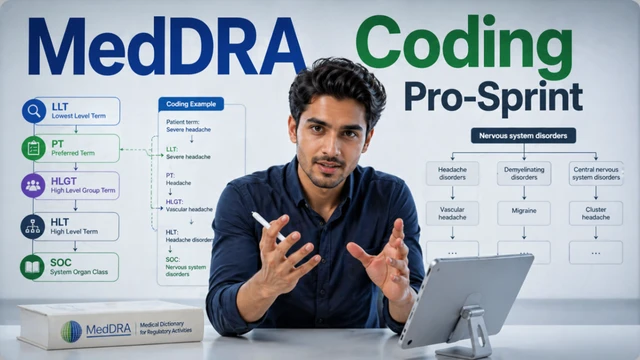
- Medical Coding: Coding adverse events, medical history, and lab data using standard dictionaries like MedDRA (Medical Dictionary for Regulatory Activities).
- Narrative Writing: Writing a clear, concise, and medically accurate summary of the adverse event case. This summary helps others quickly understand what happened.
- Follow-up: Contacting the reporter (with permission) to get missing information or clarify details about the case.
- Regulatory Reporting: Ensuring serious and unexpected cases are reported to regulatory authorities within strict timelines.
Is pharmacovigilance a good career for BPharm freshers?
Yes, absolutely. Pharmacovigilance is an excellent career choice not just for BPharm freshers, but also for BDS, BHMS, BAMS, and Nursing graduates. It allows you to use your medical knowledge in a corporate setting without direct patient contact.
The PV career path is well-defined and offers significant growth. You typically start as a Drug Safety Associate and can progress to:
- Senior Drug Safety Associate: (2-4 years) Mentoring juniors and handling complex cases.
- Team Lead / Manager: (5-8 years) Managing a team, overseeing quality, and ensuring project deadlines are met.
- Specialist Roles: You can also specialize in areas like signal detection, aggregate reporting (PSURs), or PV quality assurance.
- Director / Head of PV: (10+ years) Leading the entire pharmacovigilance department for a region or globally.
The field is stable and growing because drug safety is a mandatory legal requirement for all pharmaceutical companies worldwide.
The Skill Gap: What Your College Degree Didn't Teach You
Your professional degree is valuable. It taught you the 'why'—the science behind diseases and drugs. However, companies hire you to do a specific job, which requires knowing the 'how'.
Here’s the reality trigger: there is a huge gap between academic knowledge and industry expectations.
- What Colleges Teach: Human Anatomy, Pharmacology Theory, Physiology, Patient Diagnosis.
- What PV Employers Expect: ICH-GCP Guidelines, MedDRA & WHO-DD Coding, Safety Database (Argus) Proficiency, End-to-End Case Processing, Regulatory Timelines.
Companies don't have 6 months to train you on these basics. They need you to be productive from the first week. This is why thousands of graduates with good degrees fail to clear interviews.
Your Step-by-Step Pathway to a PV Job
Feeling overwhelmed? Don't be. Here is a structured pathway to bridge that skill gap and become a top applicant.
- Build Your Foundation: Start by mastering the fundamentals of global pharmacovigilance regulations and guidelines. Don't just read them; understand how they apply to daily work.
- Gain Hands-On Software Skills: Theory is not enough. You need hands-on experience with a safety database. This is non-negotiable for most top companies.
- Master Medical Coding: Learn to code adverse events accurately using MedDRA. This skill is highly valued and tested in interviews.
- Practice End-to-End Case Processing: Work on real-world case studies, from intake to submission. This builds the confidence and competence that interviewers look for.
- Create a Professional Portfolio: Document your case studies and projects. This portfolio becomes proof of your skills, setting you apart from other freshers.
- Optimize Your CV for Success: Rebuild your CV to highlight your new, job-ready skills. Use keywords from job descriptions to pass through applicant tracking systems (ATS).
The Solution: Learn by Doing with Job Simulations
How do you gain hands-on experience without having a job? The answer is simulation-based learning. This method allows you to work in a virtual environment that mirrors a real pharmaceutical company's setup.
You work on realistic case studies using the same tools and processes as a Drug Safety Associate. This approach builds practical skills, muscle memory, and the confidence needed to excel in interviews and on the job.
Build These Skills Now
Programs from ZANE ProEd Academy that directly address the skill gaps discussed above.
A System for Career Success, Not Just a Course
At ZANE ProEd, we provide a complete system designed to make you job-ready. Our programs are not just about watching videos; they are about doing the work.
Our End-to-End Pharmacovigilance Certification immerses you in the complete workflow of a PV professional. You'll master everything from case intake to narrative writing. To further specialize, our MedDRA Medical Coding Certification provides deep, practical training in one of the most critical skills for any PV role.
We believe in building skills through practice. This system is designed to give you the exact experience that hiring managers are searching for.
Are You Ready for a Career in Pharmacovigilance?
Stop feeling stuck and start building the skills that matter. Your degree got you to the starting line, but job-ready skills will help you win the race. The demand for skilled PV professionals is higher than ever, and now is the time to prepare.
Check how your current skills compare to industry standards. Taking the first step to understand your skill gaps is the beginning of a successful career journey.
Build These Skills Now
Programs from ZANE ProEd Academy that directly address the skill gaps discussed above.
Follow Zane ProEd on Google
Preferred SourceAdd our publication as a preferred source to get the latest clinical research guides, industry updates, and career intel directly in your Google Top Stories & AI Overviews.